HELP: Creating high frequency triangle waves using comparators

Thread Starter

welshi32

Joined Aug 30, 2026
3
Hi all. I am new to this forum and I need some help for a paper I'm writing. I'm looking for a way to generate very high frequency triangle waves(20MHz+) and I'm unsure about my implementation. My research hinges on another paper by Jian Huang and this is my reference
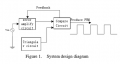
1788089815828.png
I'm still learning and I'm very unsure about my circuit.
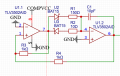
1788089934445.png
I'm looking about advice on how to improve this circuit or other reference schematics I can use. The circuit above is designed to generate 20MHz but I'm skeptical if i built it correctly or if it's even capable of producing this fast of a triangle wave.
Another concern of mine is that it might not be producing the triangle wave i'm looking for.
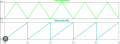
1788090141909.png
I'm worried that this circuit produces a sawtooth(bottom, cyan) but the paper calls for a triangle wave(top, green).
I'm thankful for all the advice i can get!
 

Ian0

Joined Aug 7, 2020
13,296
The circuit needs one comparator and one op-amp, not two comparators. With R1=R2 you get a triangle wave. As R1 or R2 tends towards zero you get more of a sawtooth.
 

Ian0

Joined Aug 7, 2020
13,296
The circuit you have is for a bipolar trianglewave. i.e. it is centred on 0V. For that your op-amp and comparator need positive and negative supplies.
If you only have a single supply, connect op-amp non-inverting input and comparator inverting input to half the supply (use two equal value resistors to produce a half-supply reference)
 

hrs

Joined Jun 13, 2014
538
It appears that Jian Huang leaned heavily on SLAU508 but then forgot to include it in the references.

The AD3081 has a slew rate of 30V/us. Depending on the amplitude you want that may not be enough.
 

panic mode

Joined Oct 10, 2011
5,306
using linear ramp and comparator to produce PWM is common, specially in low frequencies. it makes no difference is sloped signal is triangle or sawtooth (the only difference is phase shift which for PWM should not matter at all). but 20+ MHz? and what do you hope to accomplish with PWM at those frequencies? what is the application?
 

MrAl

Joined Jun 17, 2014
13,828
You do have to be a little careful with a sawtooth that falls from max to min versus one that rises from min to max.
That's because each one has a specific time-oriented shift in addition to the pulse width period.

If it falls from say 5v to 0v then when the signal level goes lower the center of the pulse moves slightly to the right.
When it rises from 0v to 5v the center of the pulse moves slightly to the left when the signal goes lower.
Even though it may be a small movement for small feedback changes, the effect can be very bad when it comes to stability. Imagine a fast feedback change from high to low, the pulse center could move as far as the pulse period itself, or maybe 1/2 of the total period (still not good).

If I remember right, the preferred sawtooth for stability is start high, end low, so it ramps DOWN, and that is relative to the feedback signal going higher for higher output levels, and pulse getting more narrow.

The problem is with that edge movement. It's basically edge jitter and at 20MHz it can have a significant effect. It can act like an extra pole which means extra delay which means less phase margin which can lead to instability. That means extra careful testing for stability in something like a power converter.

You're also looking at different EMI effects and different inductor or transformer flux changes. If the flux rises too fast it could saturate and blow the converter.
 
Last edited:

schmitt trigger

Joined Jul 12, 2010
2,260
It appears that Jian Huang leaned heavily on SLAU508 but then forgot to include it in the references.

The AD3081 has a slew rate of 30V/us. Depending on the amplitude you want that may not be enough.
Exactly!
A 20 Mhz triangle wave has a half period of 25 nanoseconds.
Meaning that a 1V pk-pk triangle wave it slews at 40V/us. The opamp requires several times that slew rate capability, for the triangle wave to have a semblance of linearity.
 
Top