Facebook
 Google
 GitHub
 Linkedin
Even if a given topic or subject matter previously discussed is no longer relevant to the immediate problem at hand with the deep fryer, I am not on the clock or anything; this is my own personal device, and I am trying to learn more about all aspects of electronics.What you have posted is all history and behind us.
Ignore what was written and stay in tune with us.
For your information,
1) DMM stands for Digital Multi-Meter. Your multimeter is a DMM.
2) The bowl I referred to is the oil container, #5.
3) There are two ways to turn AC power ON/OFF, using a triac, or using a relay. We have identified the relay.
4) The Sensor #18 is a capillary fluid thermometer. It controls a thermostat which has been adjusted and set at the factory. It's purpose is to shut off the heater if the temperature gets two high. It is a resettable high temperature limit switch and is used instead of a thermal cut-off fuse. This safety device is essential in case the control relay is stuck in the closed position.
5) Don't underestimate what people do. Manufacturers are legally required to install safety devices in appliances to prevent your house from burning down and to prevent electrocution. They and their lawyers do not take this matter lightly.
Now let's focus on diagnosing the problem.
Here is your circuit digram. AC power is not reaching the heater element.
At least one device in the circuit is open.
View attachment 368526
You can bypass S1 and S2 (i.e. install a jumper).
If the heater does not get hot, try a jumper across the relay (i.e. jumper across the black cables from the AC input to the heater element).
Do this and you will get closer to finding the cause of the problem.
Nevertheless, I am so blessed to have everyone's time and help so I will attempt to keep moving to make good on all the effort everyone has put in, and establish the problem beyond a reasonable doubt, and maybe even attempt to order a new part and fix it, so we can get this done, and we can hopefully avoid ultimately at the very end you all feeling like this is unresolved and/or your effort was totally in vain. Obviously, in a perfect world, we'd be teaching me not only how to fix it, but I'd want to fully understand all the aspects of the discussions and deliberations ya'll just had, so I'd be more prepared for future problems with all sorts of devices; but if we wanted to accomplish that fully, you'd probably all be here till the next glacial maximum.
3.) - I assume some A/C devices have neither a Triac nor a relay and just have neither component? Cuz obviously some devices are always powered on and closed, at least, some devices always are if the cord is plugged in, correct? Like, I would assume my great grandpa's electric devices might often have neither, cuz times were different back then? Also, conversely, I was under the impression that many modern fancy digital devices have no mechanism to completely turn off, and they always have at least some level of load/electrical consumption, even if it is a very small minimal consumption...
4.) I assume the consensus is that this sensor #18 could be the culprit, and I need to verify it is closed or open when resting and not powered and not-heated (whatever is desirable, open or closed, I need to confirm/verify I presume). No idea how to do that. i will reread again.
5.) I'm totally confused about what thing(s) I may have said that prompted this reaction from you. Maybe if I reread my messages some more, it will become obvious I said something super wrong. I don't recall alleging that manufacturers were haphazard and/or alleging that manufacturers were not mindful of litigation - We live in the most litigous world imaginable
Okay, so we have confirmed I am still instructed to attempt to do the jumper wire on the thermostat. The primary hurdle to that specific jumping scenario is that I am now even more confused about which part(s) is/are "the thermostat(s)". I'm also now very suspicious that the information you gentlemen are giving me is that, hypothetically, if I'm interpreting correct, the device has multiple components which are pedantically and/or obviously thermostatS (plural). Obviously, if I wasn't such a greenhorn, even if there is more than one device labeled thermostat, it would be obvious to me which of the thermostat(s) you were referring to... but I need everything to be very overt/blatant. Apologies.
to confirm, we now believe that to be some sort of high limit, NOT a thermostat?
I cannot possibly understand why we need to attempt to jump S1 (the safety switch). But I will do it, probably no further questions asked if that's what you tell me to do. Maybe I have a big misconception about this specifically
If the safety switch was not working, the LCD screen would not illuminate at all, beeps would not be audibly generated, nothing would happen, the whole entire device would appear nonfunctioning.
Are you telling me to use one jumper, one time, to jump both S1 and S2 simultaneously? Or are you telling me to use one jumper to jump S1, stop, verify, then remove the jumper, and use one jumper to jump S2, stop, check, verify?
You also mentioned a jumper from AC input to the heating element. If I extrapolate what you said earlier in an earlier comment, that would be the LINE blade (narrower blade), correct? Do NOT use the neutral blade, correct? Should it be obvious which of the sides of the element to connect the LINE blade to? Does it not matter which side of the element? Thank you. I feel like maybe I'm dead wrong about all this LINE/Neutral talk. Why do we even call it LINE and neutral? Why not 'Hot' and 'neutral'? I will ask chatgpt. Clearly, I have a metric crap load to learn before I can even call myself a beginner. Wow, admitteddly very happy to finally be talking to some real aficionados and be putting some effort into learning this stuff though! Again, thank you all!!
For the record, in case it is ever relevant, I think I have forgot to mention all this time that it is a 2 prong 120vac plug with NO GROUND; no idea if it is significant to any of these discussions or not. I have to admit I am surprised such a modern appliance that isn't from the Gerald Ford administration, but is much newer, has no ground, but my opinion and intuition is worth about squat.The narrow blade is LINE. The wider blade is NEUTRAL.
You should expect to find continuity from NEUTRAL to one side of the heater (though not always the case).
The LINE input ought to go through various devices, such as power switch, board fuse, thermal cut-off fuse, and a triac before reaching the heater element.
...And finally.... Voila:
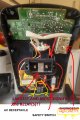
uh... I'm pretty sure that relay has more than two pins, and there are so many soldered connections under there on the bottom of that board.... That's gonna be confusing as hell for me.... I'll try to ask Gunny Google and the chatGPT gospel