Help beginner troubleshooting deep fryer

Status
Not open for further replies.

BobTPH

Joined Jun 5, 2013
11,553
So the item I pointed out is the heat sensor as I surmised. That made no sense before @MrChips post shows that that heater is inside the oil.

Now we see that the sensor is in contact with both the oil and the heating element. This arrangement allows the electronics to sense overheating by, for instance, operating it without oil.
 

wayneh

Joined Sep 9, 2010
18,117
Exactly my lament in #19. The thermostat does not appear to have an adjustment knob. The method of control may involve an electrical signal from the PCB but the pictures don't reveal that.
 

MrChips

Joined Oct 2, 2009
34,866
Look at post #20. There are up / down buttons to adjust the temperature.
The up/down buttons set the target temperature internal to the controller.
We don't see how this is used to control the actual oil temperature.
Where is the control connection between the two?
How does the controller read the actual temperature?
 

BobTPH

Joined Jun 5, 2013
11,553
The entire mechanism, heater, temperature probe and connections to the controller are immersed in the oil, as shown in the exploded diagram in post #20.
 

BobTPH

Joined Jun 5, 2013
11,553
the controller monitors the temperature at the sensor and turns the heating element on and off to reach and maintain the set temperature.

Either I am missing something or you are. Why do you think it would be unable to do that?
 

MrChips

Joined Oct 2, 2009
34,866
the controller monitors the temperature at the sensor and turns the heating element on and off to reach and maintain the set temperature.

Either I am missing something or you are. Why do you think it would be unable to do that?
How does it monitor the temperature? The sensor is a bulb type thermometer. The fluid inside the bulb expands with rising temperature. Usually this controls a mechanical ON/OFF switch. The user sets the temperature by turning a mechanical dial.

We both are missing something (in fact, three of us).
 

MrChips

Joined Oct 2, 2009
34,866
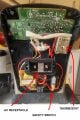
Here is what I see.

Euro-Pro F1066 deep fryer.jpg

The RED cable (possibly AC LINE IN) connects from the AC RECEPTACLE to the SAFETY SWITCH.
From the SAFETY SWITCH, the RED cable goes to the THERMOSTAT, from the THERMOSTAT to the heater element.

Note that the THERMOSTAT has white paint on the adjustment, likely set at the factory. This is the high temperature cut-off controlled by the bulb thermometer.

The circuit board under the AC RECEPTACLE is the low voltage supply board with a 3-terminal voltage regulator.
The black relay appears to be connected to the other side of the heater element for ON/OFF control.

We still don't know how the controller measures the temperature.
 

BobTPH

Joined Jun 5, 2013
11,553
Look at the exploded diagram again. Item 7 is labelled temperature sensor. Cannot see it well enough to tell, but it is probably a thermocouple or thermistor. The sensor you are looking at is, presumably, a redundant safety cutoff.
 

MrChips

Joined Oct 2, 2009
34,866
Look at the exploded diagram again. Item 7 is labelled temperature sensor. Cannot see it well enough to tell, but it is probably a thermocouple or thermistor. The sensor you are looking at is, presumably, a redundant safety cutoff.
Ah, so!
You are correct. I see item 7 in the exploded view now.
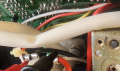
There are two green wires coming from the temperature sensor going to the PCB.

1781789318202.png
 

MrChips

Joined Oct 2, 2009
34,866
For the TS, with this new information, we can now properly proceed with trouble shooting the deep fryer.

Here are the items you need to check:

1. Check the SAFETY SWITCH.
2. Check the THERMOSTAT. Now that it has been disassembled, you need to get it working properly again.
This is the high temperature cut-of and cannot be omitted.

With both 1 and 2 closed, you should get continuity along the RED cables, from the AC power input to one the heater element.

3. Power relay

To check this, look for continuity from the other AC power input (BLACK cable) to the other side of the heater element. You need to perform this test with AC power applied.

If the relay does not close, then the problem is either a bad relay or bad temperature sensing circuit.
I am going to put my bets on a bad relay (assuming that items 1 and 2 check OK).
 

wayneh

Joined Sep 9, 2010
18,117
That all makes sense now. Power only reaches the heater element if these items are closed (showing continuity)
1) Relay which is under control of the PCB responding to the newly-discovered temperature sensor
2) Safety switch
3) High-temp safety shutoff that we thought was the thermostat
 

wayneh

Joined Sep 9, 2010
18,117
Right, and that's why I had recommended trying a jumper across both the switch and the "thermostat" (which is really a high-temp cutoff). Unless you can manually close the switch during testing, it'll surely be doing its job of breaking the circuit.
 

Thread Starter

CircuitGreenhorn

Joined Jun 12, 2026
12
The usual first step is to try and locate the appliance Service Manual, not the User Manual.
At the very least, try to find the circuit schematics.
Failing that, search on the internet to see if someone else had done a similar repair.
Failing that, you need to get out a DMM and start doing some diagnostics.

In this case, there is no AC power reaching the heater element.
Start with the AC power cord and plug, which should be a 2-prong or 3-prong plug.
The narrow blade is LINE. The wider blade is NEUTRAL.
You should expect to find continuity from NEUTRAL to one side of the heater (though not always the case).
The LINE input ought to go through various devices, such as power switch, board fuse, thermal cut-off fuse, and a triac before reaching the heater element.

If the control unit appears to be working, then the power switch and board fuse are likely not at fault.
There are sensors feeding information to the controller which drives the triac. Either the triac is faulty or a sensor is faulty, or the controller is faulty.

That is how I would approach this problem.
Thank you so much.

I am using a multimeter in a lot of the videos (I realize they are too numerous and too long to watch). Is it not a 'DMM'? It has an LCD screen, so I figured it was pretty digital.... I need to see if I can get a peak voltage adapter supposedly... maybe an oscilloscope(s) too, although I DOUBT that would be helpful with this particular project....


Yes, I speculate the control panel 100% works correctly...

What is a triac? Is that two separate full wave rectifiers in tandem?? (when I say tandem, I am not specifying whether parallel, series, and/or bridge. I haven't even gotten to that advanced stage with my thinking yet and am staying totally vague). I'm gonna ask chatpgt to dumb it down for me in a moment

No offense but I don't think that thermostat is meant to be opened up and I wonder if it's still working. With power disconnected, I'd try bypassing it with a jumper. Then apply power and turn on the unit. Quickly, briefly and safely, check for warming of the heating element. If you feel it getting warm, power down. You know you've found the culprit. If not, the problem must be elsewhere.

You should likewise be able to bypass that safety switch, or verify with your meter that there is full line voltage on both sides. I suppose it shuts off heating if the bowl is not in place?

It'd be nice to understand how that PCB controls the thermostat, which to me looks like a more-or-less normal mechanical thermostat, although without an obvious adjustment dial. All the electronics on that board are there to run the display and interface buttons. There is relatively little communication with the main power circuit for the heater element, except for setting the temperature target. There are no "power electronics" on that board. It's all about information, not power. If the fault is on that board, there's likely nothing you can do without the schematic, and maybe even with it. The components not on the board should be easier to sort out.
To respond to @wayneh, I think I know what a jumper is! I have some with alligator clips. I wish I had thought of such a genius thing. I will absolutely try that! Not sure how fast it will heat up, but I assume if it works, it heats up QUICK!

If the safety switch was not working, the LCD screen would not illuminate at all, beeps would not be audibly generated, nothing would happen, the whole entire device would appear nonfunctioning.
Actually, as far as I know, the tool has no capability of determining whether the bowl is actually in place. there is a stainless steel housing that goes around the outside the bowl, and that is what has the black plastic rails which the controller slides into and engages the switch. It might be arguably safer if it was the bowl, not the stupid housing that determined whether or not the safety switch was engaged, but I doubt anyone would ever be stupid enough to use it with no bowl. I'm unsure what happens if you ever use it without the bowl, or, more critically, with an abscense of oil (i.e., regardless of whether the bowl is in place, if the bowl is empty with inadequate or no oil, bad things might happen? I won't be leaving it on oil-less long term to find out!!!) If what I'm saying confuses you, look at number 1 versus number 5 on their diagram. Number 5 is the actual stainless steel device bowl that holds the basket and the oil and the heating element is suspended above. Number 1 they call 'the body' and it is just there to hold the controller and it holds the bowl too and has some convenent handles to pick the whole thing up with when it's hot. Mr.Chips subsequently has sent an image of the diagram I'm referring to, and others have linked it before too, but here it is also again: https://images-na.ssl-images-amazon.com/images/I/81Vc31i+AfL.pdf

You said "no "power electronics" on that board" - I am interpreting you as stating that the heating is performed electrically, but NOT digitally/'electronically', meaning there is no sophisticated signaling... IDK. I'm gonna interpret you as saying it's pretty old school in terms of the heat aspect (obviously the rest of it is pretty modern and sophisticated - LCD screen and such! IDK really know about that dichotomy or understand this electrical concepts but I vaguely understand that prior to 1947 when transistors were invented, other than some really sophisticated vacuum tube and maybe occasional sophisticated relay computers, the world was full of 'ELECTRIC DEVICES' but they had not yet developed 'ELECTRONIC DEVICES' en masse in deliverable quantity to put them in every home in America the way transistors have allowed. Hopefully I'm not retarded and I'm vaguely brushing up against your point.

I have no idea how the 'printed circuit board' controls the thermostat, but maybe I don't need to know that at this stage in my electrical journey.

To respond to both of you, @wayneh & @MrChips

I would like to identify a possible misconception or maybe a guid intuited thought: I thought that 99.999% of the time, no Americans open up and work on homeowner entry-level appliances with the possible exception of large ranges, clothes washers, dishwashers, and clothes dryers. I.e., nobody works on something like this 99% of the time. Maybe 99% is an exaggeration even if the sentiment is true; I thought they are disposable and thrown away, vast majority of time. That doesn't make me want to give up; I was just surprised you gentlemen keep alluding to a possible blueprint/diagram/schematic that could exist. Well, obviously it exists! Maybe it could be in a us patent? And/or alternatively, obviously schematics must always exist, the question is just whether anyone has released and/or leaked it to professionals and/or to the public? Anyway, I am surprised a service manual and/or wiring diagram could even potentially exist (although I admit the company who made it (Euro Pro) must've made one if nothing else for their own R&D/planning prior to the first prototype being produced). I could try asking Euro Pro customer service during business hours if I have time. I did briefly Google looking for such documents. I couldn't easily locate any. Also, in a very bizarre surprise, I could almost swear it seems like someone has opened up this and been inside it to work on it before. One of the screws to take the controller apart almost seemed stripped... Unless it is a very weird security bit that is unlike the other 5 otherwise-identical screws and I'm just having trouble seeing that the female where the screwdriver bit goes is unique to the others...


To respond to all the many comments and back and forth, I always thought there was a heating element suspended in the oil, and also a tiny little sensor and/or unsophisticated thermometer. I only thought there were two unsophisticated things in the oil. I did not realize there was a lot more drama submerged in the oil than that

to confirm, we now believe that to be some sort of high limit, NOT a thermostat?
 

Thread Starter

CircuitGreenhorn

Joined Jun 12, 2026
12
Mr Chips very generously also sent one message with a ton of images, two of which I am regurgitating here

1781833269620.png
he said "
Check that the thermostat contacts are closing properly when the oil temperature is below the set temperature.
In your case, the sensor is beside the heater element. "
https://images-na.ssl-images-amazon.com/images/I/81Vc31i+AfL.pdf

Does the even more recent-developments and the current hypotheses we are for-the-time-being going-to-be-operating-under temporarily blow those claims or suggestions and/or images out of the water?

Or is that all still the current analsysis and actually is relevant to the current new thinking, or perhaps even spurred this whole new development? I thought maybe we are determining the once-thought-to-be-thermostat is actually a high limit (but not a fuse!?For a while I was thinking term 'high limit' to be synonymous with a type of fuse and/or type of fusibile-link).

all this capillary talk is way over my head. I gotta google all that. I know what capillary action is in regards to water like under roofing shingles and stuff and I know we have capillaries that are downstream of our blood veins but this is all unheard of in my repertoire
 

MrChips

Joined Oct 2, 2009
34,866
What you have posted is all history and behind us.
Ignore what was written and stay in tune with us.

For your information,

1) DMM stands for Digital Multi-Meter. Your multimeter is a DMM.

2) The bowl I referred to is the oil container, #5.

3) There are two ways to turn AC power ON/OFF, using a triac, or using a relay. We have identified the relay.

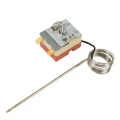
4) The Sensor #18 is a capillary fluid thermometer. It controls a thermostat which has been adjusted and set at the factory. It's purpose is to shut off the heater if the temperature gets two high. It is a resettable high temperature limit switch and is used instead of a thermal cut-off fuse. This safety device is essential in case the control relay is stuck in the closed position.

5) Don't underestimate what people do. Manufacturers are legally required to install safety devices in appliances to prevent your house from burning down and to prevent electrocution. They and their lawyers do not take this matter lightly.

Now let's focus on diagnosing the problem.

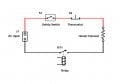
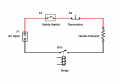
Here is your circuit digram. AC power is not reaching the heater element.
At least one device in the circuit is open.

1781836396228.png

You can bypass S1 and S2 (i.e. install a jumper).
If the heater does not get hot, try a jumper across the relay (i.e. jumper across the black cables from the AC input to the heater element).

Do this and you will get closer to finding the cause of the problem.
 
Status
Not open for further replies.
Top