Help beginner troubleshooting deep fryer

Status
Not open for further replies.

Thread Starter

CircuitGreenhorn

Joined Jun 12, 2026
12
20260608_195222.jpg

Beginner just starting out.

Can anyone please give me some tips or direction?
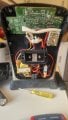
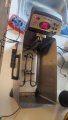
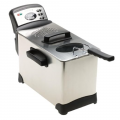
I am working on this Euro pro F1066 residential/crappy homeowner 120v deep fryer. It seems to work other than it does not heat up the oil at all. I am unsure how to check that black relay thingy.

Video 1 (oldest of the three short videos): https://youtube.com/shorts/26bQU347xPo?is=A2-4PS61RhYYTMu0

Video 2: https://youtube.com/shorts/qyNUdxSlqc0?is=5K3eaw490ybbNinE

Video 3 (newest of the three short videos so far): https://youtube.com/shorts/SGuytCRRSEE?is=miaHzUNdM8Op0rQg

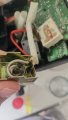
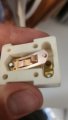
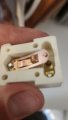
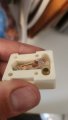
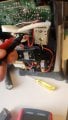
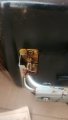
I don't see any voltage on the temp sensor that is submerged in the oil. The temp sensor is attached by wire to the thermostat (or is it called the high limit?). I am attaching three videos. In one of the three videos it shows me checking the voltage of the sensor while the whole machine is plugged in, and also in the same video, I unplug the machine and perform an ohm check on the thermostat (or high limit?) But I do the ohm check incorrectly.

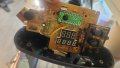
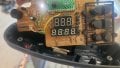
In one other of the three videos, I believe I do the ohm check on the thermostat or whatever it is called correctly. Also showing some photos.

One video shows me performing the short to ground test but maybe i need to try it again with the actual oil-holding pan/shell

What else I've tested so far:
  • Heating element makes 11 or 12 ohms
  • I tested two resistors for correct resistance
  • I pushed on the breaker as hard as I could (these have a little button on the back of the plastic controller)

I know this is just a crappy not-commercial-grade appliance. I realize it does not make monetary sense to fix it, but I'm trying to learn more. Also, a concern is that it works fine and I'm just retarded and making a mistake.

I'm hoping to improve my troubleshooting skills.

Any help much appreciated. Thank you
 

Attachments

MrChips

Joined Oct 2, 2009
34,947
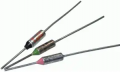
There should be a high temperature cut-off fuse that looks something like this:

1781369195338.png

It should be bolted on to the bowl. See if there is one and measure the resistance across it. If it measures open then it is blown.
 

Thread Starter

CircuitGreenhorn

Joined Jun 12, 2026
12
There should be a high temperature cut-off fuse that looks something like this:

View attachment 368326

It should be bolted on to the bowl. See if there is one and measure the resistance across it. If it measures open then it is blown.
I have spoken to some people before, none of whom are as articulate as you, and they talk about something called a "high limit". Is this synonymous with high temp cut off fuse?

Just to confirm, your image/photo shows three fuses/limits, but we would expect I would only have (one), correct?

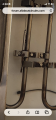
I do not know what a bowl is but I'm googling it now. the actual stainless thingy/pot/pan that all the oil sits in is a removable component. Very similar to this attached image

If I can locate it and it is blown that is actually something I may have adequate ability to deal with. If I had known about a fuse this whole time, that would've been the first thing I checked. I figured since it has a breaker thingy button on the controller, I never considered the possibility of a fuse existing

Thanks so much!!!

edit: i'm looking for the fuse but still don't see any
 

Attachments

Last edited:

wayneh

Joined Sep 9, 2010
18,127
I agree with @MrChips. A thermal fuse is the common culprit that kills many small appliances. It's a great safety feature that prevents a fire when all else fails, but they commit suicide in the process.

They're not expensive but getting your hands on the right one, delivered, may cost more than the appliance is worth. Certainly once you factor in your own time. I've got a rice cooker and a couple other things awaiting repair in my basement but of course they all use different thermal fuses. I can't just order a 5-pack off Amazon and be done with it.

Note the thermal fuses are often hidden inside a braided "jacket" of some sort.
 

Thread Starter

CircuitGreenhorn

Joined Jun 12, 2026
12
I agree with @MrChips. A thermal fuse is the common culprit that kills many small appliances. It's a great safety feature that prevents a fire when all else fails, but they commit suicide in the process.

They're not expensive but getting your hands on the right one, delivered, may cost more than the appliance is worth. Certainly once you factor in your own time. I've got a rice cooker and a couple other things awaiting repair in my basement but of course they all use different thermal fuses. I can't just order a 5-pack off Amazon and be done with it.

Note the thermal fuses are often hidden inside a braided "jacket" of some sort.
I'm still looking but I do not see it so far
 

twohats

Joined Oct 28, 2015
616
Hi,
The thermal fuse will be soldered or crimped to you device.
As stated previously it will be covered by a sleeve of some sort.
I mention this because you are not looking for a conventual pull out fuse.
It looks like a thermal fuse attached to the heating element. (Edit).
Good luck, keep us updated.
 
Last edited:

Thread Starter

CircuitGreenhorn

Joined Jun 12, 2026
12
Hi,
The thermal fuse will be soldered or crimped to you device.
As stated previously it will be covered by a sleeve of some sort.
I mention this because you are not looking for a conventual pull out fuse.
Good luck, keep us updated.
I know it doesn't look like a bladed automotive fuse or clothes dryer fuse because @MrChips generously sent that photo

This first video is kind of long but if you fast forward to the end i show everything and I think there is no fuse I cannot find it:

This second video was a video from earlier today that I never got around to sharing I believe: https://youtube.com/shorts/zNfzyYLx6zs?si=BjUBEoDw8PXpcEN5 I'm not sure if this second video will actually display a big thumbnail since it is a short not a traditional video

Also im gonna attach the photos of the front of the screen board just so there's no doubt it's not hiding up there either
 

Attachments

Last edited:

BobTPH

Joined Jun 5, 2013
11,570
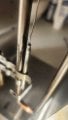
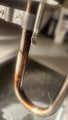
This is a detail from one of your pictures. It looks to me like a wire is disconnected from what might be a thermal sensor (the tube along side of the heating element.)

IMG_0634.png
 

BobTPH

Joined Jun 5, 2013
11,570
I still see nothing attached to the bottom. Do you not see the unconnected wire in my clip? There should not generally be any unconnected wires. And a sensor or fuse needs two connections. Perhaps the picture is misleading and the wire is connected to something?
 

BobTPH

Joined Jun 5, 2013
11,570
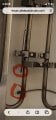
I am talking about connecting the two circled items. I cannot tell from the photo, but if the connector on the wire slides into the terminal on the suspected sensor, I think that the way it should be.

IMG_0634.jpeg
 

Thread Starter

CircuitGreenhorn

Joined Jun 12, 2026
12
Hello,

I think that black piece has nothing to do with the sensor.
The sensor probably works on expansion of a substance in the sensor.

Bertus
I am talking about connecting the two circled items. I cannot tell from the photo, but if the connector on the wire slides into the terminal on the suspected sensor, I think that the way it should be.

View attachment 368338
An insulated wire would be unlikely to be submerged in hot dirty oil. You are focusing on a plastic zip tie that I used as a pointing/visual tool to draw attention to small objects in the videos

I really would like to find this fuse but I've looked very hard
 

wayneh

Joined Sep 9, 2010
18,127
That long thin thing looks like a temperature probe.

The reference to "the bowl" refers to the bath or tub that holds the oil. A thermal fuse must be attached to some part of the device that gets hot by design, but must never exceed a certain limit. So it would make some sense to attach a thermal fuse to the outside (away from the oil) wall of the oil basin, perhaps on the bottom where it will still do its job with a low oil level.

And as soon as I say that, I realize a problem: No oil. You wouldn't want the heater full on trying to heat the oil if there isn't any present. So that almost dictates that a thermal fuse - if there is one - needs to be very near the heating element, to detect if it's dangerously overheating.

We may have misled you. Thermal fuses are very common but it's possible this unit was designed to get by without one. I have a similar fryer downstairs. If I get some time I'll try to see if it has a fuse.
 
Last edited:

Thread Starter

CircuitGreenhorn

Joined Jun 12, 2026
12
That long thin thing looks like a temperature probe.

The reference to "the bowl" refers to the bath or tub that holds the oil. A thermal fuse must be attached to some part of the device that gets hot by design, but must never exceed a certain limit. So it would make some sense to attach a thermal fuse to the outside (away from the oil) wall of the oil basin, perhaps on the bottom where it will still do its job with a low oil level.

And as soon as I say that, I realize a problem: No oil. You wouldn't want the heater full on trying to heat the oil if there isn't any present. So that almost dictates that a thermal fuse - if there is one - needs to be very near the heating element, to detect if it's dangerously overheating.

We may have misled you. Thermal fuses are very common but it's possible this unit was designed to get by without one. I have a similar fryer downstairs. If I get some time I'll try to see if it has a fuse.
No worries. I just wish I was better at troubleshooting and better at taking readings. I'd like to verify stuff
 

Thread Starter

CircuitGreenhorn

Joined Jun 12, 2026
12
@bertus @wayneh @MrChips

Where could I post to try to get some more help learning and troubleshooting this? I'd at least like to get the skill to identify which part/component is actually broken.

Unfortunately, as far as I know, I have a lifetime ban from Reddit. A fellow veteran on Reddit once totally helped me wire up a 220v compressor motor... pretty trivial thing for most people but I don't have a lot of practical skill. Wish I could message him again.

Alas, greetings and many thanks from me and my best friend (here he is)
 

Attachments

MrChips

Joined Oct 2, 2009
34,947
The usual first step is to try and locate the appliance Service Manual, not the User Manual.
At the very least, try to find the circuit schematics.
Failing that, search on the internet to see if someone else had done a similar repair.
Failing that, you need to get out a DMM and start doing some diagnostics.

In this case, there is no AC power reaching the heater element.
Start with the AC power cord and plug, which should be a 2-prong or 3-prong plug.
The narrow blade is LINE. The wider blade is NEUTRAL.
You should expect to find continuity from NEUTRAL to one side of the heater (though not always the case).
The LINE input ought to go through various devices, such as power switch, board fuse, thermal cut-off fuse, and a triac before reaching the heater element.

If the control unit appears to be working, then the power switch and board fuse are likely not at fault.
There are sensors feeding information to the controller which drives the triac. Either the triac is faulty or a sensor is faulty, or the controller is faulty.

That is how I would approach this problem.
 

wayneh

Joined Sep 9, 2010
18,127
No offense but I don't think that thermostat is meant to be opened up and I wonder if it's still working. With power disconnected, I'd try bypassing it with a jumper. Then apply power and turn on the unit. Quickly, briefly and safely, check for warming of the heating element. If you feel it getting warm, power down. You know you've found the culprit. If not, the problem must be elsewhere.

You should likewise be able to bypass that safety switch, or verify with your meter that there is full line voltage on both sides. I suppose it shuts off heating if the bowl is not in place?

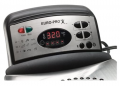
It'd be nice to understand how that PCB controls the thermostat, which to me looks like a more-or-less normal mechanical thermostat, although without an obvious adjustment dial. All the electronics on that board are there to run the display and interface buttons. There is relatively little communication with the main power circuit for the heater element, except for setting the temperature target. There are no "power electronics" on that board. It's all about information, not power. If the fault is on that board, there's likely nothing you can do without the schematic, and maybe even with it. The components not on the board should be easier to sort out.
 

MrChips

Joined Oct 2, 2009
34,947
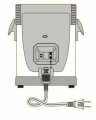
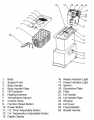
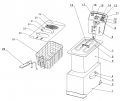
Euro-Pro F1066 5-litre Deep Fryer teardown

1781656933559.png

1781657021503.png

User Manual

1781657182318.png
1781657321958.png

1781657406029.png

1781657484316.png

1781657619303.png

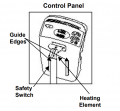
The Control Panel and heating element can be removed from the oil container.
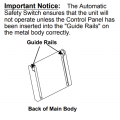
There is a Safety Switch that allows the unit to operate only when the Control Panel has been inserted correctly.
Check with the DMM that the Safety Switch is functioning properly.

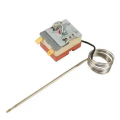
The sensor is a capillary thermostat that looks something like this:

1781658413705.png

Check that the thermostat contacts are closing properly when the oil temperature is below the set temperature.
In your case, the sensor is beside the heater element.

1781658319664.png
 
Status
Not open for further replies.
Top