Hello, why is circuit not working?

panic mode

Joined Oct 10, 2011
5,000
probably transistor got smoked too. you stated that supply voltage is 12V. how stable and precise is this 12V supply? IC1 true goes to supply rail so Vgs can be 12V. datasheet for si4466dy shows that 12V is the absolute max for Vgs. you should never allow that for this transistor. this one is meant to be triggered by much less such as 2.5V or 5V. I would not like to see anything over 10V at the gate but your circuit has nothing to keep the Vgs at safe level. the replacement also works with low Vgs but it is more robust and can survive Vgs up to 20V. Do you read datasheets? They are your best friends.

also not sure what made you draw a conclusion that IC did not work. how did you test it?
did you check important points with an oscilloscope? how about an output of the oscillator? if i am not mistaken that is pin4 (output of IC1b). this pin should be always toggling and you should be always able to change duty cycle using potentiometer - regardless of delay or state of the transistor. you can add an LED and resistor to PIN4 to see if it works. LED brightness will change when PWM duty cycle is adjusted. if you put larger cap on pin 5, you will see the LED flicker. that is one stage.

another stage is delay circuit. another stage is pair of gates driving transistor. finally you have a transistor. each stage can and should be checked. I know you are probably aiming for minimal part count design but things could also be added temporarily while troubleshooting. what kind of tools you have at your disposal?
 
Last edited:

Thread Starter

Fady.Soliman

Joined Jan 20, 2023
44
probably transistor got smoked too. you stated that supply voltage is 12V. how stable and precise is this 12V supply? IC1 true goes to supply rail so Vgs can be 12V. datasheet for si4466dy shows that 12V is the absolute max for Vgs. you should never allow that for this transistor. this one is meant to be triggered by much less such as 2.5V or 5V. I would not like to see anything over 10V at the gate but your circuit has nothing to keep the Vgs at safe level. the replacement also works with low Vgs but it is more robust and can survive Vgs up to 20V. Do you read datasheets? They are your best friends.

also not sure what made you draw a conclusion that IC did not work. how did you test it?
did you check important points with an oscilloscope? how about an output of the oscillator? if i am not mistaken that is pin4 (output of IC1b). this pin should be always toggling and you should be always able to change duty cycle using potentiometer - regardless of delay or state of the transistor. you can add an LED and resistor to PIN4 to see if it works. LED brightness will change when PWM duty cycle is adjusted. if you put larger cap on pin 5, you will see the LED flicker. that is one stage.

another stage is delay circuit. another stage is pair of gates driving transistor. finally you have a transistor. each stage can and should be checked. I know you are probably aiming for minimal part count design but things could also be added temporarily while troubleshooting. what kind of tools you have at your disposal?
Hello panic mode,

Thank you for your reply.
Actually the mosfet used is AO4466 (datasheet attached), it claims 20V Vgs which is the same as the IRFZ44n. unfortunately in am outside the city with no access to an oscilloscope but I have used an LED to check the pwm output and as I expected the LED is turned on with no flicking. Pin 4 is 11.5 V continuous. Once I change the mosfet to the IRFZ44n, the pwm works and everything is fine. I suspected the AO4466 being smoked but I did check it with the multimeter and it seemed to be okay. I am ready confused why does the mosfet even effect the pwm starting or not. Any idea why, I really appreciate all your help. Thank you in advance
 

Attachments

Thread Starter

Fady.Soliman

Joined Jan 20, 2023
44
The protection may be problematic with that large capacitor.
You still should add the resistor in series.
Hello crutschow,
Thank you for your reply, I did add the diode across the 300k resistor as panic mode suggested and still. The circuit only functions with the IRFZ44n and not the AO4466. Any idea what could be the problem, why would the mosfet even stop the pwm mode? appreciate your help. Thank you in advance.
 

panic mode

Joined Oct 10, 2011
5,000
not sure what multimeter you use. if the DMM is used as voltmeter, it may show it as average voltage or jumping value depending on sampling and value processing. using analog voltmeter would show steady value that corresponds to duty cycle, if your meter has frequency or duty cycle or scope function, this is simpler to check. if you connect LED with a resistor (1k for example) to pin4 you should be able to see LED brightness corresponding to PWM duty cycle. the same would happen if you connect the same LED and resistor to gate or drain of transistor. it would be good if you follow advices offered before, such as share PCB artwork (screenshots of your PCB design from CAD software or gerber files) and measure voltages at different points.
 

Thread Starter

Fady.Soliman

Joined Jan 20, 2023
44
Do mean from the right of the 300k resistor to ground?
Did you look at the gate of the MOSFET so see if there is a signal?

The only way I see to stop that signal is if the MOSFET gate is shorted to the source (ground).
Hello crutschow,

I checked the gate voltage and it is high in case of both mosfets. The only difference is that when the IRFZ44n is used, the pwm kicks in but with the 4466 it does not. I am starting to doubt the mosfet itself. I will try to get a new mosfet and try and let you know. It might take a bit of time tho since I am in the middle of no where.
Thank you for your help.
 

Thread Starter

Fady.Soliman

Joined Jan 20, 2023
44
not sure what multimeter you use. if the DMM is used as voltmeter, it may show it as average voltage or jumping value depending on sampling and value processing. using analog voltmeter would show steady value that corresponds to duty cycle, if your meter has frequency or duty cycle or scope function, this is simpler to check. if you connect LED with a resistor (1k for example) to pin4 you should be able to see LED brightness corresponding to PWM duty cycle. the same would happen if you connect the same LED and resistor to gate or drain of transistor. it would be good if you follow advices offered before, such as share PCB artwork (screenshots of your PCB design from CAD software or gerber files) and measure voltages at different points.
Hello panic mode,
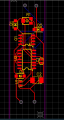
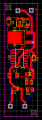
I did check with a connected LED with a resistor and there is no flickering when the 4466 is used. Attached is a photo of the pcb artwork and the gerber files. I am starting to doubt the AO4466 since it is the only thing which just stops the PWM. I appreciate any help I can get from your side.
Many thanks in advance.
 

Attachments

panic mode

Joined Oct 10, 2011
5,000
I did check with a connected LED with a resistor and there is no flickering when the 4466 is used.

meaning what exactly? connected it where?

not sure if you understood comments - if the PWM frequency is faster than 20Hz or so you will see no flickering. You will see different brightness when trimpot is in different positions (min and max). to see it flicker, you need logic probe, or oscilloscope or ... to see it on LED you need to slow the PWM oscillator down. this is easily accomplished by temporarily adding larger capacitor across existing one.

btw, those PCB tracks are tiny. way to tiny for 2A load...
what is the Cu layer width and thickness?
default thickness is either 0.5 or 1 Oz/ft^2
if using 0.5Oz/ft^2 (17.5um), output tracks would need to be at least 160mill wide (4mm)
if using 1 Oz/ft^2 (35um), they should be at least 80mil (2mm)
preferably one would add 25% or more for safety margin.
your artwork hits that you have used tracks that are only 8 or maybe 10mil wide. similarly those are tiny vias.

it also shows what i suspected - your tracks are very close to solder pads making it prone to problems. if your board without solder mask (home made for example) it would be VERY unlikely to successfully solder the parts.

next there is an issue of layout. your oscillator parts are located way to close to the output transistor. this is bound to give you hard time and instability problems. oscillators should be far from any source of noise (like output stage) and preferably shielded by copper pour or ground plane.
 

Thread Starter

Fady.Soliman

Joined Jan 20, 2023
44
Are you sure you have it connected correctly, not back-to-front? The pinout of the two FETs is quite different.
Hello Alec_t
Thank you for your reply.
Yes I am sure of the mosfet connection and it is the right way not back-to front. I double checked that with all PCBs.

Thank you for your help.
 

Thread Starter

Fady.Soliman

Joined Jan 20, 2023
44
meaning what exactly? connected it where?

not sure if you understood comments - if the PWM frequency is faster than 20Hz or so you will see no flickering. You will see different brightness when trimpot is in different positions (min and max). to see it flicker, you need logic probe, or oscilloscope or ... to see it on LED you need to slow the PWM oscillator down. this is easily accomplished by temporarily adding larger capacitor across existing one.

btw, those PCB tracks are tiny. way to tiny for 2A load...
what is the Cu layer width and thickness?
default thickness is either 0.5 or 1 Oz/ft^2
if using 0.5Oz/ft^2 (17.5um), output tracks would need to be at least 160mill wide (4mm)
if using 1 Oz/ft^2 (35um), they should be at least 80mil (2mm)
preferably one would add 25% or more for safety margin.
your artwork hits that you have used tracks that are only 8 or maybe 10mil wide. similarly those are tiny vias.

it also shows what i suspected - your tracks are very close to solder pads making it prone to problems. if your board without solder mask (home made for example) it would be VERY unlikely to successfully solder the parts.

next there is an issue of layout. your oscillator parts are located way to close to the output transistor. this is bound to give you hard time and instability problems. oscillators should be far from any source of noise (like output stage) and preferably shielded by copper pour or ground plane.
Hello panic mode,
Thank you very much for your input.
I am actually not experienced at PCBs so that is why there are those mistakes. For the LED i connected it to pin 4 and changed the pot value, the LED output was steady light.
Anyway, I do agree that the tracks are too tiny. I will remake the PCB with wider tracks and try to place the oscillator parts away from the transistor. The problem is the over all board size limit. I will remake it and post it here. I would truly appreciate your input about it.

Thank you for all the help. I really appreciate it.
Best regards,
Fady
 

crutschow

Joined Mar 14, 2008
38,526
there is an issue of layout. your oscillator parts are located way to close to the output transistor. this is bound to give you hard time and instability problems. oscillators should be far from any source of noise (like output stage) and preferably shielded by copper pour or ground plane.
That may be true for linear sine-wave oscillators, but large-signal relaxation oscillators are not very sensitive to small values of noise pickup, especially noise that is in sync with the oscillator.
I doubt that his layout has anything to do with his problems.
 

Thread Starter

Fady.Soliman

Joined Jan 20, 2023
44
Hello @crutschow @panic mode @Alec_t @ericgibbs,
How are you?
I finally got back to the city and was able to rework the PCB. I have changed the CD4093 type to a better quality(Texas instruments), I have also added the 10K resistor and the zener for protection. I have also changed the mosfet to KIA50N03B, it is a much higher amp and was relatively cheap so I decided to use it instead of the AO4466. I have made the tracks handling the load as wide as possible.
Attached is the gerber file for the new PCB, would you be so kind and have a look at it and let me know what you think. I would really appreciate your inputs since I am really a first timer with PCBs.
Also on a side note, When I was testing the circuit (the previous PCB), the solenoid was very noisy (humming sound) when working in the PWM mode. I know that with the current values of the capacitor (27nf) and the pot (100Kohm) the frequency is about 1KHZ. My question is, are there better values to use for a certain frequency that would avoid the noisy sound.

Appreciate all your inputs and help.
Thanks in advance.
Fady
 

Attachments

Last edited:

crutschow

Joined Mar 14, 2008
38,526
I know that with the current values of the capacitor (27nf) and the pot (100Kohm) the frequency is about 1KHZ. My question is, are there better values to use for a certain frequency that would avoid the noisy sound.
Reducing that RC value will increase the PWM frequency.
Changing the pot to 10kΩ and the resistor to 10nF will give a frequency about 20kHz which should be inaudible.
That will also increase the switching dissipation in the MOSFET, but it should still be low.
 

Thread Starter

Fady.Soliman

Joined Jan 20, 2023
44
Reducing that RC value will increase the PWM frequency.
Changing the pot to 10kΩ and the resistor to 10nF will give a frequency about 20kHz which should be inaudible.
That will also increase the switching dissipation in the MOSFET, but it should still be low.
Hello crutshow,
Thank you so much for your prompt reply.
For the switching dissipation in the mosfet, does that mean too much heat dissipation? Would there be any risk for the mosfet to get destroyed? Would it be safer to make the frequency maybe 10khz ?
I have attached the datasheet of the mosfet. The solenoid is a 12v 2amp type and after the delay the target is about 2.2v which should be about 0.3 amp.
I really appreciate all your help.
Thank you in advance.
Fady
 

Attachments

Thread Starter

Fady.Soliman

Joined Jan 20, 2023
44
If you are dropping the current down to 0.3A, then the simulated MOSFET dissipation is only about 20mW at 20kHz frequency, which is negligible.
Thank you so much for your reply. I will change the RC values and get the PCB done. I will keep you posted about the results once I get it.
Thank you again.
 

Thread Starter

Fady.Soliman

Joined Jan 20, 2023
44
Hello crutshow,
I have a question regarding the MOSFET, the current mosfet same as the AO4466 has a Vgs= 20V. Panic mode mentioned that 12V for the gate voltage is a bit high. Do you recommend using a resistor in series (maybe 10 OHM?) to the mosfet gate to protect it (as well as the C4093)?. Also in addition to the protection, I think it another resistor is needed to keep the gate from floating (pull down resistor) of maybe 10Kohm?
Please excuse all these questions, I am just trying to make sure that the new pcb will work with no issues.
Appreciate all your help.
Thanks in advance.
Fady
 
Last edited:

crutschow

Joined Mar 14, 2008
38,526
the AO4466 has a Vgs= 20V. Panic mode mentioned that 12V for the gate voltage is a bit high. Do you recommend using a resistor in series (maybe 10 OHM?) to the mosfet gate to protect it (as well as the C4093)?.
A small series gate resistor is to eliminate possible MOSFET oscillations, not to protect the gate.
I don't think that's a problem here, but you can add one if you like.
I think it another resistor is needed to keep the gate from floating (pull down resistor) of maybe 10Kohm?
Since the gate will never be floating on the PCB, I see no reason to add a pull-down resistor.
 
Top