Hello, why is circuit not working?

crutschow

Joined Mar 14, 2008
38,521
Yes, it's possible C3 could blow U1a when the input goes low.
One option to prevent that is to add a 10kΩ resistor in series with the two inputs to U1a (modified circuit below).
It prevents the reverse current from reaching possible damaging levels
If more convenient, R1 could be added on either side of C2 in series.
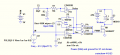
1681309242537.png
 

Thread Starter

Fady.Soliman

Joined Jan 20, 2023
44
hi,
When you charge a capacitor to say +12V and then connect the positive side to 0V, the other end of the capacitor becomes -12Volts.
This is could blow and cause an internal short circuit in the 4093, to say the Vcc supply, so most likely the 4093 is damaged.
The circuit you have designed will damage any replacement 4093 you fit, so change the design.
E
Hello ericgibbs,
Thank you very much for your answer. But the question is, why does this happen with the PCB only and not the breadboard version. I have made the exact same design with a breadboard a few times now and it works just fine. I would appreciate your feedback very much.
Thanks in advance
 

ericgibbs

Joined Jan 29, 2010
21,444
hi F,
The 4093 needs replacing, but you must put in the extra resistors that @crutschow has shown.

When you remove the old 4093, make sure that the copper tracking is as you expected, no unwanted shorts on the copper.
E
 

panic mode

Joined Oct 10, 2011
4,995
sounds like IC1a is either fried or there is a hidden short (cannot really see PCB tracks)
IC1a and the RC form startup delay. so this is supposed to be initially high then slowly go low as capacitor charges. the output of this gate (pin3) is supposed to do the opposite... stay low until delay is done then suddenly switch to true. if only gate IC1a is busted you can try disconnecting pin3 from the board and bring 12V to the pad to enable pair of output gates that drive mosfet. then circuit should still function although without startup delay.
adding 10k is one option. i would add diode across 300k resistor to limit reverse voltage.
if using Zener (such as 12V - 15V). it would serve dual function, preventing both too high and too low input voltage.
 

Thread Starter

Fady.Soliman

Joined Jan 20, 2023
44
Yes, it's possible C3 could blow U1a when the input goes low.
One option to prevent that is to add a 10kΩ resistor in series with the two inputs to U1a (modified circuit below).
It prevents the reverse current from reaching possible damaging levels
If more convenient, R1 could be added on either side of C2 in series.
View attachment 291981
Hello crutschow,

Thank you for your reply. I will try the 10k resistor solution and update. But the question is, why didn't this problem happen with the breadboard version. The difference between the PCB and the breadboard is only the CD4093 being the SMD version and the mosfet being 4466 instead of the irfz44. Any idea if the component would make a difference? Anyway I will try the resistor in series and update. Thank you, I appreciate your help very much.
 

panic mode

Joined Oct 10, 2011
4,995
that depends on specific chip used. read the datasheet from the actual manufacturer of your IC1.
i normally use TI parts and they have built in protection (diodes and resistors) as shown below.
the other possibility is that IC was damaged during soldering or that there is a hidden bridge (in this case IC is likely ok).
and this is why i proposed playing around IC1a.
1681315247906.png
 

crutschow

Joined Mar 14, 2008
38,521
But the question is, why didn't this problem happen with the breadboard version.
If you are certain the two circuits are identical, then it could be that the breadboard IC is tougher, just due to normal manufacturing variations.
If the circuit still doesn't work after adding the 10k resistor and replacing the IC, then something else is wrong.
 

Thread Starter

Fady.Soliman

Joined Jan 20, 2023
44
that depends on specific chip used. read the datasheet from the actual manufacturer of your IC1.
i normally use TI parts and they have built in protection (diodes and resistors) as shown below.
the other possibility is that IC was damaged during soldering or that there is a hidden bridge (in this case IC is likely ok).
and this is why i proposed playing around IC1a.
View attachment 291994
Hello panic mode,

Thank you for your answer, actually I am very suspicious of the IC itself as well but again I had 5 pcbs and all did not work. I just ordered a better version supposedly (Texas inustruments) and it says that it has the protections. I will give it a try and update you. Also for the suggested zener diode across the 300k, you mean across the 300k going from the negative (ground) side to the positive (capacitor side)?
Thank you very much
 

Thread Starter

Fady.Soliman

Joined Jan 20, 2023
44
If you are certain the two circuits are identical, then it could be that the breadboard IC is tougher, just due to normal manufacturing variations.
If the circuit still doesn't work after adding the 10k resistor and replacing the IC, then something else is wrong.
Hello crutschow,
I am really doubting the IC quality and this is why I am trying the 10K resistor and IC replacement. I will even use a different brand to make sure. I will update you with the output. Thank you very much for your help.
 

panic mode

Joined Oct 10, 2011
4,995
life is too short for no-name parts... specially when they do not have proper datasheets.

Adding standard diode like this will protect against reverse voltage when the input. is low.
But using Zener will do the same as well as limit max input voltage if there is a positive transient.
Basically it is additional protection to one that should be already part of IC.

1681320504783.png
 
Last edited:

Thread Starter

Fady.Soliman

Joined Jan 20, 2023
44
life is too short for no-name parts... specially when they do not have proper datasheets.

Adding standard diode like this will protect against reverse voltage when the input. is low.
But using Zener will do the same as well as limit max input voltage if there is a positive transient.
Basically it is additional protection to one that should be already part of IC.

View attachment 292017
I agree, but it was the IC available at the PCB maker. I will try the zener and let you know. Thank you very much for your help.
 

panic mode

Joined Oct 10, 2011
4,995
your circuit can be protected by adding either diode or 10k resistor (... or both if you will).
the 300k is still needed. it is part of RC that created time constant for powerup delay.
 

Thread Starter

Fady.Soliman

Joined Jan 20, 2023
44
Hello Everyone,

You guys were right, the problem was the IC (4093), All I did was replace the IC with another but a better quality apparently and it was just perfectly fine. The weird thing that happened is, after replacing the IC the problem was still there (12v output with no PWM) but after changing the mosfet from si4466dy to IRFZ44N, it worked perfect. I really have no Idea why this is the case. Any idea why wouldnt the si4466dy function probably? anything I am missing? I truly appreciate your help. Everyone here has been just great.
Thanks in advance.
 

Thread Starter

Fady.Soliman

Joined Jan 20, 2023
44
If you are certain the two circuits are identical, then it could be that the breadboard IC is tougher, just due to normal manufacturing variations.
If the circuit still doesn't work after adding the 10k resistor and replacing the IC, then something else is wrong.
life is too short for no-name parts... specially when they do not have proper datasheets.

Adding standard diode like this will protect against reverse voltage when the input. is low.
But using Zener will do the same as well as limit max input voltage if there is a positive transient.
Basically it is additional protection to one that should be already part of IC.

View attachment 292017
Hello panic mode,

I could not agree more about the no-name parts!, I got a new IC with built in protection and it worked. The strange thing tho is that when I replaced the new IC, it still did not go to the PWM mode and delay wont end. Only when I changed the mosfet from si4466dy to IRFZ44N it worked. I really do not understand why does the si4466dy stop the circuit from going into the PWM. Any idea why?
Thank you very much for all your help.
 

Thread Starter

Fady.Soliman

Joined Jan 20, 2023
44
hi F,
The 4093 needs replacing, but you must put in the extra resistors that @crutschow has shown.

When you remove the old 4093, make sure that the copper tracking is as you expected, no unwanted shorts on the copper.
E
Hello ericgibbs

I got a new IC with built in protection and better quality, it worked. The strange thing is that when I replaced the new IC, it still did not go to the PWM mode and delay wont end. Only when I changed the mosfet from si4466dy to IRFZ44N it worked. I really do not understand why does the si4466dy stop the circuit from going into the PWM. Any idea why? appreciate your help very much.
 

Thread Starter

Fady.Soliman

Joined Jan 20, 2023
44
Yes, the 10k.
Hello crutschow,
Thanks for the explanation. Instead of placing the resistor or the diode, I got a new IC with built in protection and it worked. The strange thing is that when I replaced the new IC, it still did not go to the PWM mode and delay wont end. Only when I changed the mosfet from si4466dy to IRFZ44N it worked. I really do not understand why does the si4466dy stop the circuit from going into the PWM. Any idea why? thank you, appreciate all your help.
 
Top