Facebook
 Google
 GitHub
 Linkedin
Ok, so I have some 20 amp 1000v PIV silicone diodes. I'm looking at using one to half wave rectify 120 VAC powering a "quartz" heater, to give it a "half" power setting. In a trial (with heavy clip leads making pretty solid connections per measured very small voltage drops @ the connections), I measure 6.0 amps through the diode. That measurement by clamp meter. With the diode switched out of its series connection with the load, ie., normal operation, current to the heater measured 11.5 amps, again per the clamp meter. All this is pretty much as expected. (I don't expect the clamp meter to be wonderfully accurate on a half-wave signal.) The rectification looked pretty good on my o'scope. (Yes, I used high voltage probes.)
However, with the diode in series and basically just hanging out in free air, the diode gets pretty hot, in said operation. I'd estimate about 190-195 deg. F. Ambient was about 25 deg. C. So, I'd like to heat sink the diode to the fairly heavy metal (steel) handi-box it will be in. Obviously I have to take care to avoid any shorts to the box!!
The diode measures about 8.5mm diameter: Slightly smaller than a TO-39, and a bit bigger than a TO-5. I was "sure" I'd find some sort of heat-sink-to-larger-heat-sink / metal enclosure on Amazon or eBay, but have not. I tried Mouser but didn't see anything right off the bat. Possibly my search was not defined well.
Are these diodes normally operated with little to no sinking? I can't see operating them at much over 1/3 their current rating, if so.
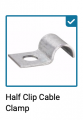
It seems to me that essentially a small "U" strap around 8.7 mm ID and some thermally conductive / electrically non-conductive "potting" compound would do the trick. Heat sink grease should work too, but, I can't really "encapsulate" the diode with it.
It also "seems" to me that I might be able to use 2 diodes in parallel, as any "unbalancing" due to variance in Vf of the two diodes in parallel, in this type operation, is swamped by the high voltage into the load itself. (I think?)
Has anyone tried anything like this? I think I can bend / fabricate a pretty good U-clamp out of soft aluminum or copper material I have on hand in small amounts. However, an easier solution if inexpensive is good too.
Thanks!
Edit: I just looked at thermal potting compounds (epoxies) on Amazon. Yikes!!! And I thought car prices had really gone up since I dabbled in this stuff! Well, I don't need CPU grade cooling here. Heat sink grease @ mechanical contact surfaces would surely suffice, and I have some of that... somewhere...
However, with the diode in series and basically just hanging out in free air, the diode gets pretty hot, in said operation. I'd estimate about 190-195 deg. F. Ambient was about 25 deg. C. So, I'd like to heat sink the diode to the fairly heavy metal (steel) handi-box it will be in. Obviously I have to take care to avoid any shorts to the box!!
The diode measures about 8.5mm diameter: Slightly smaller than a TO-39, and a bit bigger than a TO-5. I was "sure" I'd find some sort of heat-sink-to-larger-heat-sink / metal enclosure on Amazon or eBay, but have not. I tried Mouser but didn't see anything right off the bat. Possibly my search was not defined well.
Are these diodes normally operated with little to no sinking? I can't see operating them at much over 1/3 their current rating, if so.
It seems to me that essentially a small "U" strap around 8.7 mm ID and some thermally conductive / electrically non-conductive "potting" compound would do the trick. Heat sink grease should work too, but, I can't really "encapsulate" the diode with it.
It also "seems" to me that I might be able to use 2 diodes in parallel, as any "unbalancing" due to variance in Vf of the two diodes in parallel, in this type operation, is swamped by the high voltage into the load itself. (I think?)
Has anyone tried anything like this? I think I can bend / fabricate a pretty good U-clamp out of soft aluminum or copper material I have on hand in small amounts. However, an easier solution if inexpensive is good too.
Thanks!
Edit: I just looked at thermal potting compounds (epoxies) on Amazon. Yikes!!! And I thought car prices had really gone up since I dabbled in this stuff! Well, I don't need CPU grade cooling here. Heat sink grease @ mechanical contact surfaces would surely suffice, and I have some of that... somewhere...
Last edited: