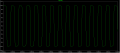
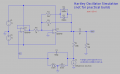
Hartely Oscillator Simulation for 225KHz

OBW0549

Joined Mar 2, 2015
3,566
I tried with multiple value but i was unable to increase the amplitude ?
Hard to say what might be limiting the amplitude. Try reducing the value of R1 to get stronger drive to your resonant circuit; that's all I can suggest.

Why frequency is about 10KHz less than calculated ?
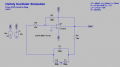
My guess would be that most of the error is due to your using an op amp which is WAY too slow for this job. The data sheet says the GBW of the LT1413 is only 950 kHz, so at 225 kHz its open-loop voltage gain is only about 4. I'd suggest using an op amp with a GBW of at least 5 MHz, preferably higher. You could try an LT1122, which has a 14 MHz GBW.
 

ronsimpson

Joined Oct 7, 2019
4,690
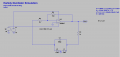
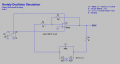
Added K statement to couple L1 & L2. Do not know if that helps.
Reduced supply voltage. Planning on using a faster amp and thought 30V was too much for a faster part.
Changed to high speed op-amp! (this is what got it going)
1593087707349.png
 

Attachments

Thread Starter

mishra87

Joined Jan 17, 2016
1,063
A quick note, on my way to work I have a hartley sim like this AD833. Had a series trim cap for fine adjust,
inductors were 5:1 ratio. it produced a stable sinewave. you must be very close, need to simulate yours when I get time.
Thanks,
Waiting if you can upload simulation file.
 

LvW

Joined Jun 13, 2013
2,026
So many people commented but this topic still lying without any logical ending !
Thanks !!
Two questions:
* Did you perform a loop gain analysis which can show how you have fulfilled the oscillation criterion (unity loop gain, phase shift at this point, excess gain at zero deg) ? Loop gain should look like a classical 3rd-order high-pass function (Butterworth response (no visible gain peaking)
* Did you check the slew rate of the opamp used? Very often it is the limited slew rate which is responsible for these observations. (a "faster" opamp has a larger small signal bandwidth, which has nothing to do with the large-signal behaviour like slew rate)
 
Last edited:

GeBJT

Joined Nov 3, 2020
19
So many people commented but this topic still lying without any logical ending !
Here is my proposal for answering your two questions in post#1. 6 months is a long time - I hope that you remain interested!
Many thanks to several others for their earlier contributions to this post providing suggestions and guidance.

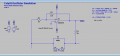
Please refer to HARTLEY224.png attached.
HARTLEY224.png


Q1: "I tried with multiple value but i was unable to increase the amplitude ?"
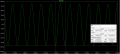
I think the problem is clipping at the op-amp supply voltages, due to uncontrolled increase of oscillation amplitude. I have added a non-linear gain R2, D1, D2. This provides a smooth (low distortion) sine wave at amplitude 1.8V.
At low amplitudes, op-amp U1 has more gain than is required for oscillation. As the amplitude increases above about one volt, the gain decreases to the exact level required to maintain constant amplitude oscillation.

Q2: "Why frequency is about 10KHz less than calculated ?"
The difference between the actual frequency and that calculated for the 225kHz tank circuit (C1,L1,L2) is because of the Q-factor and loading.
R1 is one component controlling Q and in the circuit I have increased R1 from 1k to 100k. When the Q is low, unwanted phase shift is translated into significant frequency shift.
The series resistances of L1, L2 are also important in determining Q. Lower series resistance means higher Q and lower gain requirement for U2.
The high input impedance of U2 voltage follower ensures that the tank is lightly loaded, reducing unwanted phase shift.
As near as I can measure (using LTspice FFT), the circuit now oscillates at 224.5kHz.

Simulation and schematic notes for HARTLEY224.asc.
Note the V(out) amplitude profile from 0 to 15mS. At first there is an exponential amplitude increase, then convergence to a stable value.
Amplitude stabilises after simulated 15mS. If the kickstarter, current pulse I1, is not used then simulation start-up will be much longer or might never happen.
Supply voltages are +/- 5V, within the maximum 12V of the AD8040 datasheet.
If a K statement (transformer mutual inductance M) is used, effective inductance L1+L2 is increased by 2M.
I have not assessed the simulation schematic for practical use (real build). For example (i) commercial tank components C1,L1,L2 will have tolerances well outside the accuracy of the simulation; (ii) unless they are hand made, L1 and L2 at 0.5mH will have unpredictable parasitic capacitance; (iii) real build mutual inductance between L1 and L2 will be difficult to predict.
 

Attachments

Top