Hall Effect circuitry to center V swing on zero V

Thread Starter

laruetou2

Joined Mar 9, 2022
14
I hope to use a Hall effect sensor were a variable reluctance sensor would be normally used. The ignition control module is expecting a sign wave that crosses 0 voltage and goes negative and then fires at that moment. Apparently the square wave of a Hall sensor can be easily centered on 0 voltage with minimal circuitry. Below is a simple schematic that was originally suggested by #12 and then drawn by WBahn. The input voltage to the Hall sensor would be 12V.

I know very little about circuitry. Could someone put some values on the capacitor and the resistor that would come near centering the swings on 0V (about 6V+ and 6V- range).
Thanks,
Larry
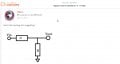
Square wave 0-10volts to -5 +5 volts _ All About Circuits.jpg
 

Ian0

Joined Aug 7, 2020
13,098
Does it work as it is?
My logic is that the vehicle has no negative supply, so the output of the reluctance sensor might be capacitively coupled, so the capacitive coupling would also remove the DC offset from the Hall effect sensor.
 

Papabravo

Joined Feb 24, 2006
22,058
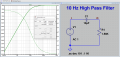
If you are hoping that there is a unique solution to your problem, you should get used to disappointment. The way to think about what that circuit is doing is to think about the frequency of the input signal. For DC and low frequencies, the output will be very small. Above a certain frequency, called the corner frequency, the output amplitude will be almost equal to the input. At the corner frequency the output amplitude will be about 71% of the input amplitude. This circuit is known as a "first order high-pass filter".

For any choice you make for the corner frequency you can choose either component value arbitrarily. Given those two choices the remaining component value can be computed. Since resistors have more precise values than capacitors, the value of the capacitor is chosen from a list of standard values and the resistor value is computed. From that computed value the closest standard value is chosen.

The corner frequency is given by the following expression:

\( f_0\;=\;\cfrac{1}{2\pi RC} \)

Suppose we choose 10 Hz. for our corner frequency, and we just happen to have some 10 μF capacitors in our parts kit. A bit of algebra allows us to write:

\( R\;=\;\cfrac{1}{2\pi C f_0}\;=\;(2\pi \cdot 10\mu \text F\cdot 10 \text{Hz})^{-1}\;=\;1591.5\Omega \)

The closest 1% resistor value would be 1580Ω, or 1.58 KΩ

Here is a frequency domain plot of the magnitude and phase response

1646918744523.png

You may find the following article relevent
https://en.wikipedia.org/wiki/High-pass_filter
 
Last edited:

AnalogKid

Joined Aug 1, 2013
12,055
Both the output impedance of the sensor and the input impedance of the control module affect the performance (and component values) of the high pass filter circuit. Do you have any information about either impedance, a part number for the sensor, etc.?

ak
 

Papabravo

Joined Feb 24, 2006
22,058
Both the output impedance of the sensor and the input impedance of the control module affect the performance (and component values) of the high pass filter circuit. Do you have any information about either impedance, a part number for the sensor, etc.?

ak
Good point. If we know those impedances, we can add them to the simulation. They will affect the results.
In the simulation above (post #3) there is zero source impedance and infinite load impedance. This is an "ideal" situation that could never happen in practice.
 

Thread Starter

laruetou2

Joined Mar 9, 2022
14
Thanks for the replies. I will spend some time today and try to decide on a physical form factor that can be fitted into my space limitations and then report back the specs.
Larry
 

eetech00

Joined Jun 8, 2013
4,704
I hope to use a Hall effect sensor were a variable reluctance sensor would be normally used. The ignition control module is expecting a sign wave that crosses 0 voltage and goes negative and then fires at that moment. Apparently the square wave of a Hall sensor can be easily centered on 0 voltage with minimal circuitry.
Doesn't the hall sensor already provide a bipolar output? Like a hall bipolar switch?
 

Thread Starter

laruetou2

Joined Mar 9, 2022
14
As said early on, I don't know much about circuitry. That said, it is my understanding that an ordinary Hall sensor (the output signal) generally has the same amplitude as the input voltage and varies between that amplitude and zero voltage. Please tell me more about a hall bipolar switch.

Here is an excerpt from a signal generator discussion at this address: http://www.bgsoflex.com/mjl/mjl_edis_stim.html
"One thing to note is that the output of the PWM port is a squarewave (0 to 5 volt), not a sinewave. Also, the signal is unipolar - the VR sensor signal (I think it was meant to say the EDIS ignition module) requires a negative voltage swing thru zero in order to trigger. But, one can use two resistors (R1 and R2) to create a DC bias of 2.5 volts, and this is presented on the other VR input, such that the square wave now has a +/- 2.5 volt swing. And, the EDIS module does not care that the signal is a squarewave (instead of a sine wave) - as long as it passes thru zero and has the proper cadance of "teeth" it will trigger all day long."

Thanks,
Larry
 

eetech00

Joined Jun 8, 2013
4,704
As said early on, I don't know much about circuitry. That said, it is my understanding that an ordinary Hall sensor (the output signal) generally has the same amplitude as the input voltage and varies between that amplitude and zero voltage. Please tell me more about a hall bipolar switch.

Here is an excerpt from a signal generator discussion at this address: http://www.bgsoflex.com/mjl/mjl_edis_stim.html
"One thing to note is that the output of the PWM port is a squarewave (0 to 5 volt), not a sinewave. Also, the signal is unipolar - the VR sensor signal (I think it was meant to say the EDIS ignition module) requires a negative voltage swing thru zero in order to trigger. But, one can use two resistors (R1 and R2) to create a DC bias of 2.5 volts, and this is presented on the other VR input, such that the square wave now has a +/- 2.5 volt swing. And, the EDIS module does not care that the signal is a squarewave (instead of a sine wave) - as long as it passes thru zero and has the proper cadance of "teeth" it will trigger all day long."

Thanks,
Larry
Yes...but if your going thru the trouble of replacing a device that generates a bipolar output (a VR sensor) then why not replace it with a hall sensor that also generates a bipolar output to help interfacing to the existing circuits?

Take a look at the Hall sensor reference docs at Allegro Micro.
Here is a sample bipolar switch:
https://www.allegromicro.com/en/pro.../hall-effect-latches-bipolar-switches/a1202-3
 

Thread Starter

laruetou2

Joined Mar 9, 2022
14
I would love to find an existing bipolar Hall sensor that was suitable for the application. That said, it will need to be "back-biased." Here is an excerpt:
"The Hall sensors used in automotive position sensing are usually a type called "back-biased" or simply biased Hall. Rather than reading magnets going by ("flying magnets"), they have one strong magnet behind the sensor, and the Hall element reads the distortion of the magnetic field when something ferromagnetic passes in-front of it."

I'm assuming that the vast majority, if not all, bipolar Hall sensors require magnets (they are not biased)?

Thanks,
Larry
 

eetech00

Joined Jun 8, 2013
4,704
I would love to find an existing bipolar Hall sensor that was suitable for the application. That said, it will need to be "back-biased." Here is an excerpt:
"The Hall sensors used in automotive position sensing are usually a type called "back-biased" or simply biased Hall. Rather than reading magnets going by ("flying magnets"), they have one strong magnet behind the sensor, and the Hall element reads the distortion of the magnetic field when something ferromagnetic passes in-front of it."

I'm assuming that the vast majority, if not all, bipolar Hall sensors require magnets (they are not biased)?

Thanks,
Larry
Yours is detecting speed of rotation right? Look at automotive hall "speed sensors" applications.
 

Thread Starter

laruetou2

Joined Mar 9, 2022
14
Yep, automotive Hall sensors (almost all "biased") is exactly what I'm looking at - generally 3 wire as opposed to 2 wire. The Hall sensor is powered and the VRS is not.

Going for a long hike tomorrow so likely off the air for a couple of days.

Thanks to all that have posted. We'll figure this out.
Larry
 

shortbus

Joined Sep 30, 2009
10,050
Yours is detecting speed of rotation right?
It looks to be on a crankshaft position arrangement. One that uses a 36-1 tone wheel, the -1 position is usually the TDC of cylinder #1. didn't look deeper to find out how they are signaling when to fire the coils without using a cam sensor though, which the Wikipedia says Ford doesn't use for this type of ignition.
 

Thread Starter

laruetou2

Joined Mar 9, 2022
14
The cam sensor is not needed because it is a wasted spark system. For a 4 cylinder, the EDIS4 module fires either side of a 2 sided coil pack. (The EDIS6 works with a pack that has 3 coils and the EDIS8 works with two 4 cylinder coil packs.) Each side of the coil pack has two spark plug connections and the cylinders those two leads go to are 180* different in the firing order. Therefore you get a spark on the compression stroke on one of the cylinders (that's what makes the engine run) and you get a harmless and pointless spark on the exhaust stroke on the other cylinder. Hence the "wasted spark" nomenclature. Example: if the firing order is 1-3-4-2, then 1 and 4 are on one side of the coil pack (on the same coil in the coil pack) and 3 and 2 cylinders are on the other coil in the coil pack.
Larry
 

shortbus

Joined Sep 30, 2009
10,050
I understand well the wasted spark system, I own a couple of old Harley's. And have worked on GM engines that also did use the 2 cylinder per coil system. But they also used cam sensors, mostly to do spark advance and retard duties. I don't see how Ford got around that part using only a crank trigger.

Why not just adapt the Ford module to your engine? And I think again from what GM does and I assume all other cars with a ECM do, that the hall sensor is expecting 5V not the full battery voltage, the 5V is generated within the ECM.
 

Thread Starter

laruetou2

Joined Mar 9, 2022
14
I feel comfortable in asserting that the wasted spark system eliminates the necessity of the camshaft sensor. But developing information on the subtleties of different ignition systems is not the thrust of this thread.

There are aftermarket ECMs that are good candidates. Megajolt is the prominent choice in that it is designed to work with the EDIS module (4, 6 or 8 cylinder). But it doesn't connect up with a sensor - it lets the EDIS module communicate with the sensors. The EDIS module is expecting a signal from a VRS, the voltage for which, can become quite variable (<1 to 50+ volts) depending on rpms. I think the voltage is pretty much irrelevant - 5V or 12V - either can work.

I'm interested in the Hall effect sensor because I think it results in somewhat more of a precise signal (square wave). When it goes from high (5V or 12V) to low (0V), its vertical. The sine wave, going from high to low (which is negative), can vary in its slope on the decline. Again, I'm why out of my comfort zone - I don't know much about circuitry. I'm just trying to cobble together a trigger wheel and sensor that will make the EDIS module and the Megajolt ECM work properly. The trigger wheel that I am required to work with is somewhat different than what Ford used. I'm trying to compensate for that with a better sensor. Maybe it will never work?

Thanks for posting.
Larry
 

shortbus

Joined Sep 30, 2009
10,050
Maybe it will never work?
I think your on your way to that goal.
I'm thinking now the sine wave that the Ford trigger set up uses controls the spark advance. You don't seem to want or think you need spark advance so I don't know anything to help you. I live in a real world of car and bike performance not in my imagination of how things work.
 

Thread Starter

laruetou2

Joined Mar 9, 2022
14
The project is for an aircraft engine. Historically, they run on magnetos with static timing, typically 25* BTDC for ignition. My project aspires to create a system that is no worse than the magneto with regard to a static advance and much better than a magneto when it comes to reliability and the robust nature of the spark. Aircraft spark plugs are gapped at .017" because of the energy limitations of the magneto. The automobile that the wasted spark components are from specify a .054 to .060 spark plug gap - much more robust. Looking to achieve better starting, better idling, better leaning of the air/fuel mixture, better everything if I add the Megajolt ECM (which is not all that expensive) for variable timing.
Larry
 

shortbus

Joined Sep 30, 2009
10,050
The project is for an aircraft engine
I hope your doing this for a ground display not in a real plane. Not sure where your from but doesn't your country do an air worthiness inspection? I'm doubting your mods would pass. Have you even posted to one of the Megajolt forums if they work without the EDIS?
 

geekoftheweek

Joined Oct 6, 2013
1,429
The sine wave, going from high to low (which is negative), can vary in its slope on the decline.
True, but it will always cross zero at the same sensor alignment every time. That is what is actually detected and the slope doesn't make a difference.

I don't see how Ford got around that part using only a crank trigger.
You could calculate the cam position from the crank sensor if you really wanted, but it could also be 180 degrees off. It would work with a wasted spark system, but not the fuel injectors.

Edit...

Actually it would work for the injectors also. My 88 2.3 Ranger had the opposing injectors firing at the same time.
 
Last edited:
Top