Facebook
 Google
 GitHub
 Linkedin
This site has proved to be an incredible resource for an ME trying to do EE things. I have been able to search and find most of my answers I have needed thus far but now I am a bit stuck and looking for some help if possible. I have found a few threads similar to what I am looking for but I don't think they are exactly the same based on the results I have been getting.
The engine is a 4BT Cummins and I built the engine wiring harness I am using around a 5v sensor/ground bus with my assumption that the datalogger I am using, OneGauge (Arduino based) would require a 5v square wave signal from the crank position sensor but I was wrong. It needs a 12v square wave signal (minimum of 7v or so to drive the isolator from talking with them). I do not have spare pins in my firewall plug, nor do I want to tear apart my harness to send 12v and the separate ground to the sensor.
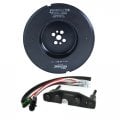
Initially I was using the factory dodge sensor (Cummins 392442) but I couldn't get it to function properly with the hub. This could be because I had it wired wrong or a fried something in the sensor. It seemed to do what I wanted to when I bench tested it, but then when I installed it, it didn't work like it was on the bench. The balancer I am using is shown below and you can see that it is essentially the opposite of most toothed wheels in terms of geometry. 5000rpm is max so that should be 167hz at max.
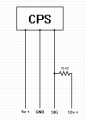
Using a resistor to pullup the signal to 5v seemed to work, so I thought maybe I could pull output signal up to 12v and wired it like below. It seemed to work fine on the bench for me but didn't work when installed.
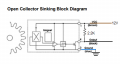
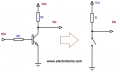
I gave up with the factory sensor and picked up a GS100701 hall effect gear tooth sensor datasheet as that is one that OneGauge has used with good success in the past. My initial thought for converting the 5v to a 12v was just to use a transistor like a switch and then have the output of the sensor connected to the base acting as the trigger. I did some research for using a transistor as a switch and found this.
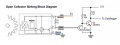
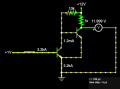
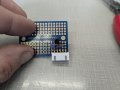
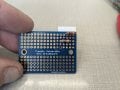
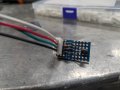
What I ended up with looked like this and again seemed to work on the bench. The pullup resistor to get the sensor to output 5v was external from this little module this time. Rb was a 1kohm, Rc was 10k IIRC. In the picture below, black is ground, green is the signal coming from the sensor (Vin), red is 12v+ (Vcc) and white is the "signal" going out to the data logger (Vo). I don't have the exact part number of the transistor I used offhand and I forgot to grab the little module today but I can check tonight if having the exact parts I used would be beneficial.
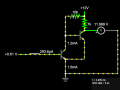
I assumed I had something messed up with the design with a transistor being current controlled so I switched to a Mosfet since they are voltage controlled, and put this together:
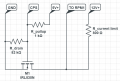
This seems to work, but it gets considerably hotter than I was expecting. Thinking more about it, my current limiting resistor might be a 400ohm one (I just used components I had available at work) which would be about a 1/2watt of power and I am pretty sure that is a 1/4w resistor I used. I am not 100% sure if the data logger is reading the signal properly because with this setup it essentially gets 2 ground pulses per revolution as it outputs 12v when near metal and 0v (ish) volts when at the gap. I bought a laser tachometer to check what the actual idle speed is so I can compare it to what my gauge is reading as well.
Am I just way overcomplicating this or is there a simpler way to use the square wave output of my hall effect sensor to send a 12v square wave to my datalogger? Any and all help is greatly appreciated because I know there are a lot of people on here that are WAY smarter than I am. Happy to give more information and whatnot too if needbe.
The engine is a 4BT Cummins and I built the engine wiring harness I am using around a 5v sensor/ground bus with my assumption that the datalogger I am using, OneGauge (Arduino based) would require a 5v square wave signal from the crank position sensor but I was wrong. It needs a 12v square wave signal (minimum of 7v or so to drive the isolator from talking with them). I do not have spare pins in my firewall plug, nor do I want to tear apart my harness to send 12v and the separate ground to the sensor.
Initially I was using the factory dodge sensor (Cummins 392442) but I couldn't get it to function properly with the hub. This could be because I had it wired wrong or a fried something in the sensor. It seemed to do what I wanted to when I bench tested it, but then when I installed it, it didn't work like it was on the bench. The balancer I am using is shown below and you can see that it is essentially the opposite of most toothed wheels in terms of geometry. 5000rpm is max so that should be 167hz at max.
Using a resistor to pullup the signal to 5v seemed to work, so I thought maybe I could pull output signal up to 12v and wired it like below. It seemed to work fine on the bench for me but didn't work when installed.
I gave up with the factory sensor and picked up a GS100701 hall effect gear tooth sensor datasheet as that is one that OneGauge has used with good success in the past. My initial thought for converting the 5v to a 12v was just to use a transistor like a switch and then have the output of the sensor connected to the base acting as the trigger. I did some research for using a transistor as a switch and found this.
What I ended up with looked like this and again seemed to work on the bench. The pullup resistor to get the sensor to output 5v was external from this little module this time. Rb was a 1kohm, Rc was 10k IIRC. In the picture below, black is ground, green is the signal coming from the sensor (Vin), red is 12v+ (Vcc) and white is the "signal" going out to the data logger (Vo). I don't have the exact part number of the transistor I used offhand and I forgot to grab the little module today but I can check tonight if having the exact parts I used would be beneficial.
I assumed I had something messed up with the design with a transistor being current controlled so I switched to a Mosfet since they are voltage controlled, and put this together:
This seems to work, but it gets considerably hotter than I was expecting. Thinking more about it, my current limiting resistor might be a 400ohm one (I just used components I had available at work) which would be about a 1/2watt of power and I am pretty sure that is a 1/4w resistor I used. I am not 100% sure if the data logger is reading the signal properly because with this setup it essentially gets 2 ground pulses per revolution as it outputs 12v when near metal and 0v (ish) volts when at the gap. I bought a laser tachometer to check what the actual idle speed is so I can compare it to what my gauge is reading as well.
Am I just way overcomplicating this or is there a simpler way to use the square wave output of my hall effect sensor to send a 12v square wave to my datalogger? Any and all help is greatly appreciated because I know there are a lot of people on here that are WAY smarter than I am. Happy to give more information and whatnot too if needbe.
Last edited by a moderator: