Ahh, not really. There is no gate voltage to those totem pole mosfets in the driver when they are off. Doesn't that make the driven mosfet "floating"?Thanks, shortbus. But the ir2104 already does that.
The way I understand it, is that it's the gate to source voltage that triggers the fet. The high-side of the driver already shuts down the fet by linking the gate to the source through an internal n-fet. Look at the diagram in post #151Ahh, not really. There is no gate voltage to those totem pole mosfets in the driver when they are off. Doesn't that make the driven mosfet "floating"?
I think you could probably go as high as 100 ohms, but maybe try 51 and see if it gets better.This is the fet I'm currently using. Do you think raising the gate's resistor could help?
Not at this moment. I'm using two different wall warts, one set at 12V for the drivers, and the other one at 12V too, but only for feeding the 7805.Are you making the 5 volts from the 12 volt supply to the drivers? 7805?
Nope... on the same board...Where does your high power and low power ground get tied together? On the other board?
It's time to draw a new schematic... first thing in the morning... nighty night, and thanks againEdit:
And the low power comes back thru the ribbon cable?
I have those too... but I was thinking about the 1n4004URF because they're of the fast type... or is that unimportant in this case?Those D2 are a little light at 1amp.
I am using BY399's.
Max.
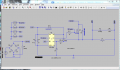
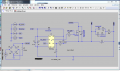
Can you post the .asc file?Ok... this is what I've got on my PCB at this moment:
I added a snubber to the motor using C1 and R3. For this purpose I used a couple of 1k@2W resistors that I had laying around, and connected them in parallel. Those in turn are connected in series with two 0.22uF@250V polyester caps that are also connected in parallel.
This last change has improved things noticeably. It's not perfect yet, but looks promising.
Right now the RC snubber is connected on the PCB, but I'll be moving it soon and connect it right on the motor's wires, as close to the motor as possible. That should also make a difference.
My plan now is use a couple of 1uF@350V electrolytic caps that I also have in store, and connect them in series with a couple of diodes, like this:
The diodes are there to protect the caps from reverse voltage. Do you think that would work?
Yes I did. I installed 47Ω and then 100Ω resistors at the fet's gate and it made absolutely no difference.Can you post the .asc file?
I'm with Max. If it's a 3 amp motor the 4000 series diodes probably won't be to happy.
Did you try slowing down the FETs?
This is exactly why you should allways have a resistor between source and gate right next to the fet. It might be unnecessary most of the time, but when things like that happen it can save your butt.... the 10 ohm SMT resistors at the fet's gates had burned out too, and so the fet's gates were left floating when I switched it on ... with catastrophic results.... again...
I know you probably don't want to hear this, and I must admit it's for my own curiosity, but would you get the same results with a .1Ufd. ceramic across the motor? No resistor.It finally works!!!!
I've finally completely stabilized the circuit! ...
There were two factors affecting it:
- EMI through brush commutation. This was minimized by placing an RC-diode filter, as shown in post #170. The values I used was R = 330Ω @ 3W, C = 3 µF @ 350V, diode #1N5400.
- And just as important (if not more) I'm using 715Ω resistors to drive the Fet's gates. I performed a lot of tests using values between 10Ω and 470Ω before finally stopping at 715Ω and making sure that no MCU spurious resets were happening. This high resistor impedance forces the Fet to "ramp-up" the current during switching, instead of allowing it to abruptly flow into the motor. And this apparently results in much less EMI noise.
Maybe a resistor that high at a fet's gate could cause some problems. And the first that comes to mind is that the Fet might heat up considerably. But I have tested it many times for a prolonged period of time and the fet barely warms up. And this is with no heat sink installed! ... but of course I'm going to install a pretty good heat sink on each fet anyway.
Now I'm going to install the other three Fets, and the second ir2104, to test it working in both directions. I'll get back later with the results.