H Bridge drive

Thread Starter

bdrmachine

Joined Jan 26, 2010
31
I am struggling with the design of a H bridge for driving a 36v 6amp brushed dc motor. Basically all I need is to turn the motor on for 45 seconds an hour, reversing direction every other time. I have seen a lot of online examples of various mosfet drivers controlling a Pmos / Nmos bridge but, the controlled voltage is below 20 volts (less than Vgs max). My understanding of any circuit that uses a bootstrap cap to drive a nmos high side would need a really large cap to supply drive for that long. I would like to use IRF4905 pmos transistors for the high side and IRLB3036 nmos for the low side as I have them on hand. How do I drive the gates without worrying about exceeding the Vgs max voltage, especially on the high side.
 
Last edited:

crutschow

Joined Mar 14, 2008
38,435
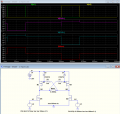
Below is the sim of a simple H-Bridge circuit that may work for you.
The Zener diodes, D1 and D2, clamp Vgs of the P-MOSFETs at 12V max (purple and blue traces).
(Note: To avoid significant MOSFET shoot-through currents, one signal must be off for a few microseconds before the other is turned on.
That will not be a problem in this application).

What signals will be controlling the bridge?

1686688959225.png
 
Last edited:

Thread Starter

bdrmachine

Joined Jan 26, 2010
31
Below is the sim of a simple H-Bridge circuit that may work for you.
The Zener diodes, D1 and D2, clamp Vgs of the P-MOSFETs at 12V max (purple and blue traces).
(Note: To avoid significant MOSFET shoot-through currents, one signal must be off for a few microseconds before the other is turned on.
That will not be a problem in this application).

What signals will be controlling the bridge?

View attachment 296382
The driving circuit is a esp32-s3 so 3.3 logic drive. I will of coarse have to level shift that up to 10V. Your circuit suggestions should solve the Vgs max issue on the hi side. I have 18v zeners on hand which are 2 volts lower than Vgs max, or do you think that is cutting it a little close?


Thanks Much.
 
Last edited:

crutschow

Joined Mar 14, 2008
38,435
I have 18v zeners on hand which are 2 volts lower than Vgs max, or do you think that is cutting it a little close?
Yes.
That's a little too high for my taste, especially if you add in the tolerance of the Zener breakdown voltage (likely ±5%), as any small spike could exceed the maximum and damage the gate insulating oxide layer.

Also there's no reason to go beyond 10V to fully turn on the MOSFET.

Safer to go with a 10-12V Zener.
 
Last edited:

dendad

Joined Feb 20, 2016
4,636
Another way is to use a single PWM driven FET for the speed control, and a DPDT relay to reverse the motor.
That may well be the cheaper way to go and would work quite well as the motor is only in use for a short time so the extra power used by the relay will not matter.
 

dendad

Joined Feb 20, 2016
4,636
I see no mention by the TS about speed control for the motor, just ON, OFF, and Reverse.
It is often a good idea to use PWM to accelerate and decelerate a motor, but even so, if speed control is not needed, the single FET for motor control and a relay used for direction is still valid. If speed control is not needed, a couple of SPDT relays can be used to give motor on/off and direction.1686728413998.jpeg
Something like this.
 
Last edited:

Thread Starter

bdrmachine

Joined Jan 26, 2010
31
The application is motor full on or off. This circuit is to replace a solar panel sun tracking control that the manufacturer thinks is worth over $2000. It was originally constructed as Dendad quoted, 1 relay for direction and fet for switching. It was a stupid control that only turned the motor on 44 seconds per half hour. I have since fitted the motors with encoders and use the open source spa.c algorithm. I do most definitely, appreciate all of your inputs.

Thanks
Again
 

Ian0

Joined Aug 7, 2020
13,126
You can buy a lot of solar panels for $2000 - more than enough to replace the power you would have gained from having them track the sun.
 

Thread Starter

bdrmachine

Joined Jan 26, 2010
31
You can buy a lot of solar panels for $2000 - more than enough to replace the power you would have gained from having them track the sun.
For sure. Tracking only gains 40%. This is for an existing install and, little room for more panels. I should be able to build 1 for around $100
 
Top