Guitar volume potentiometer advice?

Thread Starter

Zesty feline

Joined Jul 9, 2017
6
Hey everyone I play the electric guitar and am seeking advice for my volume pot, getting straight to the point, guitars for the most part use passive circuitry to alter voltage created from magnetic pickups, a major part of this circuitry is the volume potentiometer which controls the signal output of the pickups on their way to the amp.

What is common practice in the guitar world is to run our amps to sound distorted to rock out and then we clean up the amps sound with our guitars volume control in order to play lighter chords/strumming etc, (and not have to run back to adjust the amp live)

A big problem however is the guitars potentiometers alter the signal and tone coming from the guitar, removing high frequencies and creating a muddy undesirable sound the more we "clean up" our tone, they have invented "fixes" such as a treble bleed capacitor which is placed across the volume pot's input/output lungs and bleeds high frequencies into the signal when the volume pot is turned down in order to compensate, however this only captures minimal frequencies and although better than a standard pot, many including myself say it does sound thin at times.

Therefore I have come here to try and work out a way to have my guitar volume control retain it's frequency response through it's turn in order to have a cleaned up amp and the same full frequency response of a wide open potentiometer, some have said a buffered circuit could fix the issue but this would mean placing a 9v battery onboard, which is undesirable yet may be the only option.

I am by no means an electrical engineer, I can do basic soldering and can barely read electrical diagrams, can you help me?
 

Alec_t

Joined Sep 17, 2013
15,105
A buffer amplifier is what you need. It may be possible to use a 'phantom' power supply for it, so that the 9V battery (or whatever) is located at the main amp and not on the guitar.
 

Alec_t

Joined Sep 17, 2013
15,105
A big problem however is the guitars potentiometers alter the signal and tone coming from the guitar, removing high frequencies
Isn't that their intended function (crude tone control)?
Do you have a schematic of your guitar, showing the wiring and values of volume and tone controls?
 

#12

Joined Nov 30, 2010
18,224
Some information about one here...
I call B.S. That one still has a 250k pot for the output.

Been there, done that. I figured out how to put a FET preamp inside the 1/4 inch connector on the end of the cord and power it from the amplifier end, but I'm not going to hand that over in public.

What I can tell you is that the problem is in the interaction of the volume pot and the capacitance of the cord. You still need those hundreds of k ohms to avoid loading down the pickups but you need about a 600 ohm impedance to drive the cord. The best way to do that is a j-fet, and that wants a battery. The P-P output of a Les Paul, doing a hammered power chord, is 6 volts. A 9V battery can drive a j-fet as a source follower at 2&2/3 milliamps for 165 hours under those conditions. Use a 1500 ohm source resistor with 4 volts DC across it and you can drive 50 feet of good guitar cord. By good, I mean 18 pf per foot. Lesser quality, you can probably drive 30 feet of cord. You can get a j-fet input impedance up to above 500k and an output impedance of 600 ohms.

The Rangemaster is the closest commercial version I know of, but it still sucks compared to a j-fet because it has a 68k input impedance and 10K output pot and you need to get to 1500 ohms. Besides, they are hard to find, but you can build one.
http://fuzzcentral.ssguitar.com/rangemaster.php

ps, you can get an FM transmitter and that pretty much ends the cord capacitance problem.
pss. You just figured out you don't have to explain guitars to electronics nerds.:D
 

Attachments

Last edited:

MrChips

Joined Oct 2, 2009
34,630
#12 has it right. There is impedance mismatch from the guitar pickup to the cable to the amp input.
Put a preamp in the guitar to better match the impedances.
Better yet, put a DSP in the guitar and you can take care of all the noise, hum, and add all the effects you want to boot.
 

#12

Joined Nov 30, 2010
18,224
There is impedance mismatch from the guitar pickup to the cable to the amp input.
Even electronics nerds sometimes overlook the mismatch at audio frequencies, but I'll be darned, put a few hundred K in series with a few hundred pf and you're in the audio range!
 

Alec_t

Joined Sep 17, 2013
15,105
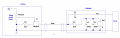
Here's a suggested j-FET buffer circuit, with a phantom power supply.
GuitarBufferAmp.PNG
Only two components are needed at the guitar end; R1 and J1. As #12 said, these can be housed inside the jack if you like (but you will then have to make sure your cable is plugged in the right way round!).
The circuit should give a flat response over the frequency range 10Hz-20kHz, for lead capacitance up to at least 1500pF and working into an amp with ~60k or more input impedance.
Current consumption is about 0.8mA.
C2 and C3 are arguably unnecessary, so try without.
 
Last edited:

Thread Starter

Zesty feline

Joined Jul 9, 2017
6
Okay everyone sorry I haven't replied as of yet, I have been busy doing my own research based on your responses and as much as I appreciate your solutions I found something that more or less does not require anything on the guitars side, two things, I dislike wearing an external buffer and I also dislike modifying my guitar..

This guy actually has a product on the market now that removes cable capacitance from a standard guitar cable, entirely from the AMP side, meaning you don't need to modify your guitar or cable or amp, it's basically in the form of an effect pedal placed before your amp, it is primarily aimed at pedalboards yet claims to also work without pedals and remove capacitance on "active" mode, their is also a coil in it that reacts like a guitar pickup (not in use when in active mode) so that feature I would never really use especially since I don't use pedals.

It's called TheGigRig Z Cable and currently sold out! http://www.thegigrig.com/z-cable-c2x17959854

Could we actually work out how to make our own version? going by it's already "niche" level retail price surely nothing state of the art is in that box?
 

blocco a spirale

Joined Jun 18, 2008
1,546
I dislike wearing an external buffer and I also dislike modifying my guitar..
You can build Alec_t's circuit into a guitar lead without having to modify the guitar or amp or requiring a bulky box at the amp end; And this addresses the cable capacitance issue at the source (rather than compensating for losses after the event)... and it's cheap.
 
Last edited:

#12

Joined Nov 30, 2010
18,224
make sure your cable is plugged in the right way round!
Colored shrink tubing makes a good marker.
you don't need to modify your guitar or cable
I call B.S.
"The special triple wire differential cable comes in four lengths"
If a $75, 3 wire cable isn't modifying your $20, 2 wire cable, I don't know what is.
Is this "not a modification" because it doesn't plug into the guitar?

The whole thing is marketing baloney. You can do what he claims with a driven shield if you're going to alter the cable to 3 wires, and no fiddling around with knobs or inductors. A driven shield would be dead perfect, right out of the box, for all guitars and cord lengths. I wouldn't bother to design of copy that z-rig unless I had a marketing writer on my team.
 

Thread Starter

Zesty feline

Joined Jul 9, 2017
6
You can build Alec_t's circuit into a guitar lead without having to modify the guitar or amp or requiring a bulky box at the amp end; And this addresses the cable capacitance issue at the source (rather than compensating for losses after the event)... and it's cheap.
Firstly guys I am with you on that idea! stuff being a slave to marketing from not having basic circuit knowledge! if this is true then thanks Alec_t, + kudos for your edit.

Colored shrink tubing makes a good marker.

I call B.S.
"The special triple wire differential cable comes in four lengths"
If a $75, 3 wire cable isn't modifying your $20, 2 wire cable, I don't know what is.
Is this "not a modification" because it doesn't plug into the guitar?

The whole thing is marketing baloney. You can do what he claims with a driven shield if you're going to alter the cable to 3 wires, and no fiddling around with knobs or inductors. A driven shield would be dead perfect, right out of the box, for all guitars and cord lengths. I wouldn't bother to design of copy that z-rig unless I had a marketing writer on my team.
I'm hearing ya' and truth be told at the end of the day I don't usually mess around with guitar gear, for the most part, my "rig" consists of a guitar, a cable and an amp, there is nothing wrong with the guitar, nothing wrong with the amp, but their is something (more or less) "undesirable" about the cable affecting the volume knob so I reckon it's worth making a special one.

So how should I wire it up? perhaps a non electrical style sketch would be easier for me to understand, I can buy cable, jacks, caps and solder I just need to know what goes where, any of you guys play much? I'd be making one for myself too.
 

Alec_t

Joined Sep 17, 2013
15,105
So how should I wire it up?
Depends on your skills and eyesight :). If the components were all surface mount types (SMD) this could be made really small (apart fom the 9V battery). However, for a beginner it would be easier to use through-hole components.
You should be able to squeeze R1 and J1 into the jack plug at one end of a cable without too much difficulty. The other, passive, components could be assembled on a small strip of Veroboard and housed with the 9V battery in a robust project box.
Let's assume you chop the cable off about 30cm from the other end. The free end of the main section of cable would go into the box, be anchored there, and connect to the board's 'input'. The short length of cable would connect to the board's 'output', be anchored to the box, come out of the box and have a jack plug for the main amp.
I'll sketch out the physical layout.
 

ian field

Joined Oct 27, 2012
6,536
A buffer amplifier is what you need. It may be possible to use a 'phantom' power supply for it, so that the 9V battery (or whatever) is located at the main amp and not on the guitar.
Its a very tempting option, a single JFET buffer based on the DOD FET amp is an excellent starting point.

The output pot is a few k, which is much easier and cheaper to source.

If you put it in the guitar and connect it directly to the pickups; you don't need the gate bleed resistor - its a very small thing, but it does improve treble response.
 

Alec_t

Joined Sep 17, 2013
15,105
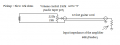
The jack plug could house R1 and J1 something like this :
PlugWiring.PNG
Make sure you identify the pinout of J1 correctly.

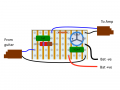
Here's a layout guide for the adapter part. It's not critical. Depending on the physical size of the components you source, you may be able to make the layout more compact than this example :
If you're new to Veroboard, the components go on the top of the board and their legs are soldered to the tracks on the underside of the board. In this pic, regard the board as transparent. Observe the correct polarity of the 100uF electrolytic cap if used. This cap should have a 16V rating or greater.
Adapter.png

Edit:
No on/off switch is needed. When the jack plug is disconnected from the guitar the current draw is zero (apart from the odd microamp of leakage :) ).
 
Last edited:

ian field

Joined Oct 27, 2012
6,536
The jack plug could house R1 and J1 something like this :
View attachment 130852
Make sure you identify the pinout of J1 correctly.

Here's a layout guide for the adapter part. It's not critical. Depending on the physical size of the components you source, you may be able to make the layout more compact than this example :
If you're new to Veroboard, the components go on the top of the board and their legs are soldered to the tracks on the underside of the board. In this pic, regard the board as transparent. Observe the correct polarity of the 100uF electrolytic cap if used. This cap should have a 16V rating or greater.
View attachment 130853

Edit:
No on/off switch is needed. When the jack plug is disconnected from the guitar the current draw is zero (apart from the odd microamp of leakage :) ).
There's a better way - fit a stereo jack in the guitar and ground the PP3 via the extra contact. the sleeve of a mono plug grounds the PP3 negative and completes the circuit. You get problems if someone put a stereo plug on the lead because they couldn't find a mono one, but you can wire the ring to ground if needs be.

There's no leakage at all because the stereo contact isn't touching anything with the plug removed. This is more or less common practice on FX boxes. Remove either plug and its switched off.
 

ian field

Joined Oct 27, 2012
6,536
Would most N-channel JFETs do or did you select the 2N3819 for specific parameters?
AFAIK: the 3819 is discontinued - but not completely impossible to find.

A good alternative is the J113 from NS - not to be confused with Asian 2SJ parts. Bought a bag of them from Farnell a few years back and never got around to doing much with them.
 

#12

Joined Nov 30, 2010
18,224
Any j-fet with Idss slightly higher than the minimum necessary will work, but they're nasty little buggers because you have to trim each one to the right current...unless you design a circuit which will set the proper voltage for any j-fet in a certain range. Nobody has offered that in public because it takes brains and parts, and nobody wants to sell a good circuit that always works exactly right, with two dozen parts, when they can get $259 for six parts and a switch.:mad:

Nobody's going to pay $1000 (Retail) for the ultimate tone amplifier when an FM transmitter on their belt will do the same job for half the price. That's why my design is not available in public. It's bleeping brilliant, but the economics of the market place will not support production line quantities.
 
Top