It explains where the misinformation comes from: guitar.comThere is a good explanation here
https://guitar.com/features/opinion...ifference-between-high-low-inputs-amplifiers/
Note that the low level input has a lower input impedance.
It explains where the misinformation comes from: guitar.comThere is a good explanation here
https://guitar.com/features/opinion...ifference-between-high-low-inputs-amplifiers/
Note that the low level input has a lower input impedance.
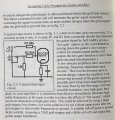
Here is an explanation from Blencowe’s book.It explains where the misinformation comes from: guitar.com
The clear diagram allows you to see exactly the resistances in the path of the signal.So transpose the 1M resistor so that it is between grid and ground and tell me how much difference it makes:@Ian0
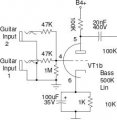
Note the different connection of the 1M resistor in the circuit we are discussing (post #29) and the one you just posted. What you have been saying is true for the circuit you posted, but not the on we have been discussing.
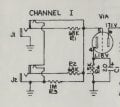
Please note he is not illustrating a valid guitar unbalanced input (except for J1 which is biased more), and the calculated gridstop for the circuit is about 180 ohms if I really wanted to put the gridstop in this circuit:Here is an explanation from Blencowe’s book.
View attachment 322642The clear diagram allows you to see exactly the resistances in the path of the signal.
a guitar plugged into J2 sees only 1MΩ, because J1’s grounding switch is open circuit.*
A guitar plugged into J1 sees two 68k resistors in series, because J2’s grounding switch shorts out the 1MΩ resistor.
It is not precisely the same circuit as your example as the 1M resistor is directly on the input, not between grid and ground, but the calculations are very similar.
I have found the circuit on Fender, Gibson, and Vox. Marshall uses a completely different circuit with a separate preamp high level input.
* In your circuit it sees 47k in series with the 1M.

Wrong on both points.Please note he is not illustrating a valid guitar unbalanced input (except for J1 which is biased more), and the calculated gridstop for the circuit is about 180 ohms if I really wanted to put the gridstop in this circuit:
View attachment 322700
Also, Please note on the high input in the illustration, is not a guitar input. Rather, its a DC coupled line input with attenuation.

That book is a bad book to reference from. Its some sort of DIY market book. Fig. 2.3 is what was called a 'combo input' where J1 would go to a guitar pickup and J2 would be used if a pedal board was plugged into it. Which is different than the dual input amp which I provided and your gibson combo has.Wrong on both points.
There’s a big clue in the title of the book Designing Valve Preamps for Guitar and Bass that it might possibly be a guitar input and not a line-level input, and also, it’s a more sensitive input with NO attenuation, so is expecting a signal in the realms of -48dBm. Where do you see attenuation?
I suppose this isn't an unbalanced guitar input either?
Nor is the J2 input for a guitar?
View attachment 322703
It's from a Gibson Guitar combo.
J2 of fig 2.3 is not a guitar input and the resistor branch is an attenuator (minus about 180 ohms of the 63K resistor).Where do you see attenuation?
I suppose this isn't an unbalanced guitar input either?
Have you read it?That book is a bad book to reference from. Its some sort of DIY market book.

The signal on GRID is 995.2mV, an attenuation of 0.04dB. The current from the signal source is 955.1nA, so the input inpedance is 1V/955.1nA=1.047MΩ.I never question the one I posted, because I know its correct.It beggars belief that I have to resort to SPICE to prove how a simple attenuator works, but here it is:
From the diagram in post #29.
With a 1V AC test signal connected to the "Guitar 2" input socket, the switch on the "Guitar 1" socket is closed and the switch on "Guitar 2" socket is open.
View attachment 322861
The signal at grid is 488.5mV (an attenuation of 6.2dB) and the current flowing from the signal is 10.88μA, so the input impedance is 1V/10.88μA = 91.9kΩ
With a 1V AC test signal connected to the "Guitar 1" input socket, the switch on the "Guitar 2" socket is closed and the switch on "Guitar 1" socket is open.
View attachment 322862The signal on GRID is 995.2mV, an attenuation of 0.04dB. The current from the signal source is 955.1nA, so the input inpedance is 1V/955.1nA=1.047MΩ.
Excellent. I am glad that you now agree that the impedances are 1.047MΩ and 91.9kΩ, and that one jack attenuates by 6dBI never question the one I posted, because I know its correct.
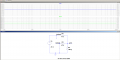
Here are the plots:The one in post #62 is incorrect. The one from " Blencowe’s book." J2 of fig 2.3
Attenuation is precisely zero, and input impedance is 1V/1uA = 1MΩ
Attenuation is 6dB and input impedance is 1V/7.353uA = 136kΩYou still don't understand the 1M means nothing for the dc coupled input impedance the pickup sees.Excellent. I am glad that you now agree that the impedances are 1.047MΩ and 91.9kΩ, and that one jack attenuates by 6dB
Here are the plots:
For the HI input:
View attachment 322937Attenuation is precisely zero, and input impedance is 1V/1uA = 1MΩ
For the LO input:
View attachment 322939Attenuation is 6dB and input impedance is 1V/7.353uA = 136kΩ
As 10% tolerance resistors would be the norm at the time these circuits were designed, then I consider them identical.
Current DOES flow back to the guitar pickup.I think its because you think a current flows back to the guitar pickup, which it doesn't. Its only a voltage source.
Current is perfectly capable of flowing through a voltage source, be it a real world one or a Spice one.I think its because you think a current flows back to the guitar pickup, which it doesn't. Its only a voltage source
Oh, the side remarks guy. I forgot about you.Current is perfectly capable of flowing through a voltage source, be it a real world one or a Spice one.
There is no need for ad hominem attacks, even when a long-held but fallacious belief has been proven wrong.Oh, the side remarks guy. I forgot about you.
You don't know about input resistors either.
Nothing has been proven but your lack of knowledge, and stubbornness.There is no need for ad hominem attacks, even when a long-held but fallacious belief has been proven wrong.
When I was in 5th grade me & a few of my bud's had electric guitars & one had a bass , but none of had a amp . We would go over to one of the guys house after school who's brother had one of those huge Vox Beatle amp . The brother worked days so the 4 of us would all plug our guitars & the one bass into that amp & make some pretty inhumane sounds that sounded to music to us . So yea , different guitar players can agree to use the same amp . To this day I have no idea if big brother ever found out or if we did some permeant damage to that amp .But it's not intended for using with two guitars simultaneously. Whenever have you seen two guitarists share an amplifier? That would imply that two guitarists could agree on which amplifier to use!
SPICE says that current flows in the input resistor and you say it doesn't. Who is right?Nothing has been proven but your lack of knowledge, and stubbornness.