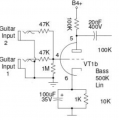
Do you understand how to calculate the resistance of two resistors in series?The 1M resistor doesn't mean anything to it. It could be 1000M or 100 ohms. The unbalanced source resistance is still 47K and thus, the input impedance is still 47K.
I guess you don't understand DC coupling resistors do not establish a current path for operation of the next stage, but instead incorporate with the voltage source as the source resistance. Thus there is no current flow like you are trying to imagine. Because the input signal + is after the 47K and not the input jack.Do you understand how to calculate the resistance of two resistors in series?

I wasn't going to introduce the concept of input capacitance (especially Miller capacitance) until our friend @LadySpark had correctly understood the resistance.The amplifier input resistance is 1047 k ohms assuming the grid does not swing positive with respect to the cathode. In normal operation the grid can be assumed to be an infinite resistance in parallel with its grid-to-cathode and heater capacitance plus its grid-to-plate capacitance X stage gain. In the case of a 12AX7 stage having gain of 60 this works out to be 1.6 pF + 60 x 1.7 pF = 104 pF. The impedance of this capacitance is -j77k ohms at 20 kHz. The tube input capacitance dominates the input impedance above ~1.5 kHz.
View attachment 322334
12AX7 datasheet https://www.drtube.com/datasheets/12ax7-rca1962.pdf
The amplifier input resistance is 1047 k ohms assuming the grid does not swing positive with respect to the cathode. In normal operation the grid can be assumed to be an infinite resistance in parallel with its grid-to-cathode and heater capacitance plus its grid-to-plate capacitance X stage gain. In the case of a 12AX7 stage having gain of 60 this works out to be 1.6 pF + 60 x 1.7 pF = 104 pF. The impedance of this capacitance is -j77k ohms at 20 kHz. The tube input capacitance dominates the input impedance above ~1.5 kHz.
View attachment 322334
12AX7 datasheet https://www.drtube.com/datasheets/12ax7-rca1962.pdf
That is analysis of the 1st amplification stage without a voltage source. The input resistance of the stage with a voltage source connected is 1M.The amplifier input resistance is 1047 k ohms assuming the grid does not swing positive with respect to the cathode. In normal operation the grid can be assumed to be an infinite resistance in parallel with its grid-to-cathode and heater capacitance plus its grid-to-plate capacitance X stage gain. In the case of a 12AX7 stage having gain of 60 this works out to be 1.6 pF + 60 x 1.7 pF = 104 pF. The impedance of this capacitance is -j77k ohms at 20 kHz. The tube input capacitance dominates the input impedance above ~1.5 kHz.
View attachment 322334
12AX7 datasheet https://www.drtube.com/datasheets/12ax7-rca1962.pdf
Hurrah! (almost).That is analysis of the 1st amplification stage without a voltage source. The input resistance of the stage with a voltage source connected is 1M.
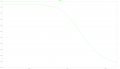
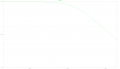
If you want to model the entire system, then a good model of a guitar pickup is 6H in series with 6kΩ, and then you need some cable capacitance.To continue the input impedance thing here is the scalar value of input impedance from 20 Hz to 20 kHz. The Y-axis is in megaohms.
View attachment 322337
Its pretty obvious you guys want to argue about it instead of learning about something you don't know.Hurrah! (almost).
Actually it's 1.047M, because the 47k is in series;
and the input resistance of the amplifier is the same regardless as to whether there is a source connected.
Read up on resistors in series before you come back!Its pretty obvious you guys want to argue about it instead of learning about something you don't know.
Bye.
Look again. Both inputs are identical.It has high gain and low gain inputs. Low gain giving an attenuation of 6dB.
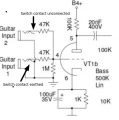
Ah, very perceptive! Let's see if I understand this:
But it's not intended for using with two guitars simultaneously. Whenever have you seen two guitarists share an amplifier? That would imply that two guitarists could agree on which amplifier to use!When 2 is plugged in, 1 still sees a path to ground through input 2. Assuming it is low impedance (compared to 47K) , there is little change to input 1.
ALmost.Ah, very perceptive! Let's see if I understand this:
Guitar Input 2 only plugged in the guitar sees 92k ohms and the input signal is attenuated by ~50%.
Guitar Input 1 only plugged in the guitar sees 1047k ohms and the input signal is attenuated by ~5%.
You are perfectly correct.Ah, very perceptive! Let's see if I understand this:
Guitar Input 2 only plugged in the guitar sees 92k ohms and the input signal is attenuated by ~50%.
Guitar Input 1 only plugged in the guitar sees 1047k ohms and the input signal is attenuated by ~5%.
I pull that info from a text book that is out of print for a few decades and is not scanned into the internet. I say that was a good test of your lack of knowledge on the subject and reaffirms what I already know.I wasn't going to introduce the concept of input capacitance (especially Miller capacitance) until our friend @LadySpark had correctly understood the resistance.
If that’s what you learned from, it’s a good job it is out of print.I pull that info from a text book that is out of print for a few decades and is not scanned into the internet. I say that was a good test of your lack of knowledge on the subject and reaffirms what I already know.