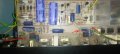
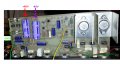
The 4th. chip doesn't seem to be sitting in its socket properly! There's also a red wire at the lower left which is rather bare and could be making (or could later possibly make!) contact with the resistor lead below it?
The 4th. chip doesn't seem to be sitting in its socket properly! There's also a red wire at the lower left which is rather bare and could be making (or could later possibly make!) contact with the resistor lead below it?
How the hell did you spot that Sarah ! ???? Ive got signal on all op amps , varying degrees of volume but all singing !!! all I did was make sure they were snug in their sockets . slight movement in one .
There is (was) one brand of IC sockets that was very prone to corrosion and bad connections in general. Maybe the company that produced this amplifier bought a bunch of those sockets. Knowing about that problem allowed me to do some very fast fixes back in that era. Others may recall that, the company known by it's two initials at the time. They still make good ICs, but no longer make sockets.
There is (was) one brand of IC sockets that was very prone to corrosion and bad connections in general. Maybe the company that produced this amplifier bought a bunch of those sockets. Knowing about that problem allowed me to do some very fast fixes back in that era. Others may recall that, the company known by it's two initials at the time. They still make good ICs, but no longer make sockets.
even though all op- amps are working the sound is still crappy through the amp speaker . distorted , hissy . just like the audio I uploaded . test point on that cap is good ,signal coming through .
How the hell did you spot that Sarah ! ???? Ive got signal on all op amps , varying degrees of volume but all singing !!! all I did was make sure they were snug in their sockets . slight movement in one .
We will begin this trouble-shooting process by measuring DC voltages.
Firstly, disconnect the loudspeaker.
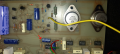
With no signal input, measure the DC voltages at the two power transistors, at the nut and bolt (C) and the two pins, B and E, all with respect to GND.
We will begin this trouble-shooting process by measuring DC voltages.
Firstly, disconnect the loudspeaker.
With no signal input, measure the DC voltages at the two power transistors, at the nut and bolt (C) and the two pins, B and E, all with respect to GND.
Something is wrong with the positive power rail.
Go back and measure the voltages on the large smoothing capacitors. You should be reading +40V and -40V with respect to GND.
Something is wrong with the positive power rail.
Go back and measure the voltages on the large smoothing capacitors. You should be reading +40V and -40V with respect to GND.
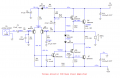
I think the 2M2906 (metal case) driver transistor is actually a 2N3906 (as shown) so it matches the 2N3904 driver transistor.
Then both little transistors are overloaded and produce distortion and smoke at high output levels and if the 2N3055 output transistors have normal but low gain.
Did the 2N3055 transistors come with transistor mounting hardware?
Did you use the insulating washers to mount the transistors to the heatsink?
Remove any insulating washers. The case of the transistors must be electrically bonded to the mounting nuts and bolts, i.e. the metal heatsinks are live, one at +40V and the other at speaker output voltage.

 Facebook
 Google
 GitHub
 Linkedin