When the power amp failed, the voice coil overheated and is now rubbing against the magnet. You can check this by removing the loudspeaker and attempting to move the cone with your two thumbs. The cone should move freely on a good loudspeaker.
When the power amp failed, the voice coil overheated and is now rubbing against the magnet. You can check this by removing the loudspeaker and attempting to move the cone with your two thumbs. The cone should move freely on a good loudspeaker.
Have removed the speaker and it looks in good shape . The cone moves freely as I think it should . I guess I should hook another amp up to it and see how it sounds . Just not sure about power draw . would a 15 watt guitar amp be ok to hook it up to?
Have removed the speaker and it looks in good shape . The cone moves freely as I think it should . I guess I should hook another amp up to it and see how it sounds . Just not sure about power draw . would a 15 watt guitar amp be ok to hook it up to?
There is no such thing as a "speaker Power Draw." A speaker rating is the maximum recommended driving power that the speaker is intended to driven with..
This means that a 50 watt speaker will be completely OK connected to a 15 watt amplifier, if that amplifier is working correctly. That means no big DC voltage at the speaker connection.
There is no such thing as a "speaker Power Draw." A speaker rating is the maximum recommended driving power that the speaker is intended to driven with..
This means that a 50 watt speaker will be completely OK connected to a 15 watt amplifier, if that amplifier is working correctly. That means no big DC voltage at the speaker connection.
I think the conclusion that it is the speaker is not warranted. He complains of low volume at the soeaker. Putting the output through an amplified speaker does not demonstrate that the signal is powerful enough to drive the speaker. it only shows that it can drive a high impedance load at line input level.
What we need to do is to test with a known good speaker, as we are doing now.
If the loudspeaker checks out ok, then one thing we can try is to increase the base bias on the two driver transistors.
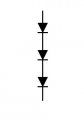
Lift one leg of the diodes and insert a third diode in series. Any silicon diode will do for now.
Disconnect the loudspeaker and measure the DC voltages at the transistor base and the speaker output before trying the live sound test with the loudspeaker connected. You want to make sure that the speaker output voltage is close to 0V.
There is no such thing as a "speaker Power Draw." A speaker rating is the maximum recommended driving power that the speaker is intended to driven with..
This means that a 50 watt speaker will be completely OK connected to a 15 watt amplifier, if that amplifier is working correctly. That means no big DC voltage at the speaker connection.
If the loudspeaker checks out ok, then one thing we can try is to increase the base bias on the two driver transistors.
Lift one leg of the diodes and insert a third diode in series. Any silicon diode will do for now.
Disconnect the loudspeaker and measure the DC voltages at the transistor base and the speaker output before trying the live sound test with the loudspeaker connected. You want to make sure that the speaker output voltage is close to 0V.
Signal tracing still makes sense as a method of locating a problem. Evaluating the bias arrangement and understanding just what is happening can lead to making it work as it should.
If the voltages on the circuit of the power amplifier are correct, checking those voltages could provide an indication of where things are going wrong. But reading millivolt levels demands a suitable meter and being good at using it.
One other consideration is that if the TS is still using a small amplifier for checking the signal, it is responding to a much smaller signal than will be driving the speaker to anything above a whisper. So just because a very small signal sounds good does not mean a larger signal will not be distorted.
AND, as for matching speaker impedance to amplifier impedance, at lower power levels, much less than half of the maximum output, matching is not so critical.
Signal tracing still makes sense as a method of locating a problem. Evaluating the bias arrangement and understanding just what is happening can lead to making it work as it should.
If the voltages on the circuit of the power amplifier are correct, checking those voltages could provide an indication of where things are going wrong. But reading millivolt levels demands a suitable meter and being good at using it.
One other consideration is that if the TS is still using a small amplifier for checking the signal, it is responding to a much smaller signal than will be driving the speaker to anything above a whisper. So just because a very small signal sounds good does not mean a larger signal will not be distorted.
AND, as for matching speaker impedance to amplifier impedance, at lower power levels, much less than half of the maximum output, matching is not so critical.
A lot of things that some of us always think everybody knows are not really so very obvious to those without years of experience. And in addition, for this repair project, not having the complete circuit schematic makes the analysis a lot more challenging. The fact that more than one or two components could have failed also makes the challenge much greater.
The explanation of why the very small signal could be undistorted while the louder signal was distorted can be explained by the fact that to eliminate crossover distortion this amplifier, like many others, tends to operate like a class "A" amplifier in the area of the signal passing through zero volts. That is done because as the output transistors transition from linear operation to a cutoff condition they are not linear, and so produce "crossover" distortion as the signal crosses over from one transistor to the other. (The actual math to explain this is rather tedious.)
For measuring the base to emitter voltages a digital meter with a 3 1/2 digit display and a 2 volt range is required to do it in a satisfactory manner. And noting the polarity is important.
A lot of things that some of us always think everybody knows are not really so very obvious to those without years of experience. And in addition, for this repair project, not having the complete circuit schematic makes the analysis a lot more challenging. The fact that more than one or two components could have failed also makes the challenge much greater.
The explanation of why the very small signal could be undistorted while the louder signal was distorted can be explained by the fact that to eliminate crossover distortion this amplifier, like many others, tends to operate like a class "A" amplifier in the area of the signal passing through zero volts. That is done because as the output transistors transition from linear operation to a cutoff condition they are not linear, and so produce "crossover" distortion as the signal crosses over from one transistor to the other. (The actual math to explain this is rather tedious.)
For measuring the base to emitter voltages a digital meter with a 3 1/2 digit display and a 2 volt range is required to do it in a satisfactory manner. And noting the polarity is important.
well , thanks for the education .. I'm afraid alot of it is over my head at the moment ..I'm reading up on the different class's of amps and ..uh yeh . ..its deep . I do however have a 3 1/2 display on my MM. ..so I'm good there ...now if I can learn how to use it properly that would be even gooder hey .The importance of polarity has been emphasized by Mr Chips...I think it's imprinted in the grey matter at last .
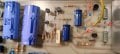
from pic top = + 0.8 , lower = -0.5 , speaker = -0.1
I hooked the amp up to that smaller speaker and it sounds pretty good if you like stoner rock guitar sounds ....which I do but I also like nice clean bass tones and I'm not getting them through this rig right now . It's got that slight hiss and the bass sounds like its been put through a fuzzface pedal .
Here' some audio . I have hooked up the big speaker to my little 15 watt guitar amp and am playing the bass guitar through it . Vol and gain are halfway up and it sounds fine until I hit the strings hard. is that a blown speaker sound ??

 Facebook
 Google
 GitHub
 Linkedin