the big speaker sounds alot better through the 15w guitar amp than its own amp which is distorted and hissy and low volume . Perhaps there is an issue with the speaker too but its more apparent now how bad the amp signal is . If they are both damaged then perhaps its better to bin it and find another project not so challenging . .. what do you guys think ? soldier on or bin it ?
If the PC board is not damaged and the power supply transformer is not damaged then the rest can be repaired by replacement of defective components. It would not be worth having it repaired in a service shop, but for the owner to do the repairs with free labor makes some sense. Of course, this is guessing that the original design was satisfactory.
With signal tracing I ask what was being used for the signal at the input? I suggest using a microphone in front of some sound source so that a consistent signal will be available.
Starting at the input, this should logically lead to the discovery of the defective stage.
If the PC board is not damaged and the power supply transformer is not damaged then the rest can be repaired by replacement of defective components. It would not be worth having it repaired in a service shop, but for the owner to do the repairs with free labor makes some sense. Of course, this is guessing that the original design was satisfactory.
With signal tracing I ask what was being used for the signal at the input? I suggest using a microphone in front of some sound source so that a consistent signal will be available.
Starting at the input, this should logically lead to the discovery of the defective stage.
I was just wondering what damaged it in the first place ... bad design ...cheap components or just high volume abuse . I have been using the bass guitar for a signal but I will use a mic for some consistent audio if that's better
I was just wondering what damaged it in the first place ... bad design ...cheap components or just high volume abuse . I have been using the bass guitar for a signal but I will use a mic for some consistent audio if that's better
Consider that signal tracing requires attention and producing sound at the same time is rather distracting. At least it would distract me. If your computer or whatever can produce a constant volume tone for the microphone that would be the best choice.
Searching for the hiss part of the signal will not require any input. Fixing the his might even cure the distortion part of the problem. OR did the amplifier always have a hiss???
Consider that signal tracing requires attention and producing sound at the same time is rather distracting. At least it would distract me. If your computer or whatever can produce a constant volume tone for the microphone that would be the best choice.
Searching for the hiss part of the signal will not require any input. Fixing the his might even cure the distortion part of the problem. OR did the amplifier always have a hiss???
If you intend to bin it, you can save it for potential learning opportunities.
The overall electronics circuit design is not exactly state-of-the-art and perhaps we can improve on it.
The hiss is a separate problem that can be dealt with at a later stage.
What I hear is poor low frequency (bass) response. When you hit the strings hard that is likely going to produce clipping. You can try turning the GAIN down. Play around with the settings on the controls. Set the TREBLE and BASS to mid-range. Set the VOLUME fully clockwise and adjust the GAIN until you get cleaner sound.
The use of the signal tracer (PC powered speaker) is because you don't have an oscilloscope. With the use of an oscilloscope you would be able to trace the signals much better. You would instantly be able to recognize the following:
DC offset (voltages)
high frequency hiss
distortion
cross-over distortion
clipping
If you want to advance further into the world of audio electronics, getting a good oscilloscope would be a fine investment.
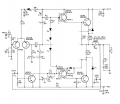
At the moment, I cannot hear cross-over distortion. It was mentioned by others that the diode bias supplied by D2 and D3 is inadequate. Other designs would use three, four, or additional series resistor in this type of circuit design. The jury is still out on the state of the loudspeaker. I would experiment with adding another diode in series with the existing two diodes.
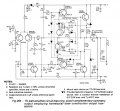
The circuit in your amplifier was likely copied from this circuit.
You will immediately notice that they have three diodes D2, D3, D4, plus R10A, 47Ω series resistor. I have omitted the protection circuit which your amplifier does not have.
The immediate give away of the state-of-the-art of your amplifier is that they used 741 op-amp which is more than 50 years old. As AG likes to say, this is a lousy noisy op-amp and is no longer used in new designs.
The bass guitar playing in post #280 probably sounds like frequencies that are too low for a small speaker AND the small speaker is missing an enclosure causing its coil to rap against its magnet structure, or possibly the amplifier is clipping on all the loudest sounds which is normal.
If you intend to bin it, you can save it for potential learning opportunities.
The overall electronics circuit design is not exactly state-of-the-art and perhaps we can improve on it.
The hiss is a separate problem that can be dealt with a later stage.
What I hear is poor low frequency (bass) response. When you hit the strings hard that is likely going to produce clipping. You can try turning the GAIN down. Play around with the settings on the controls. Set the TREBLE and BASS to mid-range. Set the VOLUME fully clockwise and adjust the GAIN until you get cleaner sound.
The use of the signal tracer (PC powered speaker) is because you don't have an oscilloscope. With the use of an oscilloscope you would be able to trace the signals much better. You would instantly be able to recognize the following:
DC offset (voltages)
high frequency hiss
distortion
cross-over distortion
clipping
If you want to advance further into the world of audio electronics, getting a good oscilloscope would be a fine investment.
At the moment, I cannot hear cross-over distortion. It was mentioned by others that the diode bias supplied by D2 and D3 is inadequate. Other designs would use three, four, or additional series resistor in this type of circuit design. The jury is still out on the state of the loudspeaker. I would experiment with adding another diode in series with the existing two diodes.
I will play around some more for sure . I wont be binning it ....shelving it rather ....ponder a bit ...read , get some more understanding. learn how to read a schematic properly!!! lol . and I will take a look at this diode idea . also I am going to source another speaker . ..maybe another bass amp . they come up on marketplace every now and then ..'projects ' . salvage parts perhaps ...compare . As for an oscilloscope .. can you recommend one? , nothing to pricey ok . of course I will be in touch , I could'nt do this without help and you have been most patient with me . thank you very much for all the advice and everyone else on here , its a long one huh !! 15 pages ..still going .
holy shit !!. thats impressive ....4 years .....that's nuts !!! bravo though . I was feeling bad thinking I'm taking up all yr time. I'm not going to feel bad anymore . LOL !! thanks
Upgrading the whole system with the current quality of opamps might solve the problems, unless that has already been done. Another thing to try, as it has worked for me a couple of times, is reheating every solder connection. That should not take long at all and it might solve the problem without knowing which one was the culprit.
y' know I just watched someone do that on a youtube vid . resolder everything . will get right on that . I havent upgraded the op amps ... the new 'old ' ones are in . guess I will be buying them again . third time lucky.
y' know I just watched someone do that on a youtube vid . resolder everything . will get right on that . I havent upgraded the op amps ... the new 'old ' ones are in . guess I will be buying them again . third time lucky.

 Facebook
 Google
 GitHub
 Linkedin



 . thats impressive ....4 years .....that's nuts !!! bravo though . I was feeling bad thinking I'm taking up all yr time. I'm not going to feel bad anymore . LOL !! thanks