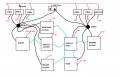
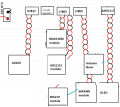
Grounding scheme for signal conditioning circuit

Thread Starter

anoopak

Joined Nov 24, 2023
77
I want to build a precision signal conditioning circuit to convert a millivolt dc signal to digital signal (RS485). A schematic of the circuit is attached. When i went through the data sheets of in-amp and ADC, i came across the concepts of DGND and AGND (some sought of grouping of GND connections to improve the noise immunity). Since I am not from electronics background I am not able to understand the concept completely. I usually tie all the GND connections to a single point (or use GND plane). With respect to the schematic, please suggest a scheme to connect GND pins of various modules used in the circuit (i.e. DGND and AGND grouping).
Notes:
(a) In the schematic Blue line represent signal connections
(b) All input power supply voltages are derived from a primary 24V dc supply using voltage regulator ICs.
AAC.png
 
Last edited:

MisterBill2

Joined Jan 23, 2018
27,182
I see a serious issue which is that there is no power supply return connection. Each module should have it's own power return connection to that power source, rather than a wire from one to the next and eventually back to the power supply. Separate power and return connections are a simple way to avoid unintended coupling between modules. They are an easy precaution to avoid problems.
 

crutschow

Joined Mar 14, 2008
38,321
It can help to have a separate analog and digital ground plane and connect them together at just one point.

The idea is to follow the digital ground current path back to the supply, and prevent it from flowing through the analog ground current path .

That can be difficult with mixed signal ICs such as A/D converters.
For that, sometimes a split ground plane is used with the split under the devices with both analog and digital I/O.
 

MisterBill2

Joined Jan 23, 2018
27,182
Since the entire package is powered from a single supply of some kind, I suggested individual connections, realizing that the power supply only has a single common point.So the two separate grounds shown should be within the power supply, or at least have much heavier connections. to the single point.
 

Lo_volt

Joined Apr 3, 2014
370
Your supply returns (grounds) should follow the same path to the output of the regulator for each voltage output. If this is on a PC board, a ground plane will work well. If this is wire, the ground should be twisted with the power supply lead. The same concept should be used on your 24 volt supply, a 24v wire twisted with a 24v return wire.

The idea is to minimize the space inside the path of the current. The current supply for each module comes from the regulator and returns through the supply return wire. If you run the two in largely separate paths, there will be a lot of area inside the current path. This will allow EM fields from the surroundings to induce noise into that current path. This will show up as noise on your power supply.

You only need one of each different voltage regulator. You can supply each of the different 5 volt modules from the same regulator.

I would suggest that you create a PC board to hold all of the regulators. Design it with two planes, 24V and 24VReturn. 24Return will be your ground reference. Place the connectors for each of the regulators near the regulator. With a pin for the return voltage on each power connector, you will be able to twist the supply and return wires tightly together.

Your Arduino has an onboard 5 volt regulator that should be able to supply the modules connected to it.

There are also versions of the 78xx regulators that use switcher circuitry inside to increase the efficiency and allow you to input higher voltages (in your case, 24 volts) so that you don't waste the power in heat. Search for "7805 switching supply" to find some examples.
 

Lo_volt

Joined Apr 3, 2014
370
1732110196816.png
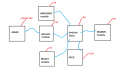
I'm realizing my Paint skills are pretty bad, but I hope this gets the point across.

To get -12 volts from 24 volts you're going to need a buck converter. If you do a PC board with the regulators on it, place the -12 volt regulator near the +12 volt regulator and twist both + and - supplies together with a single ground wire. This because some of the current from the +12 may return through the ground lead and some may return through the -12 volt lead.
 

Thread Starter

anoopak

Joined Nov 24, 2023
77
Your regulators will run hot with 24 VDC input.
How are you getting -12 V from a 7812 regulator?
(a)Initially i tried connecting voltage regulators in series. But this created instability issues. So i connected all the voltage regulators across 24V input and used zener diodes in series to drop extra voltage.
(b)K7812 is a switch mode converter from Mornsun. It output -12V when input is 12V. I dropped 12V across a zener diode and the remaining 12V is given to K7812.
 
Last edited:

Lo_volt

Joined Apr 3, 2014
370
K7812 is a switch mode converter from Mornsun. It output -12V when input is 12V. I dropped 12V across a zener diode and the remaining 12V is given to K7812.
I missed that in my earlier post. Don't bother with the zener. Just input 12 volts from your +12 volt regulator. You should check the amount of current each of your modules are drawing so that you don't over load any of your regulators or your 24 volt supply.
 

Thread Starter

anoopak

Joined Nov 24, 2023
77
Since the entire package is powered from a single supply of some kind, I suggested individual connections, realizing that the power supply only has a single common point.So the two separate grounds shown should be within the power supply, or at least have much heavier connections. to the single point.
I am not able to get this point. Can you please explain what changes I have to make in schematic?
 

MisterBill2

Joined Jan 23, 2018
27,182
I am not able to get this point. Can you please explain what changes I have to make in schematic?
Do you mean that the whole power supply circuit is not accessible ?? Or do you mean that the return connections from the different modules can't be individually brought out to the supply?
 
Top