Ground Reference Points

MaxHeadRoom

Joined Jul 18, 2013
30,682
as it was stated by Max that ground and common were the same thing).
The reason I prefer to use the term 'Common' instead of ground, is that in N.A. the term ground is used for Circuit common point And also Earth ground, so If I am making reference regarding the power common reference point, it is less likely to be ambiguous as to whether the point in question is at earth or NOT!
Unfortunately the Earth symbol is often used whether the reference point is earth grounded or not.
Max.
 

shortbus

Joined Sep 30, 2009
10,050
As a side note (not arguing against what's already been presented here) is there a better term to use for a negative voltage rail that's used as a common return point in a DC powered system?

I feel comfortable with the distinctions being made between different types of "grounds" and with the notion that a common reference point can be arbitrarily chosen anywhere. This is really just a question of vocabulary and semantics - intuitively, it makes sense to me that a negative voltage rail that's used for countless connections would be called a "common" and, like the thread starter, I had assumed that was part of the reason for the name. Is there a more appropriate name for this?
But does your, "negative voltage rail" have a negative voltage or does it actually have 'no voltage'? I have a frequency generator that uses both positive and negative voltage in the power supply, but for that to be true, it also has a 'common' connection or point. In some circuits there does exist a 'negative voltage' that isn't the common. Like the earlier battery example.
 
This is really just a question of vocabulary and semantics - intuitively, it makes sense to me that a negative voltage rail that's used for countless connections would be called a "common" and, like the thread starter, I had assumed that was part of the reason for the name. Is there a more appropriate name for this?
Sometimes you can't chose it, like the SWPS example. The primary side has an entrirely different reference point that anything on the secondary side.

The first step is to either full or half wave rectify the line voltage. Now you have ground/Common a couple of diode drops above real ground. So, when you attach your grounded scope probe, you let out the magic smoke,
(A-B) or differential measurements are possible. Measurements to scope ground are possible, but you cannot arbitrarily connect the ground clip from the scope anywhere or you will make sparks.

Generally, you isolate the DUT (device under test) because you don;t want the case of the scope to become live. You have to follow the recommendation of the manufacturer for how much your allowed to be OFF EARTH.

The ideal method is to use an Isolation Amplifier probe. These are not cheap.
 

Tonyr1084

Joined Sep 24, 2015
9,744
I've gotten the feeling you've gotten off track. Perhaps your instructor wants you to reference all voltages to ground (or what he's calling ground, though it's not NECESSARILY ground). This is a good lesson in Kirchhoff's law on voltage. The sum of the voltage drops is equal to the supply. If you look at all the voltage drops on each resistor they equal the voltage supply. There are a few ways to look at it. You can take all the voltage drops and subtract them from the supply voltage and you should ALWAYS come up with ZERO. Or, as I did, you can add up all the drops and they should equal the voltage of the power source. In this case, 20 volts. If you measure each point - A to GND (reference) you see there are 6 volts, 3 & 4 volts. A total of 13 volts. If you black (negative) probe the ground point and red (positive) probe the A point you will see 13 volts. B to GND is 9 volts and C - GND is 6 volts. Keeping the black probe on the ground point if you measure GND - D ~ you get negative 2 volts; and GND - E gives you negative 7 volts.

I think this is a lesson on Kirchhoff's law. See this link: https://www.thoughtco.com/kirchhoffs-laws-for-current-and-voltage-2698910

Just for a moment let me present an idea: If you take a battery (1.5 volts) and a lightbulb (1.5 volts) and connect them so the light illuminates - then you take a meter and check across the light bulb with a meter you'll get 1.5 volts (positive if you put the positive probe on the positive lead, negative if you put the positive probe on the negative lead). You still get 1.5 volts, but the way the meter is reading it will depend on whether you get a positive or a negative voltage. Now look at your circuit. Suppose that each resistor is a light bulb. When you probe across A - B you get 4 volts. But if you reverse the leads you get -4 volts. Why? Because the meter is reading backwards. DON'T LET THAT CONFUSE YOU. When you black probe ground and red probe a resistor below (for the sake of "Below" lets call it whatever is below the ground point) you're going to get a negative voltage.

You ask why having ground somewhere above absolute negative. The reason is because an amplifier will want to push and pull a speaker. You can only push a speaker with a positive voltage. You need a negative voltage to pull the speaker (provided it's wired correctly). And with AC circuits you can have ground at a center tapped transformer with dual bridge rectifiers configured so that you get a positive and a negative voltage above and below the ground point. Some circuits call for just that - both positive and negative voltages.
 

Tonyr1084

Joined Sep 24, 2015
9,744
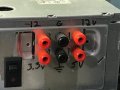
Here's a picture of my power supply, made from a SMPS from an old computer. Notice that the upper left banana jack is labeled "-12". It's negative 12 volts referenced to the black (ground) banana jack. The upper right jack is just 12 volts. Between -12 and 12 is a total of 24 volts. So I can use this supply to give me one amp at 24 volts. One amp because my supply is only rated for 1 amp negative. If I exceed that it will shut down (or blow out). I can use -12 and +5 for a total of 17 volts. Any jack and ground will give you what is displayed. If I were to use both positives, say +12 and +5 I would get the difference between them (7 volts) with what you'd think of as positive as being the +12 volt jack and the +5 volt as the negative. Using different combinations I can achieve a number of different voltages ranging at 1.7 volts; 3.3v; 5v; 7v: 8.3v; 8.7v; 12v; 15.3v; 17v; and 24 volts. I haven't looked to see all the possible values that can be had, but I suppose there's more when you factor in the -12 volt jack.

Ground (as you're thinking of it) is just an arbitrary point in a powered circuit. The lesson here is that all the voltage drops are equal to the supplied voltage. (Or the supply minus the drops equals zero).

image1 4.JPG
 

ebeowulf17

Joined Aug 12, 2014
3,307
But does your, "negative voltage rail" have a negative voltage or does it actually have 'no voltage'? I have a frequency generator that uses both positive and negative voltage in the power supply, but for that to be true, it also has a 'common' connection or point. In some circuits there does exist a 'negative voltage' that isn't the common. Like the earlier battery example.
Specifically, I'm curious about the "best" or "proper" terminology in the case where it is the most negative point on the DC side of a machine. Imagine a machine with both high and low voltage components, where the low voltage DC (5VDC, single supply) comes from a SMPS and is floating relative to the high voltage AC side.

In this case, I've heard the "negative" rail referred to as:
  • DC common
  • Signal ground
  • Digital ground
  • Analog ground
Given that both "common" and "ground" can be misleading terms (if not misleading, perhaps just misunderstood,) and can refer to any arbitrarily chosen reference point in the circuit, is there some other name for this which would be more appropriate, more precise, less prone to misinterpretation?

Whatever we call this rail, I'm comfortable with how it works and how to measure it, or measure things relative to it. I'm just wondering if there's any consensus on what to call it.
 

bwilliams60

Joined Nov 18, 2012
1,450
If you are referring to an ECM on a machine such as Heavy Equipment or Heavy Truck, the term we use in the industry is ZVR or zero voltage reference. It is separate from chassis ground which would be the frame etc, attached to the negative battery terminal.
 

Tonyr1084

Joined Sep 24, 2015
9,744
It's my opinion that the best term for the "ground point" is COMMON (in this case). Anywhere in a circuit it is common to the referenced point displayed by the ground symbol. Any other point in the circuit, be it above or below common is going to be some voltage - depending on the circuitry. Common will (in this case) be zero volts anywhere that is "common" to all points in the circuitry. Whether it's an amplifier or some other circuit.

Keep in mind that a "common" can be somewhere above or below the zero threshold. It all depends on the engineer and the design of the circuit. You can have an AC signal piggybacked onto a battery. Lets assume you have a 1 volt sine wave on top of a 12 volt battery: When the sine wave is at positive peak the combined voltage would be 13 volts. But when the sine wave is at its negative peak the voltage will be 11 volts. Why would someone do that? I haven't a clue. But it's "POSSIBLE". It all depends on what you want your circuit to do.
 

shortbus

Joined Sep 30, 2009
10,050
Whatever we call this rail, I'm comfortable with how it works and how to measure it, or measure things relative to it. I'm just wondering if there's any consensus on what to c
At this point in time, with all of the years and different websites and books out there it's always going to be up for grabs. I'm just a hobbyist but I prefer the term common instead of ground, didn't when starting out but have changed to it the more I learned about DC circuits. Similar to the whole "conventional vs electron flow" when talking about current. Damn you Ben Franklin.:)
 

Thread Starter

JackSpratt

Joined Jul 27, 2017
26
You ask why having ground somewhere above absolute negative. The reason is because an amplifier will want to push and pull a speaker. You can only push a speaker with a positive voltage. You need a negative voltage to pull the speaker (provided it's wired correctly). And with AC circuits you can have ground at a center tapped transformer with dual bridge rectifiers configured so that you get a positive and a negative voltage above and below the ground point. Some circuits call for just that - both positive and negative voltages.
I'm following you up until this point. Correct me if I'm wrong, but isn't voltage really an abstraction? The whole gist of this conversation is that voltages are not concrete, they are dependent on where someone has defined a reference point. Electricity is really current, the flow of electrons, not voltage, right? So I don't understand why you would say "You can only push a speaker with a positive voltage. You need a negative voltage to pull the speaker" and then go to say that this requires a certain "configuration", implying that the system needs to be configured physically in such a way that the result is positive and negative voltage in a tangible sense. It seems to me that in order to get the speaker to move back and forth you would need to be concerned with the way the current behaves. And whether the voltage at its highest amplitude is called positive (above "ground") and the voltage at its lowest amplitude is called negative (below "ground") depends entirely on (as has been firmly established in this thread) where the reference point called ground has been arbitrarily chosen.
 

MrChips

Joined Oct 2, 2009
34,837
Voltage is not an abstraction. You can have voltage with zero current.
When we say voltage, we really mean "voltage difference", that is, the voltage at point-A with respect to point-B.

As Max points out, we ought to stop calling things "ground" and instead use the word "common".
Old habits are hard to break.
 

shortbus

Joined Sep 30, 2009
10,050
I'm following you up until this point. Correct me if I'm wrong, but isn't voltage really an abstraction? The whole gist of this conversation is that voltages are not concrete, they are dependent on where someone has defined a reference point. Electricity is really current, the flow of electrons, not voltage, right? So I don't understand why you would say "You can only push a speaker with a positive voltage. You need a negative voltage to pull the speaker" and then go to say that this requires a certain "configuration", implying that the system needs to be configured physically in such a way that the result is positive and negative voltage in a tangible sense. It seems to me that in order to get the speaker to move back and forth you would need to be concerned with the way the current behaves. And whether the voltage at its highest amplitude is called positive (above "ground") and the voltage at its lowest amplitude is called negative (below "ground") depends entirely on (as has been firmly established in this thread) where the reference point called ground has been arbitrarily chosen.
If this is what you think in regards to an audio signal and how it works with a speaker, you haven't either been paying attention or still aren't getting it with regards to your thread. Audio is a sine wave, it's output into a speaker requires both a negative and positive voltage going both ways around a "0" or 'common' point NOT ground. Ground has nothing to do with it when talking about DC. Ground is for your protection, has nothing to do with the workings of a DC circuit. The sooner you accept this the sooner you can move on in your learning and building DC circuits.

Your quote, " So I don't understand why you would say "You can only push a speaker with a positive voltage. You need a negative voltage to pull the speaker" and then go to say that this requires a certain "configuration", implying that the system needs to be configured physically in such a way that the result is positive and negative voltage in a tangible sense."

Do you understand how a speaker works? It is a coil of wire, an electromagnet, surrounded by a permanent magnets field. You do know the like magnetic fields repel and opposites attract? This is what is happening when a speaker is giving you sound from a speaker, no magic, no ground involved. Just a positive and negative voltage changing around a '0' voltage, to change polarities to the coil/electromagnet, in a permanent magnet field.
 

Tonyr1084

Joined Sep 24, 2015
9,744
Correct me if I'm wrong, but isn't voltage really an abstraction?
Consider yourself corrected; yes, you're wrong. Voltage is defined as "Electric Pressure". Same as with a balloon. You can blow up a balloon and tie it off. Depending on the amount of air inside the balloon and the elasticity of the rubber membrane, you have POTENTIAL PRESSURE. While it's true, that pressure is measured off of the basic atmospheric understanding, the "Pressure" inside the balloon is basically "Greater than the surrounding air pressure."

Tie off the balloon and you have just a container of air under some pressure. If you put that balloon inside a pressure chamber and begin pressurizing the air inside that the balloon will visibly shrink. Enough pressure in the chamber and the balloon will appear to be completely deflated. OR take a balloon with no air blown into it and just tie it off, then put it in a vacuum chamber. Evacuate the air and the balloon will appear to inflate. So in a sense what you're describing is somewhat true that voltage can be considered to be abstract. However, that "Abstract-ness" can only be related to the point from which you measure it. If you measure the voltage of a battery from a ground ('scuse me - common) you will see the battery potential. In other words, the batterie's negative and positive terminals. But if you connect a low voltage transformer to the battery (an AC and DC circuit) and measure the voltage through a live transformer (the secondary to be clear) you'll see the battery AND the transformer voltage. When viewed on a scope you'll see the sine wave AND the battery voltage represented.

First lets consider the sine wave alone. Suppose it's a 1 volt transformer. You'll see the sine wave peak at 1 volt (not exactly true, but for the sake of argument lets just assume it is). The upper peak is the positive 1 volt and the negative peak is -1 volt. Now, throw a 6 volt battery into the mix, placing one of the transformer leads on the negative terminal of the battery. Now you have a battery and transformer in series. Now what you read on the scope is neither 1 volt nor 6 volts (though there are points when you do cross the 6 volt threshold, but for the sake of the argument lets consider ONLY the peak positive and peak negative wave forms). At the positive peak the scope will show a total voltage of 7 volts (the combination of the battery and the positive side of the sine wave), and at the negative peak of the sine wave the scope will display only 5 volts. The reason for this is that the negative pressure negates one volt, so the scope shows only 5 volts.

It's all relative to the point you choose to measure from. Measuring through the complete circuit will show a varying voltage from 5 to 7 volts positive at all times. And if you reversed the battery the same readings would be true but only in the negative range. IF you measure across the battery alone, despite what the transformer is doing you'll see only a steady 6 volts (of electric pressure).

So "Common" (what you call ground) is just one reference point you choose to measure from. When you measure the voltage drop between all the resistors above the ground symbol you see the positive voltage. Anything below you see negative. That's ALL the ground is doing for you in your circuit.

Consider temperature. Yesterday was 50 degrees. Today is 100 degrees. Did the temperature double? No. Why not? Because we reference temperature (in Fahrenheit) at some arbitrary zero point. Kelvin is the absolute zero point, but that would mean temperatures would appear much much higher that way. So 72 degrees F is the same as 295.4 degrees Kelvin. Same is true with Celsius; 72 degrees F is (72-32) x 5 ÷ 9 = 22.2 degrees C. The difference is that someone considered zero degrees C to be the freezing point of water and 100 degrees C to be the boiling point at sea level. So where you measure from is relative to your purpose.

To answer the question about WHY we have a common point in a plus / minus circuit is so that we can accomplish more in an analog circuit. Which is why I constantly refer back to the speaker amplifier.
 

Tonyr1084

Joined Sep 24, 2015
9,744
Just a little bit about Kelvin (temperature): Zero Kelvin (or K) is the point where all atomic motion stops and is considered an absolute zero, which is the equivalent of -273.15˚ C. This is NOT some arbitrary measurement, it's a scientific absolute. Below 0˚ K is not possible. At zero K there is no energy to be removed. So 100˚ K IS double that of 50˚ K. But not in Celsius nor in Fahrenheit. In Fahrenheit zero degrees is 32 degrees below the point where water freezes. In Celsius zero degrees IS the point where water freezes. So you could call 0˚ K F a "ground" point, just as you can call 0˚ C a "common" point. But 0˚ C is not absolute negative the way 0˚ K is.
{edited}
 
Last edited:

Thread Starter

JackSpratt

Joined Jul 27, 2017
26
If this is what you think in regards to an audio signal and how it works with a speaker, you haven't either been paying attention or still aren't getting it with regards to your thread.
I have been paying attention, in fact in general I'm trying very hard to to come to a complete understanding of the subject at hand (the scope of which has actually expanded somewhat from what I originally posted about but that's fine with me, I obviously have some gaps in my knowledge) It can be difficult when you try to learn about a relatively complex subject later in life. If I had studied physics for example in high school and/or college it probably would come easier. Same thing with software engineering which I first studied in school at the age of 40. Through sheer determination and brute force of will I graduated with honours and earned a living at it, but I struggled all the same due to not having acquired a strong mathematical foundation at a much younger age when the mind is much more pliable. So please bear with me. My problem is I formulate a mental conception based on the information given me and compare it the real world descriptions I come across in my reading going forward, hoping that they jibe with my conception and there are no apparent contradictions or irregularities. Unfortunately, at this point I guess my conception is incomplete because I still come across instances where things don't exactly line up. It certainly isn't for lack of trying.)
Audio is a sine wave, it's output into a speaker requires both a negative and positive voltage going both ways around a "0" or 'common' point NOT ground. Ground has nothing to do with it when talking about DC. Ground is for your protection, has nothing to do with the workings of a DC circuit. The sooner you accept this the sooner you can move on in your learning and building DC circuits.
This part of your post perplexes me. First let me say as far you post and the previous one I replied to, I'm not trying to be arrogant, you guys are the experts and I'm obviously the greenhorn, so in my effort to understand I suppose I'm playing devil's advocate at times, I probably should have included that qualification in my last post. Anyway, audio can be a sine wave or more commonly (pardon the pun) a complex waveform made up of many sine waves at different frequencies and amplitudes, but yes, I do understand how a speaker behaves (I studied audio engineering in community college, not that it is required, it's pretty obvious that a speaker has to move in and out to reproduce a waveform). I'm not sure why my struggle to square the electrical terminology with the physics leads you to believe I'm not getting ANY of it. Maybe I need to be more explicit. Now throughout this thread others have been using the terms "ground" and "common" somewhat interchangably (in fact it has prompted a debate on which is the better term to use and whether this a different term that would be less ambiguous) so why do you take such exception to my use of the term "ground" when discussing the "0 line" voltage, for lack of a better term? In fact, Tony used the term "ground" for just that in the paragraph I was responding to, so please don't take that and suggest that I'm stubbornly refusing to accept the information being provided to me. When you say "Ground has nothing to do with it when talking about DC" I really don't know where that is coming from, if we're talking about a signal that drives a loudspeaker we are talking about alternating current,no?

Do you understand how a speaker works? It is a coil of wire, an electromagnet, surrounded by a permanent magnets field. You do know the like magnetic fields repel and opposites attract? This is what is happening when a speaker is giving you sound from a speaker, no magic, no ground involved. Just a positive and negative voltage changing around a '0' voltage, to change polarities to the coil/electromagnet, in a permanent magnet field.
Yes, I do understand how a speaker works. I've been a professional musician for over 30 years, I've done audio engineering, live and studio, so if I didn't know how a speaker worked at this point I would have truly not been paying attention :) I learned that magnetic fields repel and opposites attract in grade 4, I hope you are not purposely condescending me. I really think either you haven't understood exactly what it is that I might still be confused by, and whether that is my fault for not being clear enough or whether you haven't given me the benefit of the doubt, I honestly don't know.
 

Thread Starter

JackSpratt

Joined Jul 27, 2017
26
However, that "Abstract-ness" can only be related to the point from which you measure it.
I think that was kind of the point I was trying to make about voltage. There seems to be two ways to think of voltage. One, as you say, electric pressure (once referred to as EMF, right?), or two, a measurement of electrical potential, as has been discussed, between a point in a circuit and an arbitrary reference point. The latter definition certainly leaves room for different descriptions of a single state. Abstract was probably not a good term to use. Anyway, if I could take another stab at the paragraph I was responding to in my previous reply to you, Tony, I was probably too hasty in sending off my response and didn't think it through. But at the same time there's probably some room for further clarification from my point of view. What I was suggesting was, and forgive me for repeating myself to a degree, that we had been talking about how the definition of voltage in the context of a given state of a circuit was not carved in stone due to the reference point being arbitrary, and then I keyed in with tunnel vision on the words "...configured so that you get a positive and a negative voltage above and below the ground point" and I thought, well that sounds like the "ground point" is fixed and doesn't that contradict the former? So if you would indulge me, can we break this down piece by piece so that I hopefully don't get thrown off by terminology or conventions that are a given to electronics geeks but not to yours truly?
So to start with, you wrote "You ask why (would there be a benefit to) having ground somewhere above absolute negative" and then the answer
The reason is because an amplifier will want to push and pull a speaker
I think this is one place we had a disconnect. When I asked that question way back near the beginning of this thread we were discussing the graphic I uploaded showing a very simple circuit with a handful of of resistors and the question referred only to choosing an arbitrary point in the circuit to place the black probe of the DMM such that you got different voltage readings.So your speaker scenario is a good one, especially since it is guitar amplifiers I am most interested in, but I think you can see how it kind of threw me. On to
...with AC circuits you can have ground at a center tapped transformer with dual bridge rectifiers configured so that you get a positive and a negative voltage above and below the ground point.
So here when you use the term "ground", what exactly are you referring to? I assume we're talking about a transformer with 120V mains AC on the primary. So on the secondary if you center tap it you get a voltage with 60V above and 60V below and the mid point is what you call the ground point? One thing I don't get is when you convert the AC to DC through a rectifier, does the DC still have a relationship to the AC? Intuitively I want to say no, the only relationship is the voltage difference between a given point in the (physical) AC section of the amplifier and the DC section (although the DC can have artifact components such as AC ripple) but then I have to consider a negative bias voltage which is DC. For this to make sense I have to go back to the truism that a negative voltage is possible because the common reference point has been "arbitrarily chosen", but where is it, or what is it? Is it at the center tap on the pre-rectified AC voltage secondary winding of the transformer? And there is also the distinction between a half wave rectifier and a full wave rectifier which implies that the current output of one type has a different character or properties than other despite the outputs both being direct current, which I always thought was simply the flow of electrons in one direction as opposed to alternating directions, nothing more, nothing less.I hope you can follow the path my mind is taking and set me straight, I can't be the first person who has had difficulty with this stuff.
Thanks in advance.
 

MrChips

Joined Oct 2, 2009
34,837
Now that the subject of loudspeakers has been raised, maybe this would be a good example to better understanding the concept of 0V reference point and "COMMON".

Contrary to what a previous poster said, you do not have to reverse the current in order to reverse the direction of motion of the speaker cone.

The power supply in a loudspeaker amplifier circuit can be at any absolute voltage. It can be at 0V, +100V, -100V. The loudspeaker doesn't care.
The loudspeaker can be at any absolute voltage, positive or negative.

Just for the sake of discussion, let us suppose that the -ve terminal of the loudspeaker is at 0V and the +ve terminal is at 10V.
Then we modulate the 10V with a -1V and +1V sine-wave, i.e. a peak-to-peak 2V sine-wave. The signal is now 9V to 11V. The speaker cone will be pushed out somewhat at 9V and then farther again at 11V. The cone will still oscillate even though we have not reversed the current. We will still get sound, maybe.

The problem with this, of course, is that the speaker cone would not like this. The cone is pushed out so far that it would be damaged. What the speaker wants is that the voltage-difference between the +ve and -ve terminals be close to zero volts.

You can build an audio amplifier with a single voltage power supply. The power supply might be +24V with respect to the -ve terminal of the supply. We can connect the loudspeakers -ve terminal to the -ve terminal of the supply. The output of the push-pull amplifier is at +12V. If we were to connect this directly to the +ve terminal of the loudspeaker it wouldn't like it at all. So we couple the output of the amplifier to the loudspeaker's +ve terminal using a large capacitor. Now the loudspeaker sees -12V to +12V with respect to the -ve supply voltage terminal even though there is no negative voltage coming from the power supply.

The point here is that we arbitrarily call the -ve terminal of the loudspeaker our 0v reference point or COMMON and the +ve terminal is happy to get a voltage signal that is equally balanced about this COMMON reference point.

To complete the picture, we can build the audio amplifier using a dual voltage supply, +12V, 0V, -12V.
The output of the push-pull amplifier is now at 0V. We can now connect the loudspeaker directly between the output and 0V COMMON without the need for a large value capacitor (thus extending our low frequency response down to 0Hz).

Again, the point here is that all the loudspeaker cares about is that if we call the -ve terminal of the speaker our 0V COMMON then the average voltage at the +ve terminal be at the same voltage, i.e. the voltage-difference across the loudspeaker terminals must average out to 0V.
 

Tonyr1084

Joined Sep 24, 2015
9,744
So here when you use the term "ground", what exactly are you referring to? I assume we're talking about a transformer with 120V mains AC on the primary. So on the secondary if you center tap it you get a voltage with 60V above and 60V below and the mid point is what you call the ground point?
On the "TRANSFORMER" comment: A transformer (and forgive me if this sounds condescending - I just want to make sure we're all on the same page); a transformer has a primary side and a secondary side. There are many different configurations to them. I have one on my bench right now that has three isolated secondary that output 65 VAC with a single center tap, providing two 32.5 volt sides; another with three center taps that provide 32.6 volts over the entire range with a common center tap and two taps that provide 12.1 volt each; and one that is just a single coil that provides 5.1 volts. Of the one with the most taps, on my transformer there are outputs I've labeled D, E, F, G & H. Both D & H are the ends of the secondary where you can get a total voltage of 32.6 volts. From D to F (and from F to H) there is a potential of 16.3 volts. From E to G the potential is 24.2 volts, and from E to F (and F to G) the potential is 12.1 volts. The design of this transformer (out of a scrapped stereo) is to give 65 VAC potential for the amplifier, 16.3 volts for the pre-amp, 12.1 volts for motor control such as CD players and tape players, and the 5 volt output for things like computer logic on the control board. To light LED's and such.

Since this is scrapped I can use it for far more outputs. I can use D & E for 4.2 volts (for whatever reason I may imagine), D & F for 16.3 volts, D & G for 28.4 volts or as stated above, D & H for 32.6 volts. I could use E & G for 24.2 volts. OR I can use those voltages with different center tap points to achieve other voltages as well.

With a transformer you can use the AC voltage of the output (incidentally, mine is designed for a 120 VAC input on the primary) (And the primary is isolated from the secondaries) the output of an AC source is (unless otherwise stated) 70.71% of the PEAK voltage. Transformers are much more complicated than I'm going to cover, but a sine wave voltage is 70.71% of the total height of the sine wave (total peak voltage). If you rectify it and put a capacitor on the rectified output you will get the full voltage. So in the chart I'm posting you will notice I've listed the RMS and PEAK voltages. When you measure a transformer output (in this case) at 65 VAC (RMS) the peak voltage after rectification and filtering would be 91.9 volts DC Peak. The filter capacitor smooths out the peaks and the voltage is read as a steady 91 volts DC.

The reason I covered this is because you said "I assume we're talking about a transformer with 120V mains AC on the primary. So on the secondary if you center tap it you get a voltage with 60V above and 60V below and the mid point". Transformers come in many different designs. So yes, it is possible to have a ONE to ONE transformer that has 120 VAC input and 120 VAC output, and the output COULD be center tapped as you suggested. But my fear was that you thought of a transformer as a voltage divider. Yes, you COULD use it that way, but that's not the most efficient form of a voltage divider.

we had been talking about how the definition of voltage in the context of a given state of a circuit was not carved in stone due to the reference point being arbitrary
It may be counter productive to continue pursuing the "arbitrary" nature of voltage. Generally we think of voltage in absolutes pursuant to the design we're after. But for a moment lets consider what potential "GROUND" may be at. First, the earth is a planet sized magneto. It has a massive iron core that is rotating (so scientists say). This rotation is producing a voltage of some unknown magnitude. The Aurora Borealis is the result of interaction between this voltage and the sun's solar winds. And to be clear, I'm NOT an expert on that either. But in the nature of your discussion of the arbitrary voltages, "Ground" voltage as we relate to it is zero volts. But "Ground" voltage as related to the earth's magnetosphere may be thousands of trillions of volts of some potential. So to try and understand "Ground" as always being the most negative part of a circuit, or center reference, or some bazillions of volts can be confusing. Whether you use the terms correctly or incorrectly, most often those of experience know when you say your AC circuit ground is either the most negative part of the circuit or the most center part of the circuit.

I'll bang out a drawing of the output of my transformer along with the description of the connections. I'll include on the drawing the primary side of the transformer though it's not charted. I'll post that in 30 minutes.
 
I think part of this problem is "historical", meaning at one point chassis ground was it and there was the "wrong" symbol used. The standard ground symbol (a bunch of horizontal lines in the shape of a triangle). You built stuff on metal chassis and there was NO third prong at that point.

When you go back to the first use of the "ground" symbol, there was only one.

We eventually had battery stuff too. The "B" battery with taps at 0, 22.5 and 45 Volts. See http://www.thedailybeast.com/whatever-happened-to-the-b-battery

Houses started out with "electric candles". No toasters, washing machines, microwave ovens etc.

Even dryer wiring as recent as 2001: https://www.thespruce.com/change-dryer-cord-3-prong-to-4-1152248

For me, the notable things were the "metric system" and standardization of Units; Mhos are gone and replaced by Siemens.

We did not go back and correct Ben Franklin's mistake, we just call current current and when we have to distinguish, it;s "conventional current" and "electron current".

As with "ground", we need more symbols, because now it's important to distinguish.

Switching power supplies or SMPS really messed up the notion of a common.

The symbol mess is really "history". The design era puts you at a different reference point as to how things were built.

Now, we appear to be unraveling what was accomplished by having stuff that's double-insulated.

There's a common misconception on how GFCI's work. They use transformers to difference the current in neutral and hot.

I learned the hard way. I had always thought red was positive. Totally throw that out the window. red may be positive in a car, red happens to be negative in thermocouples, Red in HVAC thermmostats. http://www.thermostatcenter.com/thermostat-wiring/

Oh, and guess what? There used to not be a C terminal (The C word - Common) in most thermostats, but now there is, because the thermostat needs independent power now.

You can't take expertise across industries. With BLACK/white and green used in power cords and USA house wiring WHICH WIRE IS hot. It's BLACK!

I still have to look up the blue/brown and green with yellow stripe color code or power cords.

In some installations, there may actually be two different ground busses. One that's green/bare and another that's yellow with green stripe. One is protective and the other is a reference. This is really the way it should be.

Switches used two wires with ground in the home and "Electrical tape" is used to change the color of the wire.
Now, the NEC wants a neutral pulled into the switch box because of home automation.

So, see all of the changes and inconsistencies?
 
So to try and understand "Ground" as always being the most negative part of a circuit, or center reference, or some bazillions of volts can be confusing. Whether you use the terms correctly or incorrectly, most often those of experience know when you say your AC circuit ground is either the most negative part of the circuit or the most center part of the circuit.
Where did you ever get that notion? telco -48 VDC relative to ground. ebeam evaportors -13 kv relative to earth/ground. Positive grounded vehicles.

Tony, you need to totally loose that notion.

Just like Ben Frankin messed up current, "Ground" has roots. It wasn;t defined right from the beginning of time, so it's definition changes.

The most commonly accepted definition is synonymous with Earth or Earth ground.

A battery powered radio with an isolated wall wart, it's customary to call the (-) battery terminal ground. Incorrect - Yes.
 
Top