Ground Reference Points

#12

Joined Nov 30, 2010
18,224
When calibrating certain tube testers, it was important to use an analog meter with say 50,000 ohms/volt input Z. So, yes the resistance presented to the circuits varied with the measured voltage. A common meter with a 10 M input Z actually UPSETS the desired value. High input Z meters were not commonplace.
Eek! :eek: I'm expecting to receive an antique tube tester for rehabilitation next week. Good to know they might have calculated the measurements for an antique meter!
 

crutschow

Joined Mar 14, 2008
38,532
The old Simpson 269 (not the more famous 270) had a 100,000 ohms/volt input.
Thus it had a 15 megohm input resistance at the 150V scale setting, typical range for measuring tube voltages.

It would also measure down to 16μA full scale.
Not bad for an analog meter.
 

WBahn

Joined Mar 31, 2012
32,891
I guess it goes back to the idea I formulated when I first took a basic electronics course regarding what voltage is. My formulation is that voltage represented a certain amount of "work" that can be done as determined by the amount of current and resistance. The voltage is dropped across the resistance in the circuit so that when you consider the negative terminal of the power source you can consider the voltage at that point to be 0V, in other words, there is no more "work" to be done, the voltage has been dropped elsewhere in the circuit. Maybe I had a bad teacher. :)
The definition of voltage ALWAYS involves differences between one point and another. Voltage is defined as the work done against an electric field in moving a test charge from one point to another. Hence, the very notion of there being a voltage at some point is meaningless unless you define what other point that voltage is relative to.

You can pick any point you want. In many physics applications they choose to set the reference point an infinite way away from all of the points under consideration. That's quite convenient for the kinds of things they are looking at.

For working with circuits having a single DC power supply, we often set the zero reference potential to be the negative terminal of the power source. That's quite convenient for the kinds of these we are looking at.

For many systems, particularly power systems, the zero reference potential is chosen to be the physical Earth ground, hence the name that is commonly used. But a better name when the common reference is NOT the physical Earth ground is "common" or something similar. But "ground" is used so ubiquitously and interchangeably with "common" that that's just the way it is.

For split power systems, such as you frequently find in amplifier and other analog circuits, we have both positive and negative voltages and there is usually some node that our signals are measured relative to, so we use that node as our common reference point.

But at the end of the day, you could throw a dart at your schematic and whatever node is closest to where you hit, you can call that your common. It just means that whenever you talk about the voltage at any other point in the circuit, you have to use the voltage at that point relative to your chosen common node.
 

Thread Starter

JackSpratt

Joined Jul 27, 2017
26
For split power systems, such as you frequently find in amplifier and other analog circuits, we have both positive and negative voltages and there is usually some node that our signals are measured relative to, so we use that node as our common reference point.
"Split power system", do you mean as in a transformer with different taps, such as 6.3V for tube heaters and 350V for B+, that sort of thing?
 
"Split power system", do you mean as in a transformer with different taps, such as 6.3V for tube heaters and 350V for B+, that sort of thing?
He means thing like an audio amplifier that has bi-polar power supplies in it of say +50 and -50 Volts. The reference is the mid-point,

There are IC's called Rail splitters that can take a single supply and create a reference 1/2 way between the single supply.

And you can push it and say that single phase/split phase domestic power in the US uses a transformer with a center tap of a 240 VAC CT secondary as the reference.

If an amp has a linear supply, the +-50 V (example) would have a reference of the center tap of the 35-0-35 transformer.
 

MaxHeadRoom

Joined Jul 18, 2013
30,681
). In your car example it sounds like the older cars you refer to actually were wired different than they are these days,
The positive chassis connection (common) was supposedly done as it was the theory at the time that it reduced corrosion points where the +ve reference connections were made to the frame as opposed to using the -ve to frame.
My first vehicle possessed this method with DC generator.;)
Max.
 

Tonyr1084

Joined Sep 24, 2015
9,744
I'm about to commit a sin that may be unforgivable: To not read all the posts before I chime in. It seems you're getting a grasp on the "ground" thing. First, as for voltages, they are all relative. We are living in a world where we call zero volts "ZERO" volts. But in reality we may be existing on an electrical plane where what we think of as zero volts may be billions of quadrillions of volts higher than we suspect. So for the sake of common references we tend to call zero volts the ground point.

Just like on a number line, there are positive numbers and there are negative numbers. You may not realize it but your stereo - um - "zero" volts point is half way between peak positive and peak negative volts. In other words, your stereo likely has 96 volts positive from "ground" AND 96 volts NEGATIVE from ground. That just means that when your speakers are wafting from a forward pulse to a reverse pulse they're seeing the potential change of 192 volts. All because the amplifier likes to PUSH AND PULL the speaker to get a better quality sound. In an "Analog" world, we experience sound as waves. An amplifier has to recreate those sound waves by pushing and then pulling the speaker cone back and forth. If it only pushed forward then a TON of information would be obscured and the sound quality would stink. So what you're calling ground that so many others are balking at and trying to explain that it's just a Common or Zero point in the circuit is just an arbitrary point. For the sake of balance it's often equally distanced between the positive peak and the negative peak.

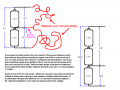
Here's a drawing showing two setups: One is that of two batteries with a zero point in-between the two batteries. I suspect by now you've got that much figured out. The second set of batteries shows that the "Common" or "Ground Reference" point is further low than it is high. So ground as you're thinking of it can be anywhere. Even at the top. If at the top then the whole circuit would be negative. But between any two given points (as on your drawing) there's going to be a more positive point and a more negative point. Thus, when you probe a resistor you're going to find one end has a positive voltage and the other has a negative.

batteries.png
 
Last edited:

atferrari

Joined Jan 6, 2004
5,012
You could set it up according to the proper use of the symbol which is Earth Ground and this would set up a reference point.:p
Max.
Hola Max,

Isn't the Signal Ground name, misleading, not for you but whoever approaches this for the first time?

It seems to exclude de facto, power supply voltages and digital signals if not expressly mentioned somewhere else in the schematic..

Why is not named "Common" what I understand is a realistic name?

Thanks to your insistent preaching (it is good you do it :)) I learnt, that for more than 40 years, I was using the Earth Ground symbol when I should have used the triangle (Signal ground). I was surprised when asking questions about a PID circuit (somewhere else in this site) and one of the replies concluded that my circuit was grounded to earth. I was just trying to show the point common to all measurements: power voltages and signals.
 

Thread Starter

JackSpratt

Joined Jul 27, 2017
26
No particular benefit.
He just wanted you to get around the idea that ground is some magical fixed point.
No they were wired the same.
It's just that any polarity sensitive devices, like a generator, starter motor, or radio for example, had to be designed to work with a negative voltage with the positive (chassis) being ground.
In those days they didn't have that many polarity sensitive devices on a car as now. ;)
When I asked about a benefit I was referring to the concept in general. What benefit is there to the "rule" that was established that states that ground can be any point in the circuit that one desires? It seems to me that this can only make things more difficult, for example if someone refers to a voltage as being, say, 100V with respect to ground, if not explicitly stated already, one would have to ask "but where is ground" to be sure they were getting the right information. Would it not be that much easier if by convention everybody agreed that the negative terminal of whatever power source was "ground" for the purpose of measuring and/or stating voltages. The fact that this is not the case suggests that this would be problematic somehow. Why? Or if not, then again, what is the benefit?
 

dl324

Joined Mar 30, 2015
18,341
Would it not be that much easier if by convention everybody agreed that the negative terminal of whatever power source was "ground" for the purpose of measuring and/or stating voltages. The fact that this is not the case suggests that this would be problematic somehow. Why?
Consider the example that's already been given with 2 batteries in series. Each battery has a negative terminal, but only one of them could be considered circuit ground.

You're over thinking this. Ground is a reference for convenience. Circuit ground doesn't have to be at the same potential as earth ground. Back in the old days, some cars had "positive ground"; which is the opposite of cars these days.
 

Thread Starter

JackSpratt

Joined Jul 27, 2017
26
But at the end of the day, you could throw a dart at your schematic and whatever node is closest to where you hit, you can call that your common. It just means that whenever you talk about the voltage at any other point in the circuit, you have to use the voltage at that point relative to your chosen common node.
I'm confused about your use of the term "common". To me common refers to something like the chassis connected to earth ground in a guitar amplifier as I talk about in the the other reply I just posted. My understanding is that it is "common" because it is the common return path for the electrical current flowing in the circuit, hence when you look at a schematic you see many triangular grounding symbols indicating various components and signal paths etc. connecting to (dare I say it) ground to complete the circuit. But you seem to be suggesting that common refers to something completely arbitrary, as in the term "ground" which started all this, (which makes sense I guess as it was stated by Max that ground and common were the same thing). I still have the feeling there is one important thing that I mis-conceptualized early on that is messing me up and I have to figure out what it is. Or is it common (pardon the pun) for newbies to get confused by this stuff in the same way that I am?
 

Thread Starter

JackSpratt

Joined Jul 27, 2017
26
Consider the example that's already been given with 2 batteries in series. Each battery has a negative terminal, but only one of them could be considered circuit ground.

You're over thinking this. Ground is a reference for convenience. Circuit ground doesn't have to be at the same potential as earth ground. Back in the old days, some cars had "positive ground"; which is the opposite of cars these days.
I probably am over thinking it, but on the other hand, I'm still confused, especially by a lot of the terminology, and I don't like to just give up. Just getting to the battery example.
 

Thread Starter

JackSpratt

Joined Jul 27, 2017
26
Consider the example that's already been given with 2 batteries in series. Each battery has a negative terminal, but only one of them could be considered circuit ground.

You're over thinking this. Ground is a reference for convenience. Circuit ground doesn't have to be at the same potential as earth ground. Back in the old days, some cars had "positive ground"; which is the opposite of cars these days.
OK, I see your point about the two negative terminals, that does indeed answer that question for me, thanks.
 

WBahn

Joined Mar 31, 2012
32,891
When I asked about a benefit I was referring to the concept in general. What benefit is there to the "rule" that was established that states that ground can be any point in the circuit that one desires? It seems to me that this can only make things more difficult, for example if someone refers to a voltage as being, say, 100V with respect to ground, if not explicitly stated already, one would have to ask "but where is ground" to be sure they were getting the right information. Would it not be that much easier if by convention everybody agreed that the negative terminal of whatever power source was "ground" for the purpose of measuring and/or stating voltages. The fact that this is not the case suggests that this would be problematic somehow. Why? Or if not, then again, what is the benefit?
There is no universal reference for the same reason that there is no universal reference when you talk about how high something is. Is it relative to the bottom of the object? Relative to the ground underneath it? Relative to mean sea level? Relative to the center of the Earth? Both are fundamentally difference measures and so both intrinsically involve a reference any time you want to talk about the measure at a point. And just like when talking about the height of something, the reference that makes the most sense depends on why you are talking about it.

For the convention you are wanting everyone to agree to assumes that every system that anyone might want to make voltage measurements on has one power source that has a negative terminal. What about a system that has many power sources? What about a system that has an AC power source? What about a system that doesn't have any power sources (for instance, might be optically or inductively powered)?
 

WBahn

Joined Mar 31, 2012
32,891
I'm confused about your use of the term "common". To me common refers to something like the chassis connected to earth ground in a guitar amplifier as I talk about in the the other reply I just posted. My understanding is that it is "common" because it is the common return path for the electrical current flowing in the circuit, hence when you look at a schematic you see many triangular grounding symbols indicating various components and signal paths etc. connecting to (dare I say it) ground to complete the circuit. But you seem to be suggesting that common refers to something completely arbitrary, as in the term "ground" which started all this, (which makes sense I guess as it was stated by Max that ground and common were the same thing). I still have the feeling there is one important thing that I mis-conceptualized early on that is messing me up and I have to figure out what it is. Or is it common (pardon the pun) for newbies to get confused by this stuff in the same way that I am?
The term "common" just means that it is a reference point that all other points have "in common". Just like a bunch of people from different places using a particular language as their "common language". Don't make it more than it is.
 

ebeowulf17

Joined Aug 12, 2014
3,307
The term "common" just means that it is a reference point that all other points have "in common". Just like a bunch of people from different places using a particular language as their "common language". Don't make it more than it is.
As a side note (not arguing against what's already been presented here) is there a better term to use for a negative voltage rail that's used as a common return point in a DC powered system?

I feel comfortable with the distinctions being made between different types of "grounds" and with the notion that a common reference point can be arbitrarily chosen anywhere. This is really just a question of vocabulary and semantics - intuitively, it makes sense to me that a negative voltage rail that's used for countless connections would be called a "common" and, like the thread starter, I had assumed that was part of the reason for the name. Is there a more appropriate name for this?
 
Top