Here's another description, not quite so technical.
We need to get the third leg up. We need to be able to point to something. Focus.
Something should be impressed on the source light. And if no source light, perhaps close by.
Aren't most black holes supposed to be in the center of galaxies? Plenty of light there.
The power released by the merging black holes was equivalent to 50 times the power of all the stars in the visible universe. In those 20 milliseconds, the energy of the waves was equivalent to annihilating the mass of three Suns.
That, I think, is science's greatest tragedy... one's an idiot until proven otherwise, and not the other way around.
And yet, that's also the most reliable path to truth...
Sad indeed for those lacking in perseverance
You know there are a million wrong ideas floating around, and that's only counting the Internet!
Somebody here regularly says, "Extraordinary claims require extraordinary proof."
Sometimes that happens.
All I can say is that this space-time thing really stretches my imagination.
And gravity stretches space-time?
Matter and energy can be interchanged?
Space and time are a function of each other?
This is not the kind of stuff that mixes well with beer.
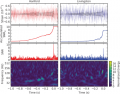
The study also once again puts Albert Einstein's theories to the test. For example, the researchers looked for an effect called dispersion, which occurs when light waves in a physical medium such as glass travel at different speeds depending on their wavelength; this is how a prism creates a rainbow. Einstein's general theory of relativity forbids dispersion from happening in gravitational waves as they propagate from their source to Earth. LIGO did not find evidence for this effect.
Artist's conception shows two merging black holes similar to those detected by LIGO. The black holes are spinning in a non-aligned fashion, which means they have different orientations relative to the overall orbital motion of the pair. LIGO found hints that at least one black hole in the system called GW170104 was non-aligned with its orbital motion before it merged with its partner. Credit: LIGO/Caltech/MIT/Sonoma State (Aurore Simonnet)
"It looks like Einstein was right—even for this new event, which is about two times farther away than our first detection," says Laura Cadonati of Georgia Tech and the Deputy Spokesperson of the LSC. "We can see no deviation from the predictions of general relativity, and this greater distance helps us to make that statement with more confidence."
“The LIGO instruments have reached impressive sensitivities,” notes Jo van den Brand, the Virgo Collaboration spokesperson, a physicist at the Dutch National Institute for Subatomic Physics (Nikhef) and professor at VU University in Amsterdam. "We expect that by this summer Virgo, the European interferometer, will expand the network of detectors, helping us to better localize the signals.”
3.5 billion light years away... We supposedly have around 400 billion stars in the Milky Way, and yet the scientists are not optimistic about witnessing a black hole merger event, or neutron star collision in our neighborhood anytime soon... it tells you something about the rarity of these things...
Astrophysicists may have detected gravitational waves last week from the collision of two neutron stars in a distant galaxy — and telescopes trained on the same region might also have spotted the event.
Rumours to that effect are spreading fast online, much to researchers’ excitement. Such a detection could mark a new era of astronomy: one in which phenomena are both seen by conventional telescopes and ‘heard’ as vibrations in the fabric of space-time. “It would be an incredible advance in our understanding,” says Stuart Shapiro, an astrophysicist at the University of Illinois at Urbana–Champaign.
Scientists who work with gravitational-wave detectors won’t comment on the gossip because the data is still under analysis. Public records show that telescopes around the world have been looking at the same galaxy since last week, but astronomers caution that they could have been picking up signals from an unrelated source.
Gravitation anyway is the very intriguing force in the Nature. One my college from distant non-European nation was telling me fantastical story what happened at their Academy of Sciences Leading State Astronomical Observatory. When some years ago happened that all stars was just for the moment on one line in our Solar system, they begun to be ready for this for a long beforehand. They used all the resources to borrow the precision weight machines (scales) if they are digital, if they are accurate very much, and if they have functionality to be PC monitored. When that day and hour was there, logically, the more than dozen different weight readings indeed shown some micrograms mass shift for the short moment, when those planets was one-side of our planet. BUT....
But all that happened roughly 8 minutes BEFORE that astronomical event was possible to see by their large array telescope....
However there is nothing be curious, indeed in the formula of grand gravitational law, where You see any time-bound part? Nowhere, it means that gravitation is coming just flash-like, with infinite speed, whilst the light waves demand a 300 000 km/sec.
Then I asked when and where I ought to look for their grand article on this topic, and said I hope they will be no doubt elected for Nobel prize. Instead they replied - <<no, there will be no any article at all, because we are living in the most hardest economy obstacles, but if we shall produce the furor, we shall loose even that financing what we have now. We not want to loss the main instrument in the region>>. Thus they asked me never to disclose what it was the nation, sorry.
But hope the fact itself may be useful to push into some brain-crinkle.
Sure it's possible for gravity-waves to affect earth before the light-waves arrive. They both travel at the 'speed of light' in vacuum. Even deep space is not completely empty of matter with Interstellar Medium plasmas which slow electromagnetic waves by a media factor of refractive index vs vacuum. Gravity waves are not electromagnetic so (to the best of our current understanding) the media refractive index would be equal to vacuum. Over vast distances this difference could mean different arrival times.
RE:"" Over vast distances this difference could mean different arrival times""
Eight MINUTES time-shift in so cosmologically small distances as Solar system nearest planets to us???
I cant see any logic in Your words, except that PROBABLY this experiment may be reformulated that gravitational waves are travelling SEVERE MANY-FOLD faster than light waves.
If not agree, where in the formula F=G*M*m/R^2 You see the any kind of the time constant??
RE:"" Over vast distances this difference could mean different arrival times""
Eight MINUTES time-shift in so cosmologically small distances as Solar system nearest planets to us???
I cant see any logic in Your words, except that PROBABLY this experiment may be reformulated that gravitational waves are travelling SEVERE MANY-FOLD faster than light waves.
If not agree, where in the formula F=G*M*m/R^2 You see the any kind of the time constant??
RE:"" Over vast distances this difference could mean different arrival times""
Eight MINUTES time-shift in so cosmologically small distances as Solar system nearest planets to us???
I cant see any logic in Your words, except that PROBABLY this experiment may be reformulated that gravitational waves are travelling SEVERE MANY-FOLD faster than light waves.
If not agree, where in the formula F=G*M*m/R^2 You see the any kind of the time constant??
Are you really going there, Newtonian 'infinite speed'? Really? We have the best evidence of gravitational waves speed consistent with Einstein's general principle of relativity that equates the numerical value of the ultimate speed of gravity to that of the speed of light from several experiments. I'll stick to GR today instead.
I find these reports fascinating, although controversial. One leading theory is that the flow of dark matter is being affected when massive bodies align.
I may believe they was able to produce the mistake for 8 picoseconds but not for 8 minutes. That is a space industry world class monitoring station equipped to measure 100 000 km distances to satellites within 3 milimeters(!!) of accuracy. Picoseconds are their everyday bread. Okay, scales maybe was slightly less precise but even 8 seconds may not counterweight the 8 MINUTES !
RE: NSA Spook - thanks for reference.
CMartinez. Even more thanks for Yours reference
The three physicists, Rainer Weiss, Kip Thorne, and Barry Barish, won the coveted prize for the detection of gravitational waves–the ripples in the fabric of spacetime that were first predicted by Albert Einstein a century ago. Weiss, Thorne, and Barish made the discovery as part of the LIGO/VIRGO Collaboration back in February 2016.

 Facebook
 Google
 GitHub
 Linkedin