Full Wheatstone Strain Gauge - Design Question

Thread Starter

protocrank

Joined Sep 16, 2025
12
Howdy,

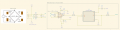
I'm designing some circuity that will provide a clean, amplified output signal from a strain gauge and would love to hear some feedback!

  1. Should I have the R1 & R2 resistors between the gauge & diff amplifier? I saw another design use these but in my head I'm thinking that they would cause a voltage drop of 1% error before reaching the amp, so perhaps it would be best to omit them.
  2. I am trying to write a transfer function to relate the voltage at AnaOut to Force in newtons. Has anyone here used a 350oHm full bridge gauge that knows how much force is required for a full scale voltage reading? I will then use a relationship to relate percentages of full scale.
Any other design tips from your experiences are much appreciated, thank you!
 

Attachments

ericgibbs

Joined Jan 29, 2010
21,420
hi pc,
Welcome to AAC.
I would keep the input resistors and capacitor in circuit, they act as a noise filter.
For your 350R bridge what is the max load and the mVout/Vextcitation.?
E
 

Thread Starter

protocrank

Joined Sep 16, 2025
12
hi pc,
Welcome to AAC.
I would keep the input resistors and capacitor in circuit, they act as a noise filter.
For your 350R bridge what is the max load and the mVout/Vextcitation.?
E
Thanks Eric!

Gotcha, I suppose by the differential nature that by having the resistors there, I still see the same difference across the high and low Vout sides of the bridge.

The sensitivity of the bridge if 2mV/V. I don't know what the max load is - I suppose I would need run a test to see how many N it requires to hit the full scale voltage and then use a linear relationship.

Best.
 

ericgibbs

Joined Jan 29, 2010
21,420
hi pc,
Assuming 2mV/V with a 3.3V bridge supply.
Gain of 100 and Vout max of say 3.0v
2mV would give 200mVout, so 3,0v/0.2v would limit the max output of bridge to ~15mV

As you have a Vzero Offset voltage of 0.5V, that would be reduced to a 2.5Vout so 2.5V/0.2V =12.6mV

So would suggest you assume a bridge output of 10mV at full load.
How is the scale being used?

E
 

Thread Starter

protocrank

Joined Sep 16, 2025
12
hi pc,
Assuming 2mV/V with a 3.3V bridge supply.
Gain of 100 and Vout max of say 3.0v
2mV would give 200mVout, so 3,0v/0.2v would limit the max output of bridge to ~15mV

As you have a Vzero Offset voltage of 0.5V, that would be reduced to a 2.5Vout so 2.5V/0.2V =12.6mV

So would suggest you assume a bridge output of 10mV at full load.
How is the scale being used?

E
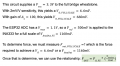
Here's the math that I've come up with, if you have the time please review and provide feedback that would be very helpful!

Screenshot 2025-09-16 at 11.53.20 AM.png
The 'Fout, Full Scale' i'm thinking will have to be an experimental value that I test to find out.
 

sghioto

Joined Dec 31, 2017
8,634
I'm designing some circuity that will provide a clean, amplified output signal from a strain gauge and would love to hear some feedback!
I don't see the need for the op amp buffer.
Why not run the bridge and INA333 from the 5 volt supply?
Pin5 Ref should connect to 1/2 Vcc for lowest offset.
 

Thread Starter

protocrank

Joined Sep 16, 2025
12
I don't see the need for the op amp buffer.
Why not run the bridge and INA333 from the 5 volt supply?
Pin5 Ref should connect to 1/2 Vcc for lowest offset.
Hey sghioto,

The incoming 5V is relatively noisy and I wanted a much cleaner +3.3V to excite the bridge with.
If i were to Ref with 1/2Vcc, so either 1.65V or 2.5V, the output from the op would be over the 1.1V max input to the ESP32-S3 ADC.
 

ericgibbs

Joined Jan 29, 2010
21,420
hi pc,
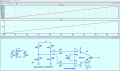
This is a LTSpice simulation of your INA amp.

I would advise you to use the same power supply of 3.3v for the Bridge and the ESP32.
The ADC in the ESP32 is a ratiometric type, which means the ADC adjusts the maximum ADC count to match the Vsupply.
This means if the bridge is powered from a separate supply say 5v, which may vary slightly the ADC conversion will be incorrect.
However, if the bridge and ESP32 are powered from the same voltage any slight drift in voltage will not cause a ADC conversion error.

On the simulation, I have varied the value of one of the 350R resistors in order to provide a test signal.

E
EG 1728.png
 
Last edited:

Thread Starter

protocrank

Joined Sep 16, 2025
12
hi pc,
This is a LTSpice simulation of your INA amp.

I would advise you to use the same power supply of 3.3v for the Bridge and the ESP32.
The ADC in the ESP32 is a radiometric type, which means the ADC adjusts the maximum ADC count to match the Vsupply.
This means if the bridge is powered from a separate supply say 5v, which may vary slightly the ADC conversion will be incorrect.
However, if the bridge and ESP32 are powered from the same voltage any slight drift in voltage will not cause a ADC conversion error.

On the simulation, I have varied the value of one of the 350R resistors in order to provide a test signal.

E
View attachment 355993
Thank you very much for providing this! I will make the suggested modifications, your input is well appreciated.

Best.
 

Thread Starter

protocrank

Joined Sep 16, 2025
12
Thank you very much for providing this! I will make the suggested modifications, your input is well appreciated.

Best.
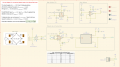
For context, this circuity I provided above is on a PCB (let's call it SensorFilter), which is connected via 6inches of wires to a MainBoard PCB. The MainBoard has the ESP32 and is powered by a 3.3V source that I can't assume is noise-free.
Would you still suggest that I route that ESP32's 3.3V supply to a wire to the SensorFilter & bridge excitation?
Another option could be to use an ESP GPIO pin and route that signal to the bridge & force a 3.3V potential.
Let me know your thoughts.

Thanks!Screenshot 2025-09-17 at 11.33.04 AM.png
 

ericgibbs

Joined Jan 29, 2010
21,420
For context, this circuity I provided above is on a PCB (let's call it SensorFilter), which is connected via 6inches of wires to a MainBoard PCB. The MainBoard has the ESP32 and is powered by a 3.3V source that I can't assume is noise-free.
Would you still suggest that I route that ESP32's 3.3V supply to a wire to the SensorFilter & bridge excitation?
Another option could be to use an ESP GPIO pin and route that signal to the bridge & force a 3.3V potential.
hi pc,
I would advise against using this option.
Another option could be to use an ESP GPIO pin and route that signal to the bridge & force a 3.3V potential.

I route that ESP32's 3.3V supply to a wire to the SensorFilter & bridge excitation?

I would use a screened wire pair, connected as close as possible to the ESP32 supply pins then to the bridge PCB.
You could add a 100nF cap, if there is space, across this pair on the bridge end.

E
 

Thread Starter

protocrank

Joined Sep 16, 2025
12
hi pc,
I would advise against using this option.
Another option could be to use an ESP GPIO pin and route that signal to the bridge & force a 3.3V potential.

I route that ESP32's 3.3V supply to a wire to the SensorFilter & bridge excitation?

I would use a screened wire pair, connected as close as possible to the ESP32 supply pins then to the bridge PCB.
You could add a 100nF cap, if there is space, across this pair on the bridge end.

E
From what i'm reading about the ESP, it seems as though their ADC has its own 1.1V reference. How do you know that their ratiometric ADC uses the 3.3V supply as its scale and not the 1.1V?
thanks!
 

MisterBill2

Joined Jan 23, 2018
27,359
I don't see the need for the op amp buffer.
Why not run the bridge and INA333 from the 5 volt supply?
Pin5 Ref should connect to 1/2 Vcc for lowest offset.
I don't see any "op amp buffer" in any of the circuits, and certainly the INA333 is not just an opamp. If it can be used at 5 volts I think that is better because it can provide a greater signal swing for the same output. AND you have a greater output from the bridge. Best of all, by not having the output so close to the supply, the linearity is better.
 

WBahn

Joined Mar 31, 2012
32,777
Howdy,

I'm designing some circuity that will provide a clean, amplified output signal from a strain gauge and would love to hear some feedback!

  1. Should I have the R1 & R2 resistors between the gauge & diff amplifier? I saw another design use these but in my head I'm thinking that they would cause a voltage drop of 1% error before reaching the amp, so perhaps it would be best to omit them.
  2. I am trying to write a transfer function to relate the voltage at AnaOut to Force in newtons. Has anyone here used a 350oHm full bridge gauge that knows how much force is required for a full scale voltage reading? I will then use a relationship to relate percentages of full scale.
Any other design tips from your experiences are much appreciated, thank you!
How much force is needed to produce a given output is dependent on a number of things, the most critical of which you haven't even mentioned.

Think about how a strain gauge works. You apply a force to something that causes a mechanical deformation of some kind. You bond a strain gauge to the mechanical device so that it sees a deformation that is related to the device's deformation. That deformation causes the electrical properties of the gauge to change -- in this case the resistance. That change is then sensed by an electrical circuit of some kind (a Wheatstone bridge, in this case).

All of those introduce a conversion gain to go from force to voltage. The dominant one, from a design standpoint, is the first one -- you design the mechanical apparatus so that you have a suitable conversion gain from applied load to mechanical stain. The other conversion factors are pretty well constrained and only vary by a relative small amount. The first one varies all over the place, from a small fraction of a newton per microstrain, to millions of newtons per microstrain.

So the answer to your second question is entirely dependent on the mechanical design of your load cell. How well do you know that?
 

MisterBill2

Joined Jan 23, 2018
27,359
OK, and I did miss the comment about the 5 volt supply being noisy.
so I would suggest filtering out the 5 volt noise. Depending on the power budget and the available space, there are some other options that might be considered.
A very effective way to improve a signal to noise ratio is to increase the signal amplitude, which is why I suggested the 5 volts.
 
Top