FM Transmitter - Breakdown & Analysis

DickCappels

Joined Aug 21, 2008
10,661
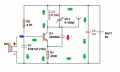
The resulting carrier signal doesn't completely go to the the antenna, some of it comes back around through the path of the R2 resistor/out towards the battery..

There is practically no RF across R2 because C1 and C3 appears as two capacitors in series that short out R2 at RF frequencies.


thus requiring the C1/C3 capacitor to keep the circuit 'clean' from the high RF?

C1 provides an RF path from the base of Q1 to ground. Remember I told you that in this oscillator the transistor is in the grounded base configuration.

C3 completes the RF circuit between the top capacitor and the emitter resistor and base, it is necessary for the circuit to oscillate. Actually if the battery has sufficiently low impedance at the oscillation frequency a separate discreet capacitor is not needed because the battery would fulfill that function.


R1 & C2 form a high pass filter, which in turn creates the feedback mentioned earlier? (why is this feedback needed?)

R1 sets the current through the transistor and C2 couples some current from the collector back to the emitter. Other than setting the current R1 is not significant. The feedback is necessary to cause the transistor to push a little more current into the LC tank circuit just as the current in the tank hits the bottom of its cycle, this little "push" at just the right time keeps the oscillator running, just a pushing somebody on a swing at just the right time keeps that person swinging rather than coasting to a stop.
 

Audioguru

Joined Dec 20, 2007
11,248
R1 & C2 form a high pass filter, which in turn creates the feedback mentioned earlier? (can the circuit function without it? how exactly does it 'tune' the tank circuit? how does it affect the carrier signal?)
R1 is the emitter resistor that must be used in this oscillator since the emitter is the input.
C2 simply passes some of the high frequency signal from the collector output to the emitter input as positive feedback so that it is an oscillator.
 

Thread Starter

Max Kreeger

Joined Oct 1, 2013
95
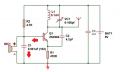
Probably should have provided another circuit of what I was imagining.

So it has been mentioned that C1 is there to short 100Mhz and only let through the desired frequency (e.g. 5Khz). Thats fine, I understand that now, but what puzzled me next was, why was there 100Mhz at the input? How was it getting there?

The circuit below is how I imagine the 100Mhz signal traveling.

The red arrows showing the potentially unwanted signals thus requiring capacitors C1/C3 to short them out.
The green showing what we want to achieve (5Khz imposed onto the carrier signal and transmitted).

Is this correct? I mean how else would a 100Mhz signal appear at the input? Unless I'm missing some theory whereby an RF signal can come out of the base of a transistor?


FM TX.png
 

nsaspook

Joined Aug 27, 2009
16,330
The RF signal travels across the transistor structure from emitter to base to collector. This means some fraction of circuit RF voltage is on the base and this voltage must have it's own low impedance loop path (c1) to generate a base current within the transistor to amplify the input signal from the emitter.
 
Last edited:

Audioguru

Joined Dec 20, 2007
11,248
The transistor is a common base amplifier at radio frequencies. Then the collector is the output and the emitter is the input. C2 provides positive feedback from the collector output to the emitter input so it oscillates at the radio frequency. The audio at the base causes the transistor to conduct more and less that causes its capacitance to increase and decrease which FM modulates the RF.
 

Thread Starter

Max Kreeger

Joined Oct 1, 2013
95
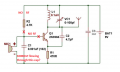
Ok..I think I got it this time. To say my theory is a bit rusty is an understatement.. again thank you all for your patience.


FM TX.png

Is this correct?

Few more questions:
1.) How does the high RF not cancel out the audio signal (blue arrow). It still has to travel left from the base to reach C1 to go to ground..wouldn't the signals 'crash' into each other?
2.) In simple examples, for oscillations to occur in the tank circuit...the capacitor is charged by the battery and then the connection to the capacitor is opened to allow the cap to discharge into the inductor..vice versa creating oscillations. Isn't the battery constantly charging the capacitor? What creates that 'open switch' state that allows it to discharge?
3.) NsaSpook mentioned the RF on the base needs a ground path to create a base current...but wouldn't the battery/microphone provide a base current?
 

nsaspook

Joined Aug 27, 2009
16,330
Ok..I think I got it this time. To say my theory is a bit rusty is an understatement.. again thank you all for your patience.


View attachment 141696

Is this correct?

Few more questions:
1.) How does the high RF not cancel out the audio signal (blue arrow). It still has to travel left from the base to reach C1 to go to ground..wouldn't the signals 'crash' into each other?
2.) In simple examples, for oscillations to occur in the tank circuit...the capacitor is charged by the battery and then the connection to the capacitor is opened to allow the cap to discharge into the inductor..vice versa creating oscillations. Isn't the battery constantly charging the capacitor? What creates that 'open switch' state that allows it to discharge?
3.) NsaSpook mentioned the RF on the base needs a ground path to create a base current...but wouldn't the battery/microphone provide a base current?
1. They don't crash, they superimpose for the total base current, each at it's own frequency and level.
2. The transistor provides the switching 'kick' to maintain oscillations. In this case it's more of a continuous kick over the cycle.
3. As in 1, the total base current is from all current sources. The contribution from the RF signal superimpose with the other current sources.
 
Last edited:

nsaspook

Joined Aug 27, 2009
16,330
So my last circuit was correct? From a DC perspective, would this be a common emitter configuration?
The arrows? Understanding the direction of energy flow is what's important from the signal perspective.

The circuit configuration (common base/emitter) matters to the signals moving in (base and emitter) and out. Strictly from a transistor DC bias perspective it doesn't matter what's common as long as the proper conditions exist inside the transistor during circuit operation.
 

Audioguru

Joined Dec 20, 2007
11,248
Is this correct?
I do not know why you have arrows on the schematic.

Few more questions:
1.) How does the high RF not cancel out the audio signal (blue arrow). It still has to travel left from the base to reach C1 to go to ground..wouldn't the signals 'crash' into each other?
The RF is at the emitter, not at the base because C1 prevents any RF at the base. The transistor base voltage changes by the audio causes the transistor to conduct more and less, and the emitter voltage changes caused by the RF positive feedback also causes the transistor to conduct more and less.

2.) In simple examples, for oscillations to occur in the tank circuit...the capacitor is charged by the battery and then the connection to the capacitor is opened to allow the cap to discharge into the inductor..vice versa creating oscillations. Isn't the battery constantly charging the capacitor? What creates that 'open switch' state that allows it to discharge?
The capacitor is charged by the battery and discharges into the inductor. The RF positive feedback to the emitter causes base-emitter current changes that causes the transistor to do the charging or discharging. The transistor is a closed switch when it is conducting and is an open switch when it is not conducting.

3.) NsaSpook mentioned the RF on the base needs a ground path to create a base current...but wouldn't the battery/microphone provide a base current?
Base current is provided by R2. There is no RF at the base. The base current has audio fluctuations.
 

Thread Starter

Max Kreeger

Joined Oct 1, 2013
95
The arrows show my understanding of how RF flows through the circuit keeping in mind NsaSpooks comment:

The RF signal travels across the transistor structure from emitter to base to collector. This means some fraction of circuit RF voltage is on the base and this voltage must have it's own low impedance loop path (c1) to generate a base current within the transistor to amplify the input signal from the emitter.
So just wanted to confirm if I was visualizing it properly..
 

Audioguru

Joined Dec 20, 2007
11,248
Repeat: There is no RF at the base.
The base is common and the emitter is the input at the RF frequency.
How do you make the transistor conduct more? Increase the base voltage or decrease the emitter voltage that do the same thing, they cause more base-emitter voltage. The RF positive feedback fluctuates the emitter voltage. The audio fluctuates the base voltage.
 

Thread Starter

Max Kreeger

Joined Oct 1, 2013
95
C1 provides an RF path from the base of Q1 to ground. Remember I told you that in this oscillator the transistor is in the grounded base configuration.
Assuming what DickCappels said looks like the following flow diagram:
FM TX.png

So who is wrong and who is right? If there is no RF at the base..why do we need to short 100Mhz at the base? I'm confused..
 
Last edited:

Audioguru

Joined Dec 20, 2007
11,248
The oscillator probably will not work if C1 is missing. I never tried it because the common base oscillator always has the capacitor C1 to short the base to ground at the RF frequency. When the base or anything is shorted to ground then it has no RF.
 

Thread Starter

Max Kreeger

Joined Oct 1, 2013
95
Thank you. Now we understand where the confusion lies.

C1 affects low frequencies differently than it affects high frequencies.

C1 and R2 set the electrical bandwidth of the microphone input, assuming that this is an electretet mic and the output looks like the drain of a JFET. 1/(2 Pi RC) = 34 kHz, or putting it another way, the reactance of C1 at 5 kHz is 32,000 ohms - not a short circuit. But wait...there's more:

At 100 MHz the reactance of C1 is only 1.6 ohms.

The result is that the 5kHz audio signal goes sailing unhindered into the base of the transistor so it can modulate the oscillator frequency while 100 MHz RF signal gets shunted to ground through a very low impedance, which allows the circuit to oscillate.
This is where my confusion lies.
- "5kHz audio signal goes sailing unhindered into the base of the transistor"
- "while 100 MHz RF signal gets shunted to ground through a very low impedance"

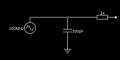
For an RF signal to be shunted through the capacitor to ground..that means obviously a signal needs to come from somewhere to be able to flow through that capacitor..to ground.. The only 2 legs that lead into that C1 capacitor is from R2..and from the Q1 base....but if there is no RF on R2 as previously mentioned and there is no RF signal on the base....how can 100Mhz be passing through the C1 capacitor? Where does it come from? I hope you understand what I mean.
FM TX.png


EDIT:
See this makes sense to me...there is a source...and that source is shunted. In the FM schematic I don't understand where the 100Mhz source is or how that 100Mhz signal goes across C1 if neither of the 2 paths leading to it carry an RF signal.
Untitled.png
Disregard the component values
 
Last edited:

Audioguru

Joined Dec 20, 2007
11,248
The datasheet of a transistor shows the very small capacitances inside it. Stray wiring capacitances are outside it. These capacitances couple RF from the emitter to the base but C1 shorts it to ground so it does not cause a problem. A short has no signal voltage across it.
At 100MHz, a tiny 5pF is 320 ohms and couples 100MHz very well. 0.001uF is 1.6 ohms and shorts 100MHz very well.
 

Thread Starter

Max Kreeger

Joined Oct 1, 2013
95
Yes! Thank you so much!!

I'm out of questions. Once again, thank you very much for your patience...truly appreciate everyone sharing their knowledge.

EDIT: ...one last one...is that the same principle for C3..stray capacitance?
 

nsaspook

Joined Aug 27, 2009
16,330
This is where my confusion lies.
- "5kHz audio signal goes sailing unhindered into the base of the transistor"
- "while 100 MHz RF signal gets shunted to ground through a very low impedance"
I understand why this is so tricky to understand so review some basics first:
The physics of how a transistor operates doesn't change due to the circuit configuration.

https://en.wikipedia.org/wiki/Bipolar_junction_transistor#Transistor_parameters:_alpha_(α)_and_beta_(β)
The proportion of electrons able to cross the base and reach the collector is a measure of the BJT efficiency. The asymmetric heavy doping of the emitter region and light doping of the base region cause many more electrons to be injected from the emitter into the base than holes to be injected from the base into the emitter. The common-emitter current gain is represented by ßF or hfe and is approximately the ratio of the DC collector current to the DC base current in the forward-active region. It is typically greater than 100 for small-signal transistors but can be smaller in transistors designed for high-power applications. Another important parameter is the common-base current gain, aF. The common-base current gain is approximately the gain of current from emitter to collector in the forward-active region. This ratio usually has a value close to unity; between 0.98 and 0.998. Alpha and beta are more precisely related by the following identities (NPN transistor):
When we do the small signal ac analysis of the FM transmitter circuit C1 is a short so no RF voltage on the transistor pin but there is an (small) RF current path there on the base because of Alpha and transistor current moving from emitter to collector.
Relation between Alpha (α) and Beta (Β)
Β = α/(1-α)
OR
α = Β /(1 + Β)

http://uotechnology.edu.iq/dep-laserandoptoelec-eng/laboratory/2/electronic1/Common Base Amplifier.pdf
 
Top