FM Transmitter - Breakdown & Analysis

Thread Starter

Max Kreeger

Joined Oct 1, 2013
95
Hi guys,

I've been looking at building a simple FM transmitter to develop my understanding of wireless transmission - I find that's the best way to learn. Unfortunately, a lot of YouTube videos fail to analyze the circuit and just jump straight into putting the components together.

I have come across the following schematic, see below:
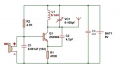
FM TX.png

While I understand the higher level theory of the system and what it needs to achieve to transmit (modulation, demodulation). I don't understand why the specific components were placed as they are. From what I can see, L1 and VC1 are forming the tank circuit, but components such as C1, C2 and C3 I can't figure out what role they play. I would appreciate any insight into the design principles behind this circuit.

Thanks in advance!
 

Thread Starter

Max Kreeger

Joined Oct 1, 2013
95
That looks like an AM transmitter - which is where you should be starting to learn.
The website definitely states 'FM'..unless they themselves have made a mistake..

Website source: http://www.buildcircuit.com/simple-steps-for-making-fm-transmitter/

EDIT: I took your advice and had a look at some AM Transmitters:
AM TX.png

Again, I can recognize the tank circuit but have trouble seeing the overall operation. I can't see how that tank circuit will allow for oscillation if it has the constant 9V charging it. I must be missing something..
 
Last edited:

nsaspook

Joined Aug 27, 2009
16,252

Thread Starter

Max Kreeger

Joined Oct 1, 2013
95
That OP circuit acts as a common base RF oscillator.


The input modulation varies the transistor PN junctions parasitic capacitances causing crude FM. Input and Output are in phase so C2 provides positive feedback/tuning for the oscillator. C1 is a RF bypass for the carrier frequency while C3 is a RF bypass for the battery.
https://wiki.analog.com/university/courses/electronics/electronics-lab-pn-junction-cap
Thanks for that!
A few more questions:
- For C2 though, how is it exactly 'tuning' the oscillator circuit?
- You mentioned C1 is a RF bypass for the carrier frequency - I'm assuming like you mentioned above, the phenomena of parasitic capacitance is creating the carrier frequency? But won't that C1 just short all AC signals from the microphone to ground? How will any signal pass it?
- Going on from the above point, so then should there technically be a bypass capacitor in the AM circuit? for the 9V input? What is the advantage of having an RF bypass Cap for the battery?
 

nsaspook

Joined Aug 27, 2009
16,252
Thanks for that!
A few more questions:
- For C2 though, how is it exactly 'tuning' the oscillator circuit?
- You mentioned C1 is a RF bypass for the carrier frequency - I'm assuming like you mentioned above, the phenomena of parasitic capacitance is creating the carrier frequency? But won't that C1 just short all AC signals from the microphone to ground? How will any signal pass it?
- Going on from the above point, so then should there technically be a bypass capacitor in the AM circuit? for the 9V input? What is the advantage of having an RF bypass Cap for the battery?
C2 is effectively in VC1 L1 tuning energy flow too. It affects the highest range of the the oscillator.
No, parasitic capacitance is NOT creating the carrier frequency, it changes the carrier frequency as the bias on the base is modulated, so you want to inject only the modulation frequency on the base not the RF carrier. The RF bypass at the battery is to lower the power source impedance at RF to a low value, if we don't do this then the battery becomes part of the tuning circuit. We want it to supply DC power not reactance.
 
Last edited:

DickCappels

Joined Aug 21, 2008
10,661
C1 makes the base look like it is at ground to the RF to make this a grounded base oscillator per Max Kreeger in post #5
C2 is feedback to the emitter
C3 makes the battery look like a short to the RF -bypass capacitor

This is an FM transmitter with some AM. The frequency modulation occurs because the base voltage is modlated by the signal from the microphone. This causes a change in the depth of the depletion layer in the revere-biased base-collector junction, the same thing that happens inside a varactor diode.
 

DickCappels

Joined Aug 21, 2008
10,661
In this case the transistor operates as a common base amplifier that oscillates because of the tuned circuit and the feedback from the collector to emitter. Another term for common base is grounded base.
 

Thread Starter

Max Kreeger

Joined Oct 1, 2013
95
So what would happen if we removed C1? The base would still be connected to ground as would the MIC input signal?

So why isn't there a capacitor in parallel to the signal generator in this example:
 

nsaspook

Joined Aug 27, 2009
16,252
So what would happen if we removed C1? The base would still be connected to ground as would the MIC input signal?

So why isn't there a capacitor in parallel to the signal generator in this example:
Why would you want a signal short across the signal generator?

In the FM transmit circuit the value of C1 is chosen to be a RF shorting path (making it a common base configuration for RF signal flow) in the carrier frequency domain while being open (making it more of a common emitter configuration for audio signal flow) in the audio frequency domain to allow the modulation to pass. The circuit operates in different modes depending on the frequency due to the reactance of C1.
 
Last edited:

Audioguru

Joined Dec 20, 2007
11,248
It is a cheap and simple circuit. Yes it generates some AM but most FM radios ignor it.
Cheap and simple circuits have performance problems:
1) Its radio frequency changes as the battery voltage runs down because it is missing a voltage regulator.
2) Its radio frequency changes if something moves towards or away from its antenna because it changes the capacitance of the tuned circuit. It is fixed by adding an RF amplifier to isolate the antenna from the oscillator.
3) It will sound muffled with high audio frequencies cut when heard on an ordinary or high quality FM radio because it is missing pre-emphasis that is used on all FM radio stations. All FM radios have de-emphasis.
4) Its mic is not sensitive and you may need to talk loudly or scream because it is missing an audio preamp.

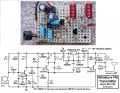
On another forum someone built a simple FM transmitter and complained about these problems so I fixed it:
 

Attachments

Thread Starter

Max Kreeger

Joined Oct 1, 2013
95
Why would you want a signal short across the signal generator?
.
That's exactly my point of confusion.

To me C1 just looks like a signal short.... across the signal generator (the mic).

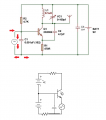
This is how I imagine the signal progressing (top figure):

From your comments, I'm guessing what the circuit is trying to achieve is the bottom figure. Would that be correct?
FM TX.png

I appreciate everyone's effort and patience.
 

DickCappels

Joined Aug 21, 2008
10,661
Thank you. Now we understand where the confusion lies.

C1 affects low frequencies differently than it affects high frequencies.

C1 and R2 set the electrical bandwidth of the microphone input, assuming that this is an electretet mic and the output looks like the drain of a JFET. 1/(2 Pi RC) = 34 kHz, or putting it another way, the reactance of C1 at 5 kHz is 32,000 ohms - not a short circuit. But wait...there's more:

At 100 MHz the reactance of C1 is only 1.6 ohms.

The result is that the 5kHz audio signal goes sailing unhindered into the base of the transistor so it can modulate the oscillator frequency while 100 MHz RF signal gets shunted to ground through a very low impedance, which allows the circuit to oscillate.

Xc = 1/(2Pi F C)
 

DickCappels

Joined Aug 21, 2008
10,661
The transistor is connected as a grounded base Colppits oscillator. For the RF, the base is grounded and the feedback to sustain oscillation flows through the capacitor connecting the emitter to the collector. The base "holds still" while all this goes on.

Maybe the discussion at the link below will also be helpful. In the discussion the battery is considered a dead short as far as the signals are concerned.
https://en.wikipedia.org/wiki/Colpitts_oscillator
 

Thread Starter

Max Kreeger

Joined Oct 1, 2013
95
Ok, so 100Mhz is the oscillating frequency...although I'm not sure how you came to that number.

I used: 1/2*pi*sqrt(LC)
L = 0.1uH
C= 100pF

Giving me a f= ~50Mhz

L = 0.1uH
C= 25pF

Gave me 100Mhz

Is that correct?
 

DickCappels

Joined Aug 21, 2008
10,661
100 MHz is near the middle of the FM broadcast band.

Your values for 100 Mhz work of a simple LC tank circuit but the actual oscillation frequency is a little different (lower I think) because of the feedback capacitor.
 

Thread Starter

Max Kreeger

Joined Oct 1, 2013
95
Ah ok... with this circuit I was just thinking the L and C in the tank circuit are picked to resonate at the carrier frequency that the designer wanted (seeing as its just a small application of the concept)..so got confused as to why the 100Mhz was pulled out.

Just to clarify/confirm a few more things:
- The resulting carrier signal doesn't completely go to the the antenna, some of it comes back around through the path of the R2 resistor/out towards the battery.. thus requiring the C1/C3 capacitor to keep the circuit 'clean' from the high RF?
- R1 & C2 form a high pass filter, which in turn creates the feedback mentioned earlier? (can the circuit function without it? how exactly does it 'tune' the tank circuit? how does it affect the carrier signal?)
 
Top