Facebook
 Google
 GitHub
 Linkedin
Hi,
I am trying to understand a circuit about a FM-radio. It is copied from: http://www.instructables.com/id/Simple-FM-Radio-sure-Works/
My drawing is attached (or : http://imgur.com/HkqR1dd ).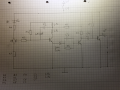
So far I figured out, that we have an LC-circuit, which oszillates at a specific frequency. The antenna catches a frequency from a radio station and if the two frequencys match, they add up. The first Transistor combined with the LC-circuit is an oscillator.
The germanium-diode is used to demodulate the signal.
The other transistors are used to amplify the signal.
I dont understand, (1) why the inductance is seperated in two parts and
(2) what the small circuit after the germanium-diode is used for. One capacity would decouple the two transistors, but why is there a resistance in parallel?
Thanks in advance,
Lukas
I am trying to understand a circuit about a FM-radio. It is copied from: http://www.instructables.com/id/Simple-FM-Radio-sure-Works/
My drawing is attached (or : http://imgur.com/HkqR1dd ).
So far I figured out, that we have an LC-circuit, which oszillates at a specific frequency. The antenna catches a frequency from a radio station and if the two frequencys match, they add up. The first Transistor combined with the LC-circuit is an oscillator.
The germanium-diode is used to demodulate the signal.
The other transistors are used to amplify the signal.
I dont understand, (1) why the inductance is seperated in two parts and
(2) what the small circuit after the germanium-diode is used for. One capacity would decouple the two transistors, but why is there a resistance in parallel?
Thanks in advance,
Lukas