Flashing LED for 10 seconds using one 555 chip

Unfortunately, a 10,000 uf, 50 volt cap that I checked on Amazon is 1.38 x 2.76 inches. Much too big to fit in a cigarette lighter adapter. Also, I assume that the brightness of the LED will fade to off as the 10 second delay expires. It is as simple as it gets though ... :)
I'm not suggesting the use of a 10k uf cap, its just a demo.

I think this is the simplest (same as post #45) and most compact. Be aware that some blinking LED's will need a series resistor. Also be aware the timing is dependent on supply voltage, RC time constant, and Mosfet VGS(th) values.
So you'll have to tune RC to obtain values for the desired timeout.
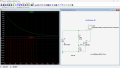
Test2.png
 
That 10,000 uF size is exactly the tell — if the LED current has to come out of the timing capacitor, the numbers never fit a 1-inch cube.

For a 20 mA LED held for 10 s, the charge is 0.02 x 10 = 0.2 C. If you allow the capacitor voltage to fall 5 V while it supplies that, C = 0.2 / 5 = 0.04 F, i.e. 40,000 uF. So a 10,000 uF part was already undersized for that topology, and still far too big physically.

The fix is to keep the timing capacitor out of the load path. Use the 555 as a 10 s monostable driving a MOSFET, with the LED current coming straight from the supply through the MOSFET. Then the timing is t = 1.1 x R x C, so 910k and 10 uF gives 1.1 x 910,000 x 0.00001 = 10.0 s, or 1M and 9.1 uF gives about the same. A 10 uF film or low-leakage tantalum fits easily; an ordinary electrolytic will drift a bit, so measure the actual time and trim R.

For the LED itself, size the series resistor for the running car voltage, not 12 V: with a red LED at about 2 V forward and 20 mA, (14.4 - 2) / 0.02 = 620 ohms, so use 680 ohms. That resistor drops about 12.4 V x 0.02 = 0.25 W, so use a 0.5 W part. And put 100 nF right at the 555 supply pins plus a 47 uF electrolytic nearby — the lighter socket is noisy and the 555 will false-trigger without it.
 
Top