Flash a 240vac Neon with a battery

Thread Starter

D6equj5

Joined Nov 4, 2017
5
Dear Forum,
years ago I was shown a flashing neon - it was powered by a 6v battery with a resistor and a capacitor. I am not an electronics wiz and need a little help with the calculations for choosing the resistor and capacitor values and types. I think the capacitor connected across the battery and the resistor from the positive battery terminal to one neon leg and the other neon leg to negative - however I just can not get this to flash... What type of capacitor and value would you suggest?

I'd appreciate some assistance with this mini conundrum, please.
 

Papabravo

Joined Feb 24, 2006
22,058
Your description sounds a bit dodgy. Short of building an inverter, which takes more than a resistor and a capacitor, I don't see those components producing an AC waveform.
 

Thread Starter

D6equj5

Joined Nov 4, 2017
5
Thank you, perhaps my memory is playing tricks - the neon flashed once every minute or so. I presume once the capacitor had charged.
 

Thread Starter

D6equj5

Joined Nov 4, 2017
5
No - certainly just the three components - is there a type of capacitor which will continue to charge beyond the output of a supply (6vDC battery) until it reaches it's stated voltage (say 100v / 240v)? Or can any capacitor only ever reach its DC supply voltage? Say a 0.1uf / 100v will only ever reach 6v if connected to a 6vdc battery?

Thank you for your time and brain with this - I have trawled gloggle without success.
 

Papabravo

Joined Feb 24, 2006
22,058
The circuit implements a relaxation oscillator. It depends on the characteristics of the neon tube. The tube should conduct at some voltage just below +80 to discharge the capacitor. The resistor and capacitor can then be charged from a low level up to the flash point. If you multiply the resistor value times the capacitor value you get the time constant of the RC circuit. It should take between three and five time constants to charge the capacitor. For example: suppose the R=1.5KΩ and the C=10,000 μfd. The time constant is 15 seconds. The charging time should be between 45 and 80 secondsdepending on the tube. I don't know if your 240 VAC tube will work with these parameters.

BTW for old radios they used to have 90V batteries, are you sure the demo used a 6V battery?

Edit: A capacitor cannot be charged above the level of the charging source. A 6V battery will charge the capacitor to just under +6V and that is it.
 

BillB3857

Joined Feb 28, 2009
2,573
I built one of those years ago, but used a 90v B-battery from a tube type portable radio that was too run down to operate the radio. I don't know if those batteries are even available now,
 

Reloadron

Joined Jan 15, 2015
7,862
Years ago Forrest M. Mimms published a few circuits for flashing and powering neon lamps, like the NE2 lamp using low DC voltage. Here is one such example, see page 115 in the link. Most circuits of this type consist of some form of oscillator, in this case a 555, driving a transformer such as an 8 Ohm / 1,000 Ohm small audio transformer. While there is no current to speak of you can get the gas in a neon lamp to ionize.

Ron
 

Rahulk70

Joined Dec 16, 2016
538
You could do it with a relay - connect the neon across the relay coil then connect and disconnect the battery. The neon will flash each time you disconnect the battery.
Running the electromechanical relay in oscillator mode with the neon lamp connected to the relay coil terminals will keep the neon continuously lighted (I've tried and it works).
 

dendad

Joined Feb 20, 2016
4,635
Ah!
This brings back memories!
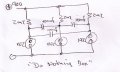
In 1971 there was a cute exchange student here in Oz from USA. I made her a "Do Nothing Box" in a plastic butter container. It was powered by 2 x 45V batteries to give 90V.
She liked it so much that a couple of years later I went to America and married her and we have been living here in Oz ever since :)
DoNothingBox.jpg
I think these are the values, but the Rs may have been higher. That will change the flash rate.
This circuit winks one neon after the other in sequence. Quite fun.
 
Last edited:

k7elp60

Joined Nov 4, 2008
562
One way to flash a neon bulb from a battery is use a small step up transformer. Use an oscillator such as a NE555 or a pair of transistors as a free running multivibrator at the flash rate you want. Drive the low turns side with the oscillator and connect the neon bulb on the secondary or high turns side. I have number of these transformers in my stock, as well as NE555 and or transistors for multivibrators. It can be done with a normal 9V battery. I just checked my stock and I have lots of NE51 and NE2 neon bulbs. I would be happy to help anyone that wants build one of these circuits and would ship the parts at your expense to you. I do not remember if this website allows personal messages. If so my screen name is k7elp60.
There are also small circuit boards available that will drive flourscent tubes from a DC supply. I have one that will illuminated up to 40W tube from a 12v DC battery.
 

Tonyr1084

Joined Sep 24, 2015
9,744
a 0.1uf / 100v will only ever reach 6v if connected to a 6vdc battery
Yup! You got it.

Was going to suggest an old transformer or other coil like
You could do it with a relay - connect the neon across the relay coil then connect and disconnect the battery. The neon will flash each time you disconnect the battery.
suggested, but then you don't need the capacitor or resistor. When you charge a 120 VAC transformer with 6 volts DC you build a small amount of magnetic energy. When you disconnect - that magnetic energy will collapse quite fast, generating the needed voltage to flash the neon bulb. But you have to make and break the contact every time you want it to flash.

You admit your memory is sketchy, so I'm sure you saw a cap and a resistor connected as per the diagram but the power source MUST have been high enough to reach the flash point of the neon bulb. Too much voltage and you'll need a resistor as well.

What's happening is that the capacitor is charging through the resistor. When the voltage is high enough to light the neon bulb it will conduct the current stored in the capacitor. When the voltage drops below its threshold the bulb will go out and stop conducting, allowing the capacitor to charge again.

I agree with Rahulk70, using the relay to supply power to itself through its normally closed contacts will cause it to chatter (when powered the relay will pull the contacts - when the contacts pull open the relay will lose power and drop out - when it drops out the flyback voltage will be sufficient to flash the neon bulb - when the contacts drop back the relay is again powered, repeating the process over and over).
 
Top