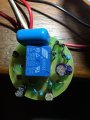
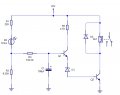
Fixing a dark sensing module, the transistor turns on by it self

ebp

Joined Feb 8, 2018
2,332
The only possible way for it to pull the relay at 1.3 V on the base (I assume to circuit common) of Q1 is that the zener is conducting in reverse with nearly zero bias, which means it is defective, possibly shorted.
 

Thread Starter

Yami

Joined Jan 18, 2016
354
The only possible way for it to pull the relay at 1.3 V on the base (I assume to circuit common) of Q1 is that the zener is conducting in reverse with nearly zero bias, which means it is defective, possibly shorted.
But the Zener is connected to the base of the Q2. Q1 turns on....I pulled the base of Q1 down to common using some alligator clips and a resistor the relay energizes but there is a slight delay.
 

ericgibbs

Joined Jan 29, 2010
21,467
hi Yami,
Do you have a link to where you got that awful circuit.?:rolleyes:
E
Do the maths for LDR Base drive., considering two transistor Vbe's in series.

Vb= 22* (1.2/(1.2+22))
 

Thread Starter

Yami

Joined Jan 18, 2016
354
hi Yami,
Do you have a link to where you got that awful circuit.?:rolleyes:
E
Do the maths for LDR Base drive., considering two transistor Vbe's in series.

Vb= 22* (1.2/(1.2+22))
I don't know the make this is how I got it. Just a follow up question please refer to the schematic doesn't R4 (connected to the base of Q1) have an impact on that equation?
Thanks
IMG_8869.JPG
 

Ylli

Joined Nov 13, 2015
1,092
Voltage across the voltage divider R3 is 6.4V when its light, when its dark it only goes to 5.6V
When the relay turns on regardless of the amount of light
Voltage across the voltage divider R3 is 5.9V when its light, when its dark it only goes to 4.8V
Whichever....

Even if the LDR (R2) drops to zero ohms, the maximum voltage you should ever see across R3 is
22 * 1.2/(1.2 + 22) = 1.14 volts. That's probably not enough to turn on the Q1/Q2 pair. Are you sure of the component values listed? Lift one leg of R4 and measure the voltage across R3 with and without light.
 

ericgibbs

Joined Jan 29, 2010
21,467
hi Yami,
Typically electrolytic caps have leakage currents in the order 10's of microamps, so the voltage on Q1 Base will be a little lower than the junction of LDR and R3.
I suspect the thinking of the designer, is that R4, with that strange value of 1.36K was an attempt at time delay.???

Even if D1 is removed, ie: shorted the circuit will not work as expected.

E
Re-Check the component values and the copper tracking.
 
Last edited:

ebp

Joined Feb 8, 2018
2,332
Neither transistor can turn on until the voltage across the capacitor is (2 x Vbe + Vz). If the zener conducts even a small amount of current below its nominal voltage, turn-on can be far lower than expected, but for the relay to pull at 1.3 V on the base of Q implies the zener is defective.
 

Thread Starter

Yami

Joined Jan 18, 2016
354
Hi guys, I made some mistake with some resistor values. I have now checked them with a meter(took one leg out and checked). Also the zener was shorted took it out. What would be a good replacement for that it is TZX 5V. only zeners I have is IN4748A which the breakover voltage is 22V! .
I was able to check the circuit with a 24V powersupply before the zener got shorted - it did work! but the time it takes to turn off the relay is a bit long I'm guessing due to the capacitor parallel to the base.
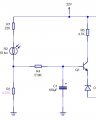
Here is the revise version of the circuit.


Darksensing.jpg
 

Dodgydave

Joined Jun 22, 2012
11,395
T = 1.1 *RC so that's 56 seconds Approx .

Further note, i would replace the transistors with one MPSA14G Darlington, and put the zener in series with the Base feed.
 

Thread Starter

Yami

Joined Jan 18, 2016
354
Thanks everyone for your help and time. I would really like to know one more thing, please correct me if I'm wrong. Capacitor (C1) charges through R1,R2 and R4 right? and it discharges through R3 and R4 right? The reason I ask this because I notice that the transistor turns on and off at different rates. So when calculating the time constant should I include the other resistors?
Thanks so much
Sen.jpg
 

Ylli

Joined Nov 13, 2015
1,092
Effectively, yes. Technically you would need to create a Thevenin equivalent of the combination of R1, R2, R3, and R4. The cap charges and discharges through that equivalent resistance to the Thevenin equivalent voltage. And that is neglecting the small base current into Q1.
 

Thread Starter

Yami

Joined Jan 18, 2016
354
Effectively, yes. Technically you would need to create a Thevenin equivalent of the combination of R1, R2, R3, and R4. The cap charges and discharges through that equivalent resistance to the Thevenin equivalent voltage. And that is neglecting the small base current into Q1.
So Rth should be use when calculating the time constant? T = R*C (R = Rth?)
 

Ylli

Joined Nov 13, 2015
1,092
So Rth should be use when calculating the time constant? T = R*C (R = Rth?)
Yes, but the voltage across the cap only needs to vary by a few tenths of a volt to go from off to on (and vis-versa). So the time delay may only be a few tenths of the RC depending on how much the Vth has changed with the change in lighting on the LDR.

So many variables here, even ambient temperature will have some effect..... Best way to determine delay time is experimentation.
 
Top