Five New Climate Reports

wayneh

Joined Sep 9, 2010
18,110
OK, let's use your data........:rolleyes:
The data show warming since we came out of a little ice age a few hundred years ago. Fine.
The data also show CO2 rising over the last couple hundred years. Fine.

The CAGW hypothesis is that the correlation of these observations is not coincidence, and more specifically is due to human activity. That's a reasonable hypothesis, although it ignores established data showing that historical CO2 lagged warming and was thus likely a result of warming, rather than the other way around.

But then the wheels really come off. Testing the hypothesis required building models of the climate that consider how human-made CO2 might affect future climate. These models have to use an estimate of the positive feedback associated with CO2. Even the alarmists agree that CO2 alone won't have a significant impact. It's the positive feedback – warmer oceans means more moisture in the air, which means still more greenhouse effect – that raises temperatures so alarmingly. I believe most of the models used feedback factors of 2-5, even though the true value is unknown and could be zero or even negative.

These models failed miserably over the last 20 years. The null hypothesis that the elevated CO2 in our atmosphere will have no effect, cannot be ruled out.

Where are the data that conclusively tie current temperatures with elevated, manmade CO2? Not just correlation, but causality.
 

Glenn Holland

Joined Dec 26, 2014
703
Every time the subject of man made global warming comes up, I ask this simple question:
What is the solution?

All hear is the same old worn out rhetoric like:
"Develop alternative energy sources and stop burning fossil fuels".
"Develop more fuel efficient cars".
"Invest more in mass transit".
"Open up more bike lanes".
"Build high rise apartments in compact cities and everyone will travel by trains".

OK - Where are all those alternative energy sources? We're still drilling for oil and gas (and causing earthquakes in Oklahoma) and most power plants are coal and natural gas.

OK - Even if a 100% fuel efficient car were developed, the energy consumption would still be quite large. It requires at least 30 Hp. to keep a 3000 Lb. object (a car) moving at 55 MPH.

OK - Mass transit doesn't go every place everyone wants to go whenever they want to go. If you're dependent on mass transit, your freedom to travel is going to be greatly limited and it will take 3 to 4 times longer to get anywhere than driving.

OK - So everyone is going to bike an average of 20 miles per day and spend hours getting some place that driving could take them in only 1 hour. And you will be totally exhausted from all the pedaling.

OK - Who's going to pay for all those high rise apartments and trains? High rises and trains are NOT affordable for the middle class so the government must subsidize all these hyper expensive amenities. But the government doesn't have any money that hasn't come from taxes on the middle class.

However here's a simple solution that doesn't cost anything: Since most environmental problems are man made, then stop making man. In other words use birth control. Problem solved.
 

Thread Starter

BR-549

Joined Sep 22, 2013
4,931
We already did that years ago. But it doesn't help when you open the borders. Now we have to raise and provide power to their kids.
See how it works?
 

Glenn Holland

Joined Dec 26, 2014
703
We already did that years ago. But it doesn't help when you open the borders. Now we have to raise and provide power to their kids.
See how it works?
Here in California, we're experiencing a socio-economic problem what I call "Second Hand Parents".

It's analogous to breathing "Second Hand Smoke" from someone else's smoking and we're acting as parents for someone else's offspring.
 

ronv

Joined Nov 12, 2008
3,770
The data show warming since we came out of a little ice age a few hundred years ago. Fine.
The data also show CO2 rising over the last couple hundred years. Fine.

The CAGW hypothesis is that the correlation of these observations is not coincidence, and more specifically is due to human activity. That's a reasonable hypothesis, although it ignores established data showing that historical CO2 lagged warming and was thus likely a result of warming, rather than the other way around.

But then the wheels really come off. Testing the hypothesis required building models of the climate that consider how human-made CO2 might affect future climate. These models have to use an estimate of the positive feedback associated with CO2. Even the alarmists agree that CO2 alone won't have a significant impact. It's the positive feedback – warmer oceans means more moisture in the air, which means still more greenhouse effect – that raises temperatures so alarmingly. I believe most of the models used feedback factors of 2-5, even though the true value is unknown and could be zero or even negative.

These models failed miserably over the last 20 years. The null hypothesis that the elevated CO2 in our atmosphere will have no effect, cannot be ruled out.

Where are the data that conclusively tie current temperatures with elevated, manmade CO2? Not just correlation, but causality.
I think your right. The water vapor is the problem, The CO2 is only the catalyst. I don't think there is anything wrong with the science, but the model may be tough. But at the same time you can't ignore the science without risk.
Edit:
Often when you fly to Asia now days you can see the "stuff" in the air at 30,000 feet.
 

Glenn Holland

Joined Dec 26, 2014
703
China is now the world's biggest emitter of CO2 and a lot of other noxious stuff.

They're building a lot of coal fired power plants and ironically, coal from the U.S. will be shipped from the Port Of Oakland to China.

It's sure bet that China will ignore most environmental regulations adopted by the U.S. and other industrialized countries and they will continue to ramp up pollution big time.
 

ronv

Joined Nov 12, 2008
3,770
upload_2016-9-15_22-3-14.png
No. The hottest day we had here this summer was 100 - 103 F. The hottest day there has been in my area in my lifetime was around 108 F and the hottest recorded was in the state was 126 F back in 1936

http://www.infoplease.com/ipa/A0001416.html

BTW the maximum temperature span we have covered 181 Degrees Fahrenheit from the coldest temperature presently recorded to the hottest presently recorded. And extra degree day or two, http://www.degreedays.net/introduction ,a year and a bunch of biased whiners graphs doesn't mean jack shyte to us.

When we start seeing 126+ F every day for weeks on end we may consider things changed but until then everything is still very much well within the known and obviously survivable upper limits of our systems as they have been for over 3/4 of a century now. :rolleyes:

In our are the only thing that pushed our annual average up was this. https://weather.com/storms/winter/news/record-february-temperature-records-set Above normal temps in February.

It pushed the statistical average up for the year without there being a single above average summertime temperature event and is many times the actual sources of the changes in much of the statically higher numbers per season, that for some biased reason, never ever gets discussed in the overall numbers and where they came from or how they were factored. :p

Simply put a higher statistical average does not indicate a higher peak temperature. It's basic Junior high school math all of us should be able to follow but sadly very few obviously can or do. :(

So yea, maybe statistically our temperature went up a degree or two as well but at least we know the when and where it came from and it wasn't in the summer here. :oops:
How about by year?:D
upload_2016-9-15_22-3-14.png
 

JoeJester

Joined Apr 26, 2005
4,390
"This July and August were the hottest months on record."
And December and January are the coldest months on record. It's been like that around here since they started keeping the record at DFW in 1948.

average.png
 

GopherT

Joined Nov 23, 2012
8,009
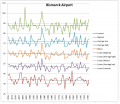
Nice graph @ronv four of the five linears show a "decreasing" temperature trend.
The deepest ocean is what....say 30,000 feet. At say....32 degrees F.

We have drilled down to say.....40,000 feet on land and it was say....350 degrees F.

Why isn't the ocean transferring huge amounts of heat from the earth? Why doesn't the ocean have a much higher average temp, like land does? Most of the ocean volume temp is close to 32 degrees F. Why does it remain so cool, relative to the warm cradle it resides in?

Evaporation must be a terrible thing to waste.
Trouble with thermodynamics much?
 

joeyd999

Joined Jun 6, 2011
6,315
Even the alarmists agree that CO2 alone won't have a significant impact. It's the positive feedback – warmer oceans means more moisture in the air, which means still more greenhouse effect – that raises temperatures so alarmingly. I believe most of the models used feedback factors of 2-5, even though the true value is unknown and could be zero or even negative.
Here is a nice discussion about this at WUWT, invoking electrical engineering concepts.
 
considering the significant increase in average earth temperature over the past century.
Turns out similar observations apply to the atmospheres of Mars and Venus --and-- more to the point Solar activity! -- Egads! That 'anthropogenic greenhouse gas' is strong stuff:eek: golly golly!

Ooops! Sorry! I forgot! Truth, reason and independent thought were among the first causalities of the New World Order!:oops:;)

Contritely saying my Heil Ban Ki-moons
TTFN - HP;)

PS -- Hey! It wasn't my idea to allow political dissuasion on these fora:rolleyes:
 

tcmtech

Joined Nov 4, 2013
2,867
How about by year?:D

And by year what?????? o_O

shorter fall, warmer winter, shorter spring, longer growing season = bad? :rolleyes:

As I pointed out earlier a warmer fall, winter or spring (what our local climate trend has been for following for ~30 years now) can easily push the mean average for the year up but it has zero significance in reality other than having created milder more favorable conditions in those seasons.
Our summers however have stayed well within the normal range they always have been if not have gotten a bit cooler but longer. :rolleyes:

This shouldn't be difficult statistical concepts to follow but obviously it is. Average mean value is not a real number plus it says nothing about the actual real conditions that lead to it. :oops:

As I said before statistically our mean average may have went up but the timelines of when those warmer than typical for the season days has everything to do with it s overall significance.

Without a seasonal time frame and context a few additional Degree days of change over a whole year don't mean Jack Shyte in reality. :(

BTW our average annual mean temp is ~53 degrees a good 4.7 degrees below the planetary average putting us in the planetary mean average equivalent of latter part of the last ice age. :eek::rolleyes:
 

Thread Starter

BR-549

Joined Sep 22, 2013
4,931
I am not a global warming guard. I am a global warming monitor. I only inform you of fraudulent activity.
 
Top