Figuring out LED arrangement for a small model pub but to be honest read to much and now confused.

Thread Starter

Dave the Rave

Joined Aug 25, 2025
6
Hi All

whilst I work in the LED signage industry I,m no designer so here we go

all Fv from test meter diode mode
2 x street lamps FV 2.65
1 x White led Fv 2.2
2 x sign LED’s Fv 2.66

what would be the best arrangement for these to use a small battery pack I.e. AA cell dual battery I was thinking a series/parallel circuit.

any assistance would be great
I’m all ears
Thanks
Dave
 

MrChips

Joined Oct 2, 2009
34,626
A test meter on diode mode is not going to give you the correct forward voltage of an LED. The test current is too low.

Your best solution is to use a resistor in series with a 6 V or 9 V battery or power supply. Adjust the value of the resistor and/or voltage until you get adequate brightness. Then measure the LED voltage and current.
 

dl324

Joined Mar 30, 2015
18,216
all Fv from test meter diode mode
2 x street lamps FV 2.65
1 x White led Fv 2.2
2 x sign LED’s Fv 2.66
That'd be fine if you were planning to operate the LEDs at the current used by the meter.

What is the max current/power rating for the LEDs?

As an alternative to using current limiting resistors, you could set the current limit on a bench supply and test the LEDs to see how much current you need for the desired brightness.

If you don't have such a power supply, you can build a current source using an LM317; as long as the current is at least 10mA.

Some discrete current sink/source circuits: https://forum.allaboutcircuits.com/...-of-different-color-leds.207564/#post-1994195

Using an opamp: https://forum.allaboutcircuits.com/threads/mosfet-open-discussion.202006/#post-1923976
 

Thread Starter

Dave the Rave

Joined Aug 25, 2025
6
That'd be fine if you were planning to operate the LEDs at the current used by the meter.

What is the max current/power rating for the LEDs?

As an alternative to using current limiting resistors, you could set the current limit on a bench supply and test the LEDs to see how much current you need for the desired brightness.

If you don't have such a power supply, you can build a current source using an LM317; as long as the current is at least 10mA.

Some discrete current sink/source circuits: https://forum.allaboutcircuits.com/...-of-different-color-leds.207564/#post-1994195

Using an opamp: https://forum.allaboutcircuits.com/threads/mosfet-open-discussion.202006/#post-1923976
Thanks for the info
I don’t have the max current values as they were not supplied typical Temu sellers lol but can use a bench supply and work out what I need to
Thanks everyone that posted
Dave
 

Irving

Joined Jan 30, 2016
4,996
Welcome to AAC.

Can you post pics of the devices, or links to the product on Temu.

Set your current limit on your bench supply to 50mA to start and 6v, that should give you a meaningful Fv without frying them. Most hi-power LEDs will need to be on a heat-sink to run at full power.
 

dl324

Joined Mar 30, 2015
18,216
I don’t have the max current values as they were not supplied typical Temu sellers lol but can use a bench supply and work out what I need to
Can you post pictures of the LEDs?

I'd start with a 3V supply since you want to operate from 2 AA cells. I'd start with a low current, e.g. 10mA, to see if that gives sufficient brightness. Obviously, you won't have much head room with the LEDs, so you'll need to operate them in parallel, each with their own current limiting resistor.
 

Thread Starter

Dave the Rave

Joined Aug 25, 2025
6
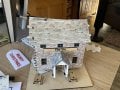
Attached images of the leds using except a standard 3mm warm white which I have the following information
I/VF 20ma 3-3.2v
I was thinking of upgrading to a PP3 9 volt source as it would fit inside the model
I have attached an image of what I make so you see the idea
2 street lights
2 sign lights that can be driven on a CR2032 cell
1 internal warm white light
Hope this helps figure the LED’s I’m using
P.S the model is not complete ;-)

regards
Daveimage.jpgIMG_0551.jpegIMG_0552.jpeg
 

Irving

Joined Jan 30, 2016
4,996
Neat model; that's some serious modelling. Those smaller SMD style LEDs may work OK at 3v but you might need 20 - 30mA to get the brightness you need.

A coin cell won't last very long. It has a rated capacity of 220mAh at 0.2mA constant draw, with a recommended max draw of 1mA, with an end voltage of 2.0v, but below 2.6v is useless for you, According to one manufacturers data sheet, extrapolating for 10mA, you might get a a couple of minutes before the voltage drops too low to turn the LED on. AA cells are better, but not much. Yes, they have higher capacity, but measured down to 0.8v - again, below about 1.3v they are useless for you - so maybe an hour or so continuous. A PP3 9v sounds better, but its not really; yes, higher voltage, but you just end up wasting more as heat in the dropper resistor. LEDs are constant current devices, the brightness is determined by current and its non-linear. The best way to drive LEDs from a battery is a constant current buck-boost driver which will optimise battery capacity, but some might consider that overkill for this (though not necessarily expensive).
 

Thread Starter

Dave the Rave

Joined Aug 25, 2025
6
Thanks for the reply
So to get on your page, I would need a battery and then input to a buck booster to supply the required voltage and constant current
Am I right?
 

BobTPH

Joined Jun 5, 2013
11,463
Thanks for the reply
So to get on your page, I would need a battery and then input to a buck booster to supply the required voltage and constant current
Am I right?
A nine volt battery plus resistor for each LED comes close to a constant current source. But it wastes about 1/3 the power.

A buck converter taking 9V down to about 3.5V plus a carefully (experimentally) selected resistor for each LED would be more efficient. Boost is not required unless you use a 3V battery.
 

Thread Starter

Dave the Rave

Joined Aug 25, 2025
6
A nine volt battery plus resistor for each LED comes close to a constant current source. But it wastes about 1/3 the power.

A buck converter taking 9V down to about 3.5V plus a carefully (experimentally) selected resistor for each LED would be more efficient. Boost is not required unless you use a 3V battery.
Thanks I’m sure I can get that sorted I do have some buck regulators somewhere in my experiment box lol
 

Thread Starter

Dave the Rave

Joined Aug 25, 2025
6
IMG_0557.jpeg
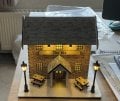
Wel all I can say is thanks for your input, I had a buck regulator left over from another project so, did as explained earlier but used slightly bigger resistors as it worked out at 39r so used 47 as I had them, I think the result is spectacular

so thanks all for your input and assistance
Dave the RAVE
 
Top