Dropping resistors of different color leds

Thread Starter

Kim Sleep

Joined Nov 6, 2014
391
Ok, in a 9v circuit, I have 4 outputs of a 4017 ic, each output has a 2n2222 driving 4 leds in series.
Each 2222 sets of 4 leds is a different color, BLUE, YELLOW, RED, GREEN.
What are the values of the dropping resistor for each set of 4 xLED colors, so that the leds sort of match in intensity???
I have no idea of the ratings of each of the LEDS...these are 100 in a bag, from a Asian supplier.
Whatcha think?
Replies are greatly appreciated
 

dl324

Joined Mar 30, 2015
18,219
You have very little/no headroom using 4 LEDs with a 9V supply.

Without datasheets for the LEDs, you can determine characteristics experimentally. Operate them at about 10mA and measure the forward voltage of a dozen or so LEDs of each color.

If you can't set an appropriate current limit on your power supplies, you can make one with a transistor, a diode, and a couple resistors. Or you could use a potentiometer, connected as a rheostat, in series with the LED. If you use a pot, be mindful of its power dissipation.
 

dl324

Joined Mar 30, 2015
18,219
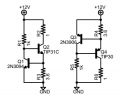
Here are some current sink/source examples using 2 transistors and some resistors. The 1 ohm resistor represents the load.
1753806430505.png
For 10mA, replace the 3.6 ohm resistors with 62 ohms. The TIP transistors can be replaced with 2N3904 and 2N3906 transistors, respectively; and you can use a 9V supply.
 
Last edited:

WBahn

Joined Mar 31, 2012
32,703
Ok, in a 9v circuit, I have 4 outputs of a 4017 ic, each output has a 2n2222 driving 4 leds in series.
Each 2222 sets of 4 leds is a different color, BLUE, YELLOW, RED, GREEN.
What are the values of the dropping resistor for each set of 4 xLED colors, so that the leds sort of match in intensity???
I have no idea of the ratings of each of the LEDS...these are 100 in a bag, from a Asian supplier.
Whatcha think?
Replies are greatly appreciated
You'll have to do it by experimentation. You have no reason to think that there is any reliable relationship between the current and intensity for LEDs of the same color in that bag. For all you know, they are floor sweepings from different lines and perhaps even different manufacturers.

Have you considered the minimum voltage that you need to apply to a string of four blue LEDs and how that compares to your 9 V supply?
 

MrChips

Joined Oct 2, 2009
34,628
thats why I said approximately the same intensity. The green has the least intensity compared to the other colors
How do you know that?
Did you measure it?

LED intensity is dependent on so many variables besides colour, e.g., type of housing, clear vs diffused, emission angle, efficiency, human perception of intensity.
 

WBahn

Joined Mar 31, 2012
32,703
thats why I said approximately the same intensity. The green has the least intensity compared to the other colors
And there's no way for anyone to give you an approximate answer with any significant degree of confidence.

Why not just experiment with the LEDs you actually have and figure out how much current each color needs in order for them to appear to be about the same intensity for your purpose? Once you have that, you can easily figure out what the resistance values are that you need to achieve it.
 

MrChips

Joined Oct 2, 2009
34,628
As WBahn says, select samples of all the different colours and packages of LEDs and have them all connected in parallel with their own series resistor to the same voltage source at the same time. Adjust the series resistor for your perception of equal intensity.

Then measure the supply voltage, the voltage drop across the LED, the voltage drop across the series resistor, and the resistance of the series resistor. That should tell you everything you need to know about the LED operating voltage and current.
 

sghioto

Joined Dec 31, 2017
8,633
thats why I said approximately the same intensity. The green has the least intensity compared to the other colors
I believe I have a pack of those same LEDs you have.
My results with an average of 10ma per string and my visual perspective:
Green = 22 ohm
Red = 470 ohm
Yellow = 270 ohm
Blue = 270 ohm but two of the blue LEDs had to be in parallel because of the higher voltage drop of appx 2.7 volts per LED.
With all four LEDs in series the string would not illuminate even with zero series resistance.
 
Last edited:

MisterBill2

Joined Jan 23, 2018
27,166
In a low-priced assortment of LEDs there will be variations in the relation of current to intensity and the forward voltage drop. so experimenting will be the only option, because there is no data sheet available.
 

Thread Starter

Kim Sleep

Joined Nov 6, 2014
391
I believe I have a pack of those same LEDs you have.
My results with an average of 10ma per string and my visual perspective:
Green = 22 ohm
Red = 470 ohm
Yellow = 270 ohm
Blue = 270 ohm but two of the blue LEDs had to be in parallel because of the higher voltage drop of appx 2.7 volts per LED.
With all four LEDs in series the string would not illuminate even with zero series resistance.
Thank you sir
 

Rf300

Joined Apr 18, 2025
72
Blue = 270 ohm but two of the blue LEDs had to be in parallel because of the higher voltage drop of appx 2.7 volts per LED.
With all four LEDs in series the string would not illuminate even with zero series resistance.
NEVER EVER put 2 LEDs in parallel! LEDs are current driven, not voltage driven. Each LED in parallel must have its own series resistor.

Concerning the values of the series resistors for the LEDs: I want to emphasize WBahn's post #10. Simply use the "try and error method" for determining the best values for the resistors.

It seems that you don't have any data sheet of the LEDs, therefore assume for a first approach a few mA current for the LEDs (2 - 3 mA should be enough for modern low current LEDs as long as you don't want to build an LED video wall). Subtract the forward voltage of your LEDs (different for each colour) and the saturation voltage of the driving transistor from 9 V, divide the result by the desired forward current for the LEDs. This is the starting point for your series resistors. Then build a prototype and look at the brightness of your LEDs, if one colour is too dark, reduce the resistor value, if it is too bright, increase the resistor value.
 
Rule of thumb. Red LEDs drop about 1.8V at 10mA and blue LEDs about 3.2V. Yellow and Green somewhere in between. So for Blue LEDs four in series would drop around 12.8V - hence post #3 which recommends a 2x2 series/parallel configuration which means two LEDs in series, dropping 6.4V, around 0.3V across the collector/emitter, leaving 2.3V to drop across the series resistor - nominally 230R so use maybe 220 or 270. Each pair of blue LEDs needs it's own series resistor per post #15. In theory, you can get away with four red LEDs in series with a resistor to drop about 1.5V - i.e. 150R. But to minimize the effect of any supply voltage change I'd use the same configuration of 2x2 series/parallel. The 150R resistor would become 2 x 510R. Maybe use 470R.

Now, try all four colours 2x2 series/parallel, with a total of 8 resistors all with the same value of 470R, each with two series LEDs. The percieved brightness of blue LEDs is much brighter at lower current so this is a good starting point.
 

Thread Starter

Kim Sleep

Joined Nov 6, 2014
391
Rule of thumb. Red LEDs drop about 1.8V at 10mA and blue LEDs about 3.2V. Yellow and Green somewhere in between. So for Blue LEDs four in series would drop around 12.8V - hence post #3 which recommends a 2x2 series/parallel configuration which means two LEDs in series, dropping 6.4V, around 0.3V across the collector/emitter, leaving 2.3V to drop across the series resistor - nominally 230R so use maybe 220 or 270. Each pair of blue LEDs needs it's own series resistor per post #15. In theory, you can get away with four red LEDs in series with a resistor to drop about 1.5V - i.e. 150R. But to minimize the effect of any supply voltage change I'd use the same configuration of 2x2 series/parallel. The 150R resistor would become 2 x 510R. Maybe use 470R.

Now, try all four colours 2x2 series/parallel, with a total of 8 resistors all with the same value of 470R, each with two series LEDs. The percieved brightness of blue LEDs is much brighter at lower current so this is a good starting point.
Im trying that!
 
Top