Energy from reciprocating beam

Thread Starter

JulesP

Joined Dec 7, 2018
458
The timing of a 555 depends on both component values and supply voltage, and the triggering also depends on a stable voltage. A large filter capacitor across the IC supply, and usin a regulated supply for the timer will help. Any voltage noise can have an effect on the triggering, and so it is useful to have a separate power feed for the timer.
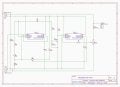
On the circuit board, since there are multi-pin power connectors already, I suggest separate pins and traces for the motor power circuit. Even the best DC motors create some power circuit noise that can affect other parts of the system. The connections to C1 seem to be sharing a current path with other elements, but not having the circuit visible now that may not be an issue.
I do suggest making the negative common trace as wide as is reasonable since lower ground impedance reduces unintended coupling.
At the moment I get these frequency variations without the motor connected.

C1 connects to the circuit as attached but the line from the emitter of the power transistor to GND runs underneath it.

Do you also mean I should put a 10uf cap across pins 1&8 of both ICs?
 

Attachments

Alec_t

Joined Sep 17, 2013
15,121
Is there any way to improve stability
Building it on strip-board instead of a breadboard should help. All those straggly connecting wires act as antennae and are notorious for picking up all sorts of interference.
Breadboards are not intended for heavy currents, so any inherent connector resistance associated with push-in wires results in voltage drops which can cause the circuit to act erratically. You really want a 'star ground' arrangement, so that no heavy load current flows through signal conductors.

Edit: Trying to cover the whole frequency range with one pot and one cap is challenging. Switched timing capacitors would make pot adjustment less finocky.
 
Last edited:

MisterBill2

Joined Jan 23, 2018
27,591
I would suggest both the 10 mFD and also a 0.1 mFD cap. that is to take care of noise at both ends of the frequency spectrum. Since the change that you are seeing is quite small, the causes may be fairly subtle. And is the power supply regulated?
 

Thread Starter

JulesP

Joined Dec 7, 2018
458
Building it on strip-board instead of a breadboard should help. All those straggly connecting wires act as antennae and are notorious for picking up all sorts of interference.
Breadboards are not intended for heavy currents, so any inherent connector resistance associated with push-in wires results in voltage drops which can cause the circuit to act erratically. You really want a 'star ground' arrangement, so that no heavy load current flows through signal conductors.

Edit: Trying to cover the whole frequency range with one pot and one cap is challenging. Switched timing capacitors would make pot adjustment less finocky.
Perhaps when I’ve constructed it on the PCB then that will improve matters.
 

Thread Starter

JulesP

Joined Dec 7, 2018
458
I would suggest both the 10 mFD and also a 0.1 mFD cap. that is to take care of noise at both ends of the frequency spectrum. Since the change that you are seeing is quite small, the causes may be fairly subtle. And is the power supply regulated?
You mean both in parallel between pins 1&8 of both 555s?
I believe my supply is regulated but I don’t have the specs to hand.
 

MisterBill2

Joined Jan 23, 2018
27,591
You mean both in parallel between pins 1&8 of both 555s?
I believe my supply is regulated but I don’t have the specs to hand.
Yes, that is what I suggest. One thing is that the 555 is not listed as a precision timer, although it is fairly good. For that small deviation that you are getting, it may even be temperature changes causing the drift.
The closer you look, the bigger small changes seem to be.
 

Thread Starter

JulesP

Joined Dec 7, 2018
458
As an afterword to this thread, I wanted to post some interesting results for the two-stage SHM oscillator.

It took a while to synchronise the timer/motor circuit with the pendulum as fine control of the timer was not as one would wish. Nevertheless, here is a link to a folder with two short videos showing the pendulum motion with the beam locked and unlocked. The pendulum and counterweight vertical displacement were determined with slow-motion imaging.

https://www.dropbox.com/sh/nr2ih4r08bzbane/AABclU_21CLL1wmtZZ6H4e2ba?dl=0

The attachment is my calculations showing that with the beam locked the overall system efficiency was about 5.4% (error estimated to be +- 0.5%) whereas when the beam is unlocked the efficiency rose to 50.4%, nearly a ten-fold increase.

I'm sure one could have a whole thread examining why that is so but I find it a very interesting feature of this setup just as I do the equal energy values of the pendulum and counterweight. Perhaps they are working more as an integrated, compound system than one might imagine.

Jules
 

Attachments

Last edited:

MisterBill2

Joined Jan 23, 2018
27,591
Certainly a mechanical system operated in resonance will be more efficient than at any other point.
So the TS has demonstrated the value of this mode quite well. And aside from the efficiency benefit, it is probable that the mechanical stresses are reduced, a secondary result of the resonant mode.
 

Thread Starter

JulesP

Joined Dec 7, 2018
458
Certainly a mechanical system operated in resonance will be more efficient than at any other point.
So the TS has demonstrated the value of this mode quite well. And aside from the efficiency benefit, it is probable that the mechanical stresses are reduced, a secondary result of the resonant mode.
It’s in resonance with both the beam locked and unlocked but when the counterweight free to move it participates in an unexpectedly dynamic way.
 

shortbus

Joined Sep 30, 2009
10,050
Wow! Those videos are amazing! But they don't do anything more than this one, and it takes no energy after being set in motion. Where yours takes energy to keep it moving. And neither one does anything but move until it uses up it's energy.


MisterBill2

Joined Jan 23, 2018
27,591
Certainly the motions in post #110 take energy! The initial potential energy of being lifted changes to kinetic energy when the balls are released, and while the elastic collisions are fairly efficient there is a real energy loss each time. In addition some of the kinetic energy is converted to sound, and also lost.
 

Thread Starter

JulesP

Joined Dec 7, 2018
458
Certainly the motions in post #110 take energy! The initial potential energy of being lifted changes to kinetic energy when the balls are released, and while the elastic collisions are fairly efficient there is a real energy loss each time. In addition some of the kinetic energy is converted to sound, and also lost.
There are some similarities but the feature of my experiment that interests me is the way in which the counterweight becomes coupled to the pendulum motion to create a much more efficient system as the calculations I included show.
The energy losses in Newtons cradle are small with each swing but easily observable and in my setup a lot of energy is lost in the friction of the gearbox necessary to increase the torque of the small motor.

I would add that both demonstrate Newton’s First Law but the two stages in my arrangement also show how the two subsystems interact in a ‘constructive’ manner. I doubt that the energy calculation for the pendulum and the counterweight being identical is just a coincidence but I couldn’t prove it yet.
 
Last edited:

shortbus

Joined Sep 30, 2009
10,050
I would add that both demonstrate Newton’s First Law but the two stages in my arrangement also show how the two subsystems interact in a ‘constructive’ manner. I doubt that the energy calculation for the pendulum and the counterweight being identical is just a coincidence but I couldn’t prove it yet.
Make it do something, as of so far it is just a toy that doesn't even function as long as Newtons pendulum, if you take away your motor. By make it do something I mean do something that would take more power than your motor adds to the mechanism. And I'm not talking perpetual motion type of thing, just something that the motor used alone can't/couldn't do.
 

MrAl

Joined Jun 17, 2014
13,711
Wow! Those videos are amazing! But they don't do anything more than this one, and it takes no energy after being set in motion. Where yours takes energy to keep it moving. And neither one does anything but move until it uses up it's energy.

Steel balls have very high Q so there is not much energy loss per collision. Try that with sponge balls. Diamond balls would keep moving longer than steel balls. Wood balls would come to rest much sooner.
An ideal inductor in parallel with an ideal capacitor with some initial energy input can transfer that energy back and forth indefinitely. An ideal transmission line that folds back on itself can transfer the initial energy input around forever.
Even the slightest loss in any of these systems means it comes to rest sooner or later. That means we cant take any energy out without making it slow down and come to rest eventually once all the energy runs out.
 

shortbus

Joined Sep 30, 2009
10,050
Even the slightest loss in any of these systems means it comes to rest sooner or later. That means we cant take any energy out without making it slow down and come to rest eventually once all the energy runs out.
Which is why I've been saying this "beam" idea while interesting is never going to be anything more than that - interesting, no mechanical advantage at all.
 

Thread Starter

JulesP

Joined Dec 7, 2018
458
Which is why I've been saying this "beam" idea while interesting is never going to be anything more than that - interesting, no mechanical advantage at all.
It’s purpose was not to show some mechanical advantage but to show an interesting feature which is presented in the calculations file. The efficiency of the system rises ten fold when the beam is free to move and the energy expended by the pendulum and counterweight are identical.
 

shortbus

Joined Sep 30, 2009
10,050
The efficiency of the system rises ten fold when the beam is free to move and the energy expended by the pendulum and counterweight are identical.
That's why I said it was "interesting" but to no advantage at all. putting two children on a teeter-totter/seesaw will do the same thing. But your beam or the seesaw does nothing but amuse some one.

You seem to have changed your expectations from your first post -
I would like to extract and measure the energy available from the beam’s reciprocating movement by using perhaps a load cell, piezo electric device or even a magnet moving in a solenoid and storing the energy in a capacitor/battery.
 

Thread Starter

JulesP

Joined Dec 7, 2018
458
That's why I said it was "interesting" but to no advantage at all. putting two children on a teeter-totter/seesaw will do the same thing. But your beam or the seesaw does nothing but amuse some one.

You seem to have changed your expectations from your first post -
I may go on to extract the energy in sone way but other things have come along that need my attention. If we get another lock down who knows
 

SamR

Joined Mar 19, 2019
5,491
Any time a pivot balance beam question comes up I am reminded of the extremes that were gone to in order to create an accurate and repeatable analytical triple beam balance. Extreme accurate machining of the metals, reducing air flow interaction with the enclosure, huge massive bases to position it on to eliminate outside motion interference, Jewel plate and edge polishing to minimize the area of interaction at the pivot, etc. Extreme measures that were quite costly. It only took a few years after the Electronic Balances came onto the scene for the balance beam technology to become antiquated and so expensive as to no longer be practicable. Not to mention not as accurate by a couple of decimal places. Is a very good analogy for the advantage of electrical systems over mechanical. Accurate and efficient mechanical systems require extreme and costly measures. One reason less time is spent winding watches or clocks these days.
 
Top