Electronic Transformer - used for 12V halogen Lamps

Thread Starter

Yami

Joined Jan 18, 2016
354
Hi, I was wondering if you could help me understand the working of the "electronic transformer" used for 12V halogen lamps etc. How is the switching frequency set. What is the use of the Diac?
I have included part of the schematic .
Thanks in advance
Yamin
*Please not that I'm using an isolation transformer when working with this circuit
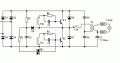
Electronic transformer.gif
 

MisterBill2

Joined Jan 23, 2018
27,186
The Diac appears to be both a feedback element and part of a starting circuit. Until some current flows in the winding T1A there will be no base drive and so no oscillation.As the voltage across C2 rises, eventually DB1 will conduct, biasing Q2 into conduction and starting the oscillator working. The frequency is determined mostly by the RC time constants of the base drive networks and the resonance of T1.
 

Thread Starter

Yami

Joined Jan 18, 2016
354
The Diac appears to be both a feedback element and part of a starting circuit. Until some current flows in the winding T1A there will be no base drive and so no oscillation.As the voltage across C2 rises, eventually DB1 will conduct, biasing Q2 into conduction and starting the oscillator working. The frequency is determined mostly by the RC time constants of the base drive networks and the resonance of T1.
Ah make sense. Correct me if I'm wrong the "RC" network is made up R3 and C2 right? or is it made up of R2, R3 and C2?

And potentially a newbie question - but this is something I always have wondered. Lets say I wanted to check whether the transistors are turning on or not (I know I could take it out of circuit and use the diode function of the multi meter). So after powering up I check the collector emitter voltage - since the transistors are turning on and off should I use the AC voltage measurement or the DC voltage measurement function of the multi meter?

Thanks
 

MisterBill2

Joined Jan 23, 2018
27,186
I am thinking the R4 C3 and R5 C4 that couple the bases to the feedback transformer are the time delay elements once the circuit is oscillating. Yes, reading an AC voltage emitter to collector would show that the transistors are switching off and on, but reading an AC voltage across T1A will also give an indication. And only if all is functioning correctly then you will see about 12 volts at some high frequency at the output terminals. One more thing is that unless there is some additional filtering that you have not shown, on the input power side, this device will be radiating interference for quite a distance.
 

ebp

Joined Feb 8, 2018
2,332
The characteristics of T1 sets the frequency.

These circuits work on transformer saturation. When the circuit is started by an initial pulse through the diac, Q2 turns on, The current through T1A into the output transformer provides positive feedback to the base of Q2 and negative drive for the base of Q1 (note phasing dots). The current in T1A rises until the core in T1 saturates and transformer action more or less stops (there is still some, but far less). Q2 loses its base drive and in consequence begins to turn off. This reverses the polarities of the base drive windings, accelerating the turn off of Q2 and starting turn-on of Q1. As Q1 begins to turn off, the same action as before, with opposite polarities ensues until the transformer again saturates in the opposite direction from the first half cycle.

Each time Q2 turns on, C2 is discharged via D5, so the diac doesn't conduct again until the next time the input power is cycled.

R5 limits the base current into Q2 and C4 allows higher transient base current at the transitions of T1 to speed up turn-on and turn-off of the transistor. Their role in determining switching frequency is minor.

The main converter is a half-bridge. C7 provides a local return path for high frequency noise from the secondary side to the primary. It will be a value low enough to limit line frequency current to a safe level and of a type that is specifically designed to virtually eliminate the possibility of it failing short-circuit.
 

Thread Starter

Yami

Joined Jan 18, 2016
354
I am thinking the R4 C3 and R5 C4 that couple the bases to the feedback transformer are the time delay elements once the circuit is oscillating. Yes, reading an AC voltage emitter to collector would show that the transistors are switching off and on, but reading an AC voltage across T1A will also give an indication. And only if all is functioning correctly then you will see about 12 volts at some high frequency at the output terminals. One more thing is that unless there is some additional filtering that you have not shown, on the input power side, this device will be radiating interference for quite a distance.
It hasn't got any filtering! :O
 

Thread Starter

Yami

Joined Jan 18, 2016
354
The characteristics of T1 sets the frequency.

These circuits work on transformer saturation. When the circuit is started by an initial pulse through the diac, Q2 turns on, The current through T1A into the output transformer provides positive feedback to the base of Q2 and negative drive for the base of Q1 (note phasing dots). The current in T1A rises until the core in T1 saturates and transformer action more or less stops (there is still some, but far less). Q2 loses its base drive and in consequence begins to turn off. This reverses the polarities of the base drive windings, accelerating the turn off of Q2 and starting turn-on of Q1. As Q1 begins to turn off, the same action as before, with opposite polarities ensues until the transformer again saturates in the opposite direction from the first half cycle.

Each time Q2 turns on, C2 is discharged via D5, so the diac doesn't conduct again until the next time the input power is cycled.

R5 limits the base current into Q2 and C4 allows higher transient base current at the transitions of T1 to speed up turn-on and turn-off of the transistor. Their role in determining switching frequency is minor.

The main converter is a half-bridge. C7 provides a local return path for high frequency noise from the secondary side to the primary. It will be a value low enough to limit line frequency current to a safe level and of a type that is specifically designed to virtually eliminate the possibility of it failing short-circuit.
Ah I see, thanks for the detailed explanation, and there is no "hot" ground "cold" ground like in normal smps right? Both the grounds are common
 

MisterBill2

Joined Jan 23, 2018
27,186
Ah I see, thanks for the detailed explanation, and there is no "hot" ground "cold" ground like in normal smps right? Both the grounds are common
The 12 volt output is sort of isolated from the common, and the DC negative within the device is not exactly at the input common. So while this package is not directly connected to the AC line it is not at all isolated from a shock hazard point of view. For a cheap source of filter parts for the AC line filter, usually they can be found in an older obsolete computer power supply. The really good ones had a separate filter board. And the donor supply does not need to be functional to have these parts.
 
Top