ah that's why it's so difficult to calculate, I started from Hopkinson's formulas and focused on the reluctance values, considering that in the gap the reluctance is that of the air, yes so the calculations are too long, but so in your opinion, for my purpose and that is to direct voltages at a distance where there is air in the space, as Bob has already stated, it is better to use the solenoid shape rather than the U shape, right?How good is your vector calculus? You have to integrate the flux over all possible paths to calculate it. You will a probably need some grads, divs and curls which I haven’t tackled since I graduated.
yes indeed you are right, in fact I was intrigued by the "U" shape precisely because it can better direct the electromagnetic field lines, but if the ability to induce voltages at a great distance is worse than the cylindrical shape (solenoid) then I choose the solenoid shape, so at least even if it is less directional, but at least I get more induction and therefore electromotive force at a greater distance. so what do you think of my reasoning, that is, if it were you, which shape would you choose between the "U" shape and the cylindrical shape to be able to induce voltages at a greater distance?A U shaped core will keep the field more confined than a straight one. You want the poles far apart for long distance power transfer.
I thought I answered that in my previous post, but, to be clear, the cylinder shape.between the "U" shape and the cylindrical shape to be able to induce voltages at a greater distance?
ok ok sorry now I understand, google had not translated a partI thought I answered that in my previous post, but, to be clear, the cylinder shape.


Hi there,If it is a theoretical project, why is space a concern? That sounds like a practical consideration to me.
Hi,the distance should be around 20 cm, obviously with a very limited efficiency, the system is not resonant, no no I will not use radio waves, since we are talking about near field induction
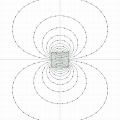
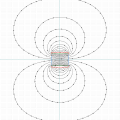
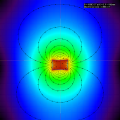
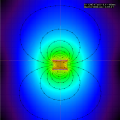
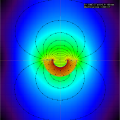
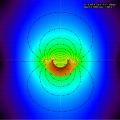
thank you so much for all this work of creating the images and all the study. so now it is even clearer, that having a nucleus with greater permeability, in this case 10,000 times compared to air, the field lines close more quickly, precisely because they will tend to travel through space with less resistance or better said, greater permeability. and therefore moving the focus on the shapes, a "U" shaped nucleus will tend at the poles, to close the field lines more quickly and therefore less propagation in the surrounding space, is this reasoning of mine correct?Simulation in program VizMag:
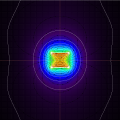
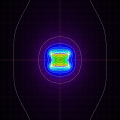
Left pictures are coil with air core field, right pictures - μ10000 core.
With air core, field propagates to longer distance,
but with μ10000 core field concentrates close to coil.
View attachment 351519 View attachment 351517
White lines are flux density contours
View attachment 351529 View attachment 351530
yes sure, I already had in mind to be able to separate the "main" coil into two different coils that add up vectorially in space, in this way I can better manage the excess heat, and also I can increase the frequency and therefore also the induced electromotive force without worrying about too much wire. anyway now I understand that between the two shapes, the cylindrical one is much better than the "U" shaped oneHi,
Wow, that's quite a distance for wireless power transfer as I'm sure you know. At that distance the overall permeability is going to be low no matter what you use for a core.
For something this unusual though it would be better to try some test samples, especially if you only have two materials in mind. Create a winding using a bobbin then insert one material at a time and check the efficiency. With only two materials in mind you can even create two bobbins and test both at the same time, unless maybe you are going to need a lot of turns on the bobbins.
In the end, you will have to test this anyway that's the way power electronics is.
Because of the large separation distance, you are going to need a lot of current and/or a lot of turns of wire. Should be interesting to see what results you can get in real life.
If the Q of the transmitter coil is large there might be very little loss, but also very little power transfer.I suggest taking a look at some of the actual, and the proposed, wireless magnetic battery charging systems. Possibly some of them are actually designed to be very efficient. I have not studied them in detail, but some claim better than 90% coupling efficiency. (Not that I believe the claims)
My point was that possibly an examination of what others have done may provide a hint at what could work well. Or at least sort of work well.If the Q of the transmitter coil is large there might be very little loss, but also very little power transfer.
Like Rudolf Diesel and his engine. He discovered that increasing the compression ratio up to 100:1 increased the efficiency, but reduced the power available from a given engine capacity. It just reduced the fuel usage by a larger amount.
My reply was not about how coil field add or subtract, it was simply about a way to test what core material was best.yes sure, I already had in mind to be able to separate the "main" coil into two different coils that add up vectorially in space, in this way I can better manage the excess heat, and also I can increase the frequency and therefore also the induced electromotive force without worrying about too much wire. anyway now I understand that between the two shapes, the cylindrical one is much better than the "U" shaped one
you gave me a perfect explanation, thank you very much, yes I think I will do the same, I will try the two shapes, with coils with air core, also because as you already said, in reality everything is different. even if I know more or less the behavior that I will have, I will try. I will also ask Danko if he can make me a diagram, in this case of two coils with air core, with two different shapes, the first solenoid/cylindrical shape and the second U-shaped.My reply was not about how coil field add or subtract, it was simply about a way to test what core material was best.
If you were to wind one bobbin that could fit either core where each core was made with a different magnetically active material (or even air) you could simply test one, then remove the core and insert the other core, then test that one. You then simply test the results.
This implies that bother cores are at least roughly the same shape with the same cross section. Testing different shapes would of course require testing both shapes independently with the same number of turns on each core.
U shaped cores are better when they mate with another U shaped core. These can show some really good coupling. So good in fact, that if you had cores with really well polished core faces and energized them just one time with the right current excitation and windings, they would stay stuck together even after the excitation was removed. When separated, the force would be a lot less of course but the main key here is the tighter the magnetic path is the stronger the force. Tighter here meaning the more closed the path is. That is, a continuous path from one pole to the other through one core and then through that core back to the other core face.
With two cylindrical core pieces face to face, there is only one face of each core in line with the other. That means that one air path is short and one is longer. With two U shaped cores, both paths are the same length.
This just means that both types should be tested as magnetic fields can be tricky in practice. With the right U sizes you should be able to achieve better coupling although the sizes might be larger than you would like. With smaller cores though, the two faces would still be the same distance apart so coupling may be better than with two cylindrical cores.
I'll draw up a picture if this isn't clear yet.
good morning @Danko , sorry to bother you, your diagram helped me a lot to understand that the permeability of the core tends to close the electromagnetic field lines more. I would like to ask you if you could provide me with some new diagrams, in this case of two coils, both with air core: the first coil with air core, will have a cylindrical/solenoid, while the second coil with air core will have a U shape. the frequencies will be the same and also the dimensions (magnetic paths, cross section) for the U-shaped coil with an air gap of 2.5 cm. so I ask you if you could provide me with these diagrams if it is possible for you, thanksSimulation in program ViziMag:
Left pictures are coil with air core field, right pictures - μ10000 core.
With air core, field propagates to longer distance,
but with μ10000 core field concentrates close to coil.
View attachment 351519 View attachment 351517
White lines are flux density contours
View attachment 351529 View attachment 351530
Hello @Sabro,good morning @Danko , sorry to bother you, your diagram helped me a lot to understand that the permeability of the core tends to close the electromagnetic field lines more. I would like to ask you if you could provide me with some new diagrams, in this case of two coils, both with air core: the first coil with air core, will have a cylindrical/solenoid, while the second coil with air core will have a U shape. the frequencies will be the same and also the dimensions (magnetic paths, cross section) for the U-shaped coil with an air gap of 2.5 cm. so I ask you if you could provide me with these diagrams if it is possible for you, thanks
ok that's fine Danko, I'll wait, thank you very much for your availability and kindness
Thanks for the link. I‘m Working on a multiphase buck with integrated magnetics, and getting a bit stuck on working out the flux density!you can use ViziMag for calculating and simulating your coils.
| Thread starter | Similar threads | Forum | Replies | Date |
|---|---|---|---|---|
| A | Electromagnet | General Electronics Chat | 92 | |
| R | Electromagnet Turns And Same Field generated?? | General Electronics Chat | 5 | |
| B | Super capacitors for electromagnet? | Power Electronics | 27 | |
| E | Building an electromagnet | General Electronics Chat | 3 | |
| E | Solenoid electromagnet is getting hot instead of magnetic | General Electronics Chat | 13 |