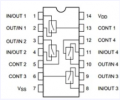
You need to connect Pin 14 to your 4.5 V DC and Pin 7 to your GND (the negative side of your battery pack).
Any unused control pins (pins 5,6,12,13) need to be tied to GND or Vdd. The easiest way to do this is choose either pin 6 or pin 13 as your unused switch and tie it to the power pin right next to it.
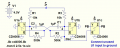
2) The drawing implies that board consists of horizontal tracks from side to side (such that the IC pin 11 is connected to R3 and R4 and also to a wire that goes down to C1). But, if that's the case, then wouldn't both C1 and C2 be shorted out? And wouldn't opposite pins on the IC be shorted together?
Are the circles places where the tracks have been cut?
But even that would still leave a number of things shorted, it would seem.
Correct, the circles are places where the tracks are cut.
I failed to notice that the track cuts horizontally between the two pins of each capacitor haven't been brought to the front, and so don't show on the image! Poor checking on my part!
Pins 1, 2, 13 and 14 all connect to Vcc (strictly Vdd for CMOS!), so no tracks are cut under the I.C.
Consider that the remaining section is what would be used to provide the switching function across the triggered device push button. When evaluating a circuit it is useful to consider the actual application, not just what is shown. So while that fourth switch is not part of the oscillator circuit, it is certainly part of the application.
Consider that the remaining section is what would be used to provide the switching function across the triggered device push button. When evaluating a circuit it is useful to consider the actual application, not just what is shown. So while that fourth switch is not part of the oscillator circuit, it is certainly part of the application.
Cool little project. Since the built‑in IC is non‑retriggerable, that CD4066 + multivibrator idea really is a neat way to “tap” the button electronically at a fixed interval without having to hack the logic itself. For a first build, I’d probably copy crutschow’s perf‑board layout as closely as possible and keep all wiring short and neat so it actually fits inside the snowman’s base.
I have a small snowman with lights that sits on the mantel. It takes 3 x 1.5V AA batteries.
It has a momentary switch, and when you press the momentary switch, the snowman lights up in various places and in sequences.
After 30 seconds the lights return to off.
I want the lights to stay on indefinitely (until I turn the on/off switch off).
I held the momentary switch to see if the lights would stay on, but even holding down the momentary switch, the lights turn off after 30 seconds of activity.
I'm looking for an easy way to electrically simulate pressing the momentary switch every 30 seconds to keep the lights on until I turn the power switch to OFF. Or to bypass the momentary switch altogether, although I believe the IC is controlling the lights,so this may not be possible.

 Facebook
 Google
 GitHub
 Linkedin


 One of the best "tools" out there, along with duct tape.