Electrically Simulate Pressing a Momentary Switch Every 30 Seconds

Thread Starter

buzzlebeebizzle

Joined Dec 12, 2025
24
I have a small snowman with lights that sits on the mantel. It takes 3 x 1.5V AA batteries.

It has a momentary switch, and when you press the momentary switch, the snowman lights up in various places and in sequences.

After 30 seconds the lights return to off.

I want the lights to stay on indefinitely (until I turn the on/off switch off).

I held the momentary switch to see if the lights would stay on, but even holding down the momentary switch, the lights turn off after 30 seconds of activity.

I'm looking for an easy way to electrically simulate pressing the momentary switch every 30 seconds to keep the lights on until I turn the power switch to OFF. Or to bypass the momentary switch altogether, although I believe the IC is controlling the lights,so this may not be possible.

What is the simplest way to do this?

Thank you,

buzz
 

crutschow

Joined Mar 14, 2008
38,423
Since we don't know exactly what voltage the momentary switch is switching you could use a CD4016 IC CMOS switch since it can switch a floating voltage.
It could be triggered by a CMOS LMC555 timer, which can operate to a lower voltage than the standard 555 bipolar version.

Does that sound like something you could build?
 

MisterBill2

Joined Jan 23, 2018
27,358
Use a two transistor alternate action flip-flop, I think that it would more correctly be called a multivibrator. some of them drove two LEDs alternately. Set it for a 15 second per side cycle. one side will simulate pressing the button for 15 seconds. The circuit has been around for at least 50 years so it should not be too hard to find a copy.
 

Thread Starter

buzzlebeebizzle

Joined Dec 12, 2025
24
Since we don't know exactly what voltage the momentary switch is switching you could use a CD4016 IC CMOS switch since it can switch a floating voltage.
It could be triggered by a CMOS LMC555 timer, which can operate to a lower voltage than the standard 555 bipolar version.

Does that sound like something you could build?
I think I may be able to figure it out with some internet searching. I'm not familiar with either of the components you mentioned. Thank you though!
 

Thread Starter

buzzlebeebizzle

Joined Dec 12, 2025
24
Use a two transistor alternate action flip-flop, I think that it would more correctly be called a multivibrator. some of them drove two LEDs alternately. Set it for a 15 second per side cycle. one side will simulate pressing the button for 15 seconds. The circuit has been around for at least 50 years so it should not be too hard to find a copy.
I know what a transistor is, and that's about it. I'll try some searching on the interwebs for a plan for a multivibrator. I should make sure safe search is on first, because the results potentially could be zesty. :) Thank you!
 

WBahn

Joined Mar 31, 2012
32,776
One subtlety you need to determine is what happens if the momentary switch is pressed just before the lights go out. Does it turn than on for another 30 seconds (meaning that it is retriggerable), Or, does it ignore button presses until after time expires (meaning that it is nonretriggerable).

One way to avoid the issue is to have your electronic switch cycle much faster than 30 seconds. If it cycles once per second, the longest your light would be off for would be one second (on average, it would be more like half second). The faster you cycle it, the more power it will consume, but using a CMOS timer should make it so that the energy used by the timer and switch are very small compared to the energy used by the lights themselves, so you could probably have it cycle at 10 Hz, making it so that there would only be a slight flicker between each 30 second session.
 

sghioto

Joined Dec 31, 2017
8,634
Would be helpful to know what the voltages are on both sides of the push button switch.
Or possibly what or where the wires from the switch connect to.
Do you a volt meter to get some readings?
You also mentioned it has an On- Off switch.
What happens if the push button is held down when turning On and Off?
 

Thread Starter

buzzlebeebizzle

Joined Dec 12, 2025
24
One subtlety you need to determine is what happens if the momentary switch is pressed just before the lights go out. Does it turn than on for another 30 seconds (meaning that it is retriggerable), Or, does it ignore button presses until after time expires (meaning that it is nonretriggerable).

One way to avoid the issue is to have your electronic switch cycle much faster than 30 seconds. If it cycles once per second, the longest your light would be off for would be one second (on average, it would be more like half second). The faster you cycle it, the more power it will consume, but using a CMOS timer should make it so that the energy used by the timer and switch are very small compared to the energy used by the lights themselves, so you could probably have it cycle at 10 Hz, making it so that there would only be a slight flicker between each 30 second session.
I have a lot of internet study to do before I can implement this switch. I'm sure I can do it, but it will take me time to figure it out, likely not before Christmas. Thank you!
 

Thread Starter

buzzlebeebizzle

Joined Dec 12, 2025
24
Would be helpful to know what the voltages are on both sides of the push button switch.
Or possibly what or where the wires from the switch connect to.
Do you a volt meter to get some readings?
You also mentioned it has an On- Off switch.
What happens if the push button is held down when turning On and Off?
I will need to do some surgery on the snowman to get to the wires. I can easily find out if holding down the momentary switch while turning on the power switch does anything. Thank you for the suggestion!
 

WBahn

Joined Mar 31, 2012
32,776
I will need to do some surgery on the snowman to get to the wires. I can easily find out if holding down the momentary switch while turning on the power switch does anything. Thank you for the suggestion!
Also do a simple test to determine if it is retriggerable.

Turn it on and press the button and let it run through until it turns off the lights.
Then press and release the button and let it run through until it turns off the lights while timing how long this takes. (Let's assume 30 seconds).
Then press and release the button and let it run until it is about 5 seconds before it would turn of.

Does it still turn off at the end of the original 30 seconds (so, about 5 s after the most recent press), or does it say on for another 30 seconds after that last press?
 

crutschow

Joined Mar 14, 2008
38,423
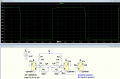
Below is the LTspice sim of a multivibrator and switch circuit using just one CD4066 CMOS quad bilateral IC switch package:
Two of the switches form the classic, two-switch (MOSFETs here) multivibrator oscillator circuit, which drives the third switch to connect across the PB switch ("PB" connections).
(Note that the switches are shown as separate devices, but they are all in the one CD4066 package.)

Using this CMOS bilateral switch means you don't have to worry about the value of the switch voltages, since it will switch any voltage between zero and the supply voltage without a concern about polarity direction.

The sim shows it oscillating with about a 0.8s period for the component values shown, so the device should never be off for more than that time.
The values of C1, C2, R2, and R4 determine the oscillation period.

1765649008637.png
 
Last edited:

MisterBill2

Joined Jan 23, 2018
27,358
OK!! Crutschow has implemented my suggestion in a more space efficient and smaller package, with the added benefit of including the extra switch section to tie across the button contacts. Fewer parts than my suggestion, and an easy fix for not knowing the button connections polarity!
Many thanks to Crutschow for that added feature !!
As for the actual voltage, we can assume it is less than 4.5 volts. In post #1 we read: " It takes 3 x 1.5V AA batteries." That is a good clue!
 

Thread Starter

buzzlebeebizzle

Joined Dec 12, 2025
24
Also do a simple test to determine if it is retriggerable.

Turn it on and press the button and let it run through until it turns off the lights.
Then press and release the button and let it run through until it turns off the lights while timing how long this takes. (Let's assume 30 seconds).
Then press and release the button and let it run until it is about 5 seconds before it would turn of.

Does it still turn off at the end of the original 30 seconds (so, about 5 s after the most recent press), or does it say on for another 30 seconds after that last press?
I turned the power switch on with the momentary switch depressed. The lights immediately came on and extinguished 30 seconds later.

Then I pressed the momentary button to turn on the lights again. After the lights had been on for 20 seconds, I pressed the momentary switch again.

The lights went out 30 seconds after the initial press; the press while the lights were already activated seemed to have no effect.

Thank you for the suggestions!

buzz
 

Thread Starter

buzzlebeebizzle

Joined Dec 12, 2025
24
Below is the LTspice sim of a multivibrator and switch circuit using just one CD4066 CMOS quad bilateral IC switch package:
...
Is this what I need to buy?
https://www.digikey.com/en/products/detail/texas-instruments/CD4066BE/67313

I don't know why this solution is brilliant yet, but I have no doubt that it is!:)
Thank you so much for this suggestion! I don't know how to implement it yet, but the part is inexpensive, and I hope it's simple for me to implement.

Thank you again!
 
Last edited:

crutschow

Joined Mar 14, 2008
38,423
Is this what I need to buy?
Yes.
I don't know why this solution is brilliant yet,
Only that it takes just one active device package to do what you want.
Most other solutions would likely require more than one active component package.
I don't know how to implement it yet
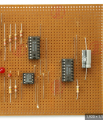
Simplest is to wire it on a small perf board similar to this:
Using a socket as shown, for the CD4066 IC is recommended

1765663783764.png
 
Last edited:

MisterBill2

Joined Jan 23, 2018
27,358
Indeed that circuit is brilliant!! And it uses a minimum of parts to do the job. AND, based on the results of the suggested test, the timer is NOT RETRIGGERABLE. So it might be that the timer needs to be set for 31 seconds instead of 30 seconds. It seems that the timer ignores inputs until it has completed the program. At this point I see no reason to investigate past finding a point to tie into the trigger button leads. With that analog switch device it is not polarity sensitive. (That is an added benefit of the CRUTSCHOW design.)
 
Top