Electric systems in different regions

Reloadron

Joined Jan 15, 2015
7,891
Anything in my facility I had anything to do with included 3 phase power monitors at design. Nitrogen pumps we had two, one to take about 120 PSI up to 750 PSI and a second stage taking the 750 PSI to about 3200 PSI. Yes, those pumps are expensive and when you figure a 3 phase monitor is about a hundred bucks they are cheap at the price. The chem pumps used on the auto-claves were $250,000 pumps running 600 degree grade A water at about 3,000 PSI. Again, a phase monitor is about a hundred bucks. If I had anything to do with a design involving 3 phase power there were phase monitors included which also looked at phase rotation and under or over voltage, not just phase loss.

Here is a classic little old circuit that was used throughout the buildings. My areas were built during the mid 1960s. All power was 3 phase delta and anyone familiar with 3 phase delta knows there is always a floating voltage to ground.
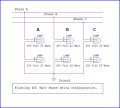
3 Phase Ground Fault.jpg
Each panel had 6 lamps on each side. Bulbs would last tens of thousands of hours. Normally the bulbs would glow faintly but if we had a phase short to ground (bad roof top blower or a clave heater short the shorted phase would extinguish and the remaining two phases would glow full brilliance. Those little bulb networks were located throughout the facility.

Ron
 

Thread Starter

Maciek Gromek

Joined May 8, 2017
72
Each panel had 6 lamps on each side. Bulbs would last tens of thousands of hours. Normally the bulbs would glow faintly but if we had a phase short to ground (bad roof top blower or a clave heater short the shorted phase would extinguish and the remaining two phases would glow full brilliance. Those little bulb networks were located throughout the facility.
Ron
In Europe is practically only "Wye" (we say "Star") which is weaker actually because on a "Wye" motor winding is 230v (eur) or 277 (n.america), and on a "Delta" motor winding is 400v (eur) or 480v (n.america) and, in addition, the current is probably even 3 times bigger on "Delta"
And I'm sorry but what was actually the function of these lamps, it was only signalizing or lighting something?
Regards
 
Last edited:

Reloadron

Joined Jan 15, 2015
7,891
And I'm sorry but what was actually the function of these lamps, it was only signalizing or lighting something?
Since with 480V delta all three phases "float" above ground. Shorting any of the three phases to ground could virtually go unnoticed. However, if a phase was shorted to ground we wanted to know about it and correct the problem. Why? Well the big reason is if another phase was to short to ground, anywhere in the facility on that same transformer, we then have a big problem. The original sub in my building had two transformers each using a 3 phase 5 KV primary. That was it, two 480 VAC 3 phase sources. When we built the new sub, just before I retired it was also two transformers but located outside and each used a 13.3 KV primary. Everything distributed was delta and again a delta phase short to ground was not a big deal but if another phase shorted to ground it became a big deal real fast. :)

Keep in mind the use of the lamps to signal a phase ground fault was part of the 1960s building design. All of the really nice power monitoring devices had yet to be invented. Thus those lamps located through the facility in the overhead. They worked and worked well for what they were designed for.

Looking back on all of it today as I was getting ready to retire we finally hired a new facilities engineer for our building and facility. That was one of the happiest days of my life. I just wish we would have added him at least 10 years sooner. :) I was an instrumentation type, along with data acquisition. Facilities and large scale power distribution was not really my forte or scope. While interesting enough I usually had a plenty full plate with what I was good at and my actual work scope. :)

Ron
 

Thread Starter

Maciek Gromek

Joined May 8, 2017
72
Looking back on all of it today as I was getting ready to retire we finally hired a new facilities engineer for our building and facility. That was one of the happiest days of my life. I just wish we would have added him at least 10 years sooner. :) I was an instrumentation type, along with data acquisition. Facilities and large scale power distribution was not really my forte or scope. While interesting enough I usually had a plenty full plate with what I was good at and my actual work scope. :)
Ron
Yes that's the problem at work, when it's too much to do and too few people, ThankYou very much
 

MaxHeadRoom

Joined Jul 18, 2013
30,684
Higher current for identical loads on low voltage compared to same load on High voltage maybe?
Incidentally I have 30amp breakers in my panel.
Max.
 

Reloadron

Joined Jan 15, 2015
7,891
I'm sorry I'm still so hungry for knowledge ;) do You know why in RV Trailers use to use 30A breakers, and why not at houses? Regards
I don't know about anywhere else but here in the US most RV parks offer two connection pedestals, you can use 50 Amp service or 30 Amp service. Many older parks may only offer 30 Amp service. Apparently at one point in time 30 Amps was considered adequate. The problems surface in the summer dog days when you are inside a metal box baking in the sun trying to remove heat from the air. As far as I know they only have 120 Volt service but not being an RV guru I will leave this for a motor home type.

Here in Cleveland we also have Lake Erie so plenty of boats and dock space. We just had a horrible incident where a 35 foot boat docked and went to "shore power". The family dog went overboard and the boaters noticed the dog was in distress so the father jumped into the water and immediately had problems, also in distress. Then a 17 year old son jumped in and the same thing happened. With a final breath he yelled or gasped electricity. People watching were screaming to the mother to unplug the shore power which she did. The dog and father survived but the 17 year old died of electrical shock. Last I heard the shore power was checked and found to be wired correctly and correct ground. This would leave an on board problem with the boat if true.

My guess here is RV Parks and Boat Marinas should be subject to regular inspections and both RVs and Boats should have on board systems to make sure power is correct. Pretty sure RVs include something but unsure about boats here in the US.

Ron
 

Thread Starter

Maciek Gromek

Joined May 8, 2017
72
Higher current for identical loads on low voltage compared to same load on High voltage maybe?
Incidentally I have 30amp breakers in my panel.
Max.
I just thought that 30 Amp breakers are not common at homes, if it's for single circuit You can run a few appliances even on only one receptacle, but in trailers there are 30 Amp sockets, so I don't know, it ain't no appliances with plugs to 125v 30A sockets? If not, than they are only for adapters to 15 amp sockets.
 

Thread Starter

Maciek Gromek

Joined May 8, 2017
72
I don't know about anywhere else but here in the US most RV parks offer two connection pedestals, you can use 50 Amp service or 30 Amp service. Many older parks may only offer 30 Amp service. Apparently at one point in time 30 Amps was considered adequate.
Ron
ThankYou so probably there are not many appliances with plugs 125v 30 or 50 amps, like for example welders ? Regards
 

Reloadron

Joined Jan 15, 2015
7,891
ThankYou so probably there are not many appliances with plugs 125v 30 or 50 amps, like for example welders ? Regards
For the US here is a NEMA chart showing the various plugs, including a 125 V 30 A plug. While not real common for 30 Amp 125 Volt service they do exist. For the most part the 30 and 50 Amp connectors seen in RV parks and Boat marinas are twist lock type rather than straight.

Years ago had an engineer manage to get behind a test stand and trip over a straight plug cord. This pulled the plug out of a wall socket and resulted in a few bad things happening. From that day forward anything critical used a twist lock plug rather than straight blades. Anything critical should have a twist lock plug or be hard wired to mains power. :)

Ron
 
In the home 20 A 125 V is common but that's for kitchens and bathrooms. A welder isn;t really a home appliance, so you would put in a separate circuit for that. Larger breakers would be reserved for hot water heaters, and air conditioners. You might also feed a sub-panel for say a shop or a garage.

Air conditioners have to have a local disconnect close to the outside unit. If you want to make the service tech happy, you can add an outside 120 V receptacle there too for the technician to plug in his vacuum pump.

You can also use an interlocked breaker for generator input. An interlocked breaker prevents the main and the back fed breaker to be on simultaneously.

I agree with Ron. The 50 A 208 plugs don't come out very easy, but the twist locks are very useful.

Larger things would be hardwired to a local disconnect.
 

Reloadron

Joined Jan 15, 2015
7,891
Reading the post by KISS had me remember another picky detail. 120 / 125 VAC service is real common with 20 Amp service outlets here in the US. There is a caveat though in industrial or even residential service in that 120 VAC 20 Amp is common and all done with AWG 12 wire. Now if you want a 30 Amp 125 Volt service you will have to run AWG 10. When we look at RV Pedestals or Boat Shore Power those are wired with AWG 10 for 30 Amp service and then when we bump up to 50 Amp service we start looking at AWG 6 wiring.

KISS, funny you mentioned the air conditioner. I just replaced the 240 VAC fan motor and starter cap. Can't complain after 10 years I guess but also as you mentioned I have a 120 VAC GFIC duplex outlet out there for just that reason and using a drop light in the evenings. There is also a disconnect right where the power comes out to the air conditioner. Maybe this year when I get the garage built I will add a small over hang to the house over the air conditioner and my emergency back up generator.

Ron
 

born2dive00

Joined Oct 24, 2016
285
Maciek I have travelled the world over and have come across many of the things you are talking about, my wife is also British.
1st. 120 volts is sufficient for most household equipment and even appliances to run on
2nd concerning the amperage in us vs rest of the world, 240v is 1/2 the amps as 120 ie. a hair dryer on 120v @ 5A would be running (assuming you are using a good converter box) would run on 240v at 2.5amps.
3rd. The only house hold appliances that run on 240v are electric stoves and ovens, and motors really over 1/4hp like water pumps for wells, and large central air air conditioners.
4. 440v or 3 phase is not typically used in the states unless running industrial equipment like pizza ovens in the commercial pizza joints or
heavy industrial machinery like in a tooling or wood working shops.

If you are just looking for a high quality converter box to automatically detect and step up or step down voltages get this one. https://www.amazon.com/LiteFuze-convertingbox-Voltage-Converter-Transformer/dp/B00C2MQSDC
We have travelled the world with it for our apartments due to the mixed appliances we have from different parts of the world. It has more converting power than anything you will need. I remember in an apartment in Italy, it kept blowing the master breaker because it has so much capability, I believe that the apartment master was a 30a @240v.

There are 3 reasons that some parts of the world uses 120v vs 240v. 1. 120v safer than 240 in case of shock. (think of a small 100v capacitor vs large 10,000v capacitor) the small one will sure as hell give you a good sore arm, but with the 10,000v capacitor you wont have an arm (maybe more to worry about)
2nd government economics, it is cheaper to drop the line voltage down to 240 than to 120, why? to drop the voltage down from 240 line voltage you will need more transformers to drop the line voltage to house voltage, those additional transformers cost money.
3 government control of manufacturing (trade), of technology, yet another reason was to control the spread of unwanted technology, originally the us and Europe were the largest mfg of electronics. Europe did not want American electronic goods coming in to Europe, and vice versa. they wanted to promote electronics mfg within their own countries/ regions. how better is this done, make sure someone else's stuff wont work in your country.
Now since the world is so small, and the electronics mfg has moved overseas and the availability of bi voltage power supplies for computers and such the 120v - 240v is not really a big issue.

Hello I'm from Europe, I wanted to talk a little about electric systems What is actually about using 120 volts in America and 240 volts for big appliances, because in Europe or Asia it is voltage over 200 volts like 230v for every appliance even with the lowest power and three phase 400 volts for big appliances. Do You think is this to high for households?, like for example for American conditions. Have You in America got a proplems with to low voltage when using for example hairdryers on 120 volts I,ve heard that breakers turn off when it's 2000 watts and like 20 amps, and how about very big houses (like in Hollywood ;-) Do the voltage falls down significantly? Regards
 

born2dive00

Joined Oct 24, 2016
285
The reason that the camper/trailer parks use 30 amp breakers is 1 the distance from the plug in to the trailer/ camper is rather short 5m or less, 2 Normally 240 is what is run out to the power stands with 1 common and 2 power wires of 120 they then bridge to get 240v or tap for 120v. If you take a normal camper plug , it is set up to send 240v to the camper master board, if you put a 110 adapter on it basically disconnects the power from one of the terminals and grounds itself for 120.
3.the cord that normally runs 30 amps is very thick normally 4 or 6 gauge, with 3 wires common, and 2 120v bound to a 240.
4 the power going from the post can be either 110 (extension cord) or 240 camper cord, or you can use a 240 camper cord with the adapter for 110 (be prepared to pop the 110 breaker if you over load it) The reason that they run 30 amps is that the master breaker board does not really care what you use. it will power only the systems it can. I.e. if you have the camper pluged into 110 it will work the tv and toaster and lights, but because the breaker is not detecting 240 it will not turn on the AC (on larger units).

They use 30A on 110 and typically that same post will have upto 30A on 240 available ( 2 lines 120v @ 30A but not necessarily fused for it typically the 240 will be fused at 15-20A) so basically it has to do with what items get what power supply i.e. Air cons, electric ranges, and some refridgerators will not work on 110,
but the 110v stuff like water pumps, appliances, some air cons, fans TV's work only on 110v because they are bridging 2 110v wires you can get both 240and or if separating the lines with taps get 110v from the 240 post outside in the campground.

In the states I have never been to a camp ground that has only 110v available for the campers.
Now in Europe when they say 220v they mean 220v if you bridged the 220v in Europe you get 440v. so as you see this is why a us built motor home driving in Europe must either have a buck converter/ transformer for the 110v needs or run off the generator ( which by the way is prohibited in most of Europe)

Hope this helps.
Here is a very good video of what I mean
about how the posts use 2 120v lines to make 240v.

I just thought that 30 Amp breakers are not common at homes, if it's for single circuit You can run a few appliances even on only one receptacle, but in trailers there are 30 Amp sockets, so I don't know, it ain't no appliances with plugs to 125v 30A sockets? If not, than they are only for adapters to 15 amp sockets.
 
Last edited:

Thread Starter

Maciek Gromek

Joined May 8, 2017
72
There are 3 reasons that some parts of the world uses 120v vs 240v. 1. 120v safer than 240 in case of shock. (think of a small 100v capacitor vs large 10,000v capacitor) the small one will sure as hell give you a good sore arm, but with the 10,000v capacitor you wont have an arm (maybe more to worry about)
ThankYou very much. You are right, this again about politics, Europe creates own system after America has discovered and introduced electricity, and now in Europe there is no voltage below that standarized 230v (of course on the load sometimes it falls down even below 200v), there is only 24v ac, ensuing from the law, and so called "safety and hygiene of the work" or sth like that, but it's only for lighting. In the UK they have 110v safety voltage, so they can run much more appliances at industral places. (UK has inversely than USA actually, 240v at homes, and safety 110v for dangerous work places). Regards
 
What do you guys use for control voltages in motor controls? We generally use an isolated 120 V supply unless there's a reason not to. So, if you have a 208 V motor, the isolated control voltage of 120 will be derived from the 208 by a transformer to avoid pulling a neutral.

The control transformer allows one to easily accomodate the 208, 240, 277, 440 and 460 V as well.

There are still exceptions: http://www.alliedelec.com/motor-starters/dol-star-delta-starters/?navigation=4294611823&show=60 Some have a 600 V coil.

A good reason to use 24 VAC is because of LED indicators.
 

MaxHeadRoom

Joined Jul 18, 2013
30,684
'Motor Controls' covers a wide range of product.
I use VFD's which are non isolated as well as servo motor controllers which can be supplied with mains rectified AC direct, as well as KB/Baldor DC and BLDC motor controllers that operate also across the mains supply.
For control circuit wiring I use 24V DC which is pretty much the industry standard now.
As well as DC being more efficient and reliable for contactor-relay coil/solenoid use
Max.
 
Last edited:

Reloadron

Joined Jan 15, 2015
7,891
For control circuit wiring I use 24V DC which is pretty much the industry standard now.
As well as DC being more efficient and reliable for contactor-relay coil/solenoid use
All of my newer designs involved 24 VDC control. The older auto-clave pits designed mid 60s were all 120 VAC and considering these pits share electricity and a few types of water I always hated the arrangement. I was out of town once and had some "help" from a third shift supervisor and his crew. :)

Cooked Coil.png

When placing a 24 VAC coil in a 24 VDC control system it works real well. Unfortunately only for a short period of time. :) Fortunately alarms functioned and shutdown happened as it should. When things went wrong I would always photograph the problems and bring things up at meetings. The guys were of well intention but I pointed out I was paid for 2 AM phone calls even when out of town.

Anyway my conviction is that 24 VDC control systems are the way to go.

Ron
 

MaxHeadRoom

Joined Jul 18, 2013
30,684
When I first became involved here in N.A in retro-fitting or developing new control design for production machinery and based on my European training where DC solenoids etc where quite common, I met with alot of resistance by those who had 'always done it this way' i.e. the 120vac control and devices.
One factory had a lot of down time due to AC solenoids burning out, often caused by mechanical maintenance pushing double valves over manually with one side energized, resulting in immediately burning the coil out.
It is not good practice, but nothing happens with a DC solenoid coil. Also I don't recall ever changing a DC coil out on a solenoid or contactor coil.
It can also happen if the AC solenoid armature does not fully shift over.
Gradually over time the trend moved towards the DC control, especially with the introduction of PLC control.
Max.


.
 

Thread Starter

Maciek Gromek

Joined May 8, 2017
72
The 50 A 208 plugs don't come out very easy, but the twist locks are very useful.
The NEMA 50A connectors are not available probably, only California 50A receptacles with ground pins and surface, are they twist-locking too? In Europe connectors are installed with the bigger amperages in case. like instead 15 or 16 amp is 30-32 amp
 
Last edited:
Top