Electric systems in different regions

Thread Starter

Maciek Gromek

Joined May 8, 2017
72
I THINK the highest single phase voltage used is 277, but it's derived from a 3 phase Y system. I don't think there is any point to it.

I was privy to a guided tour of down below of what controls the massive greenhouses and water displays here: https://longwoodgardens.org/events-and-performances/events/production-greenhouse-insider-tour

I think the voltage was around 5000 Volts below. It's a really massive place, below on the surface and below the surface. Below the surface tours don't exist to the public.
You wrote 5000v not 500v ? If it's 5kV medium voltage it is very profesional job to insulate good the wires I think, I was interested about distribution the medium voltage in the buildings or "nearly to people", they do that in Japan commonly, ThankYou for that
 

Thread Starter

Maciek Gromek

Joined May 8, 2017
72
It was like 5000 or higher. It was marked. I just don;t remember.
This "place" is a building. It's huge climate controlled building with walkways, man-made ponds, misters, foggers, fountains, lighting, you name, restrooms etc. With a "basement" that houses the controls.
and it's more likely let's say this 5000 v is everywhere, also for lighting? or there are transformers everywhere to step-down the voltage from 5kV, how do You think?
 

Thread Starter

Maciek Gromek

Joined May 8, 2017
72
and it's more likely let's say this 5000 v is everywhere, also for lighting? or there are transformers everywhere to step-down the voltage from 5kV, how do You think?
I know that in big buildings like skyscrapers it's 3-phase 277/480v which is stepped down in every what of distance to 120/208v because 277v is too high for IT appliances for example, in europe it doesn't need to have additional transformers because 230v is in that range of power suppliers but if it would be medium voltage like in "Longwood Gardens" it needs to be, because of low voltage stuff. Do You know maybe in how many floors or how much power needs to be for additional transformers in the skyscrapers, and are they hard to place? Regards
 
Last edited:

Thread Starter

Maciek Gromek

Joined May 8, 2017
72
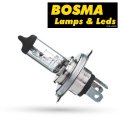
Hello, I got one more question which fits to this thread, have You have in N. America someday the car light bulbs for double switch with three pins, I mean, like for short light and long light?
 
Last edited:
Do You know maybe the american practices about using the motors for saws, when You want to change the direction of rotating of the saw, what is the often solution in America when You don't have three phase system, is that multi-magnet motor which makes the natural rotation? Is that rather DC or AC single phase?, or maybe just electric generator whith 3 phases
Maciek: In America, 99% of small appliances sold are 120 volts. Where dc is required for electronic devices the switching power supplies generally have switch selectable 120/240 input so they can be sold in countries using 240 power. Air Conditioners up to about 10K BTU run on 120 volts. Beyond that again generally 240 volt input is required. According to the National Electrical Code, any 240 volt outlets are specially keyed to not accept 120 volt plugs. The heavier demand appliances such as hot water heaters, clothes dryers, and stoves require 240 volts. In my experience, there is very little confusion about this even with the uninitiated. I have not heard of any homes with three phase power input. The common input for new home construction is 240 volts 200 amps.. There are however many existing homes with 60 amp or 100 amp inputs. I don't understand why you would want to change direction of rotation of a saw. I had a rather elaborate wood shop in my basement and never once even thought about changing the direction of rotation of one of my saws. Maybe you could explain why this is necessary. With three phase, just interchanging two phases will reverse direction of rotation of a motor.
 

Thread Starter

Maciek Gromek

Joined May 8, 2017
72
The standard 1157 brake/park lamp. Dual filament different wattages. http://www.bulbs.com/product/1157B2

Not sure what you mean by short and long light?
I don't know what is the driving law in the US, in Europe we have the shorter "passage lights" when You pass different cars and long road lights when You driving on long distances, and we have to this for example respectively 40 and 45 w in one bulb
 

MaxHeadRoom

Joined Jul 18, 2013
30,682
Here in N.A. there are a couple of methods used for e.g. DRL's (day time running lights), which are mandatory in most parts of N.A. on my 'one of the last Oldsmobiles' for e.g. the DRL's put the head lights in series during daytime running.
Other methods use resistors etc.
Max.
 

Reloadron

Joined Jan 15, 2015
7,891
and it's more likely let's say this 5000 v is everywhere, also for lighting? or there are transformers everywhere to step-down the voltage from 5kV, how do You think?
The building I worked in had a sub-station within the building. This was a single building and part of a huge complex. Our area was a sort of skunk works (an official pseudonym for Lockheed Martin's Advanced Development Programs) adopted by many businesses. We had a tremendous demand for power and had two three phase feeders of 5 KV. As demand grew we needed more power and we built a new sub-station just for our building. The old sub used two large transformers reducing 5 KV down to 480 which fed among other things lighting transformers of 277 V and all of our 120 V needs.

The new sub we added was about a $1,000,000 project and we had a choice of 25 KV feeders or 13.3 KV feeders. We opted for the latter. When looking at cost, using all Siemens equipment the cost of the 25 KV switch gears was a nightmare so while buying 25 KV power was less than 13.3 KV power it would have taken a little over twenty years before we saw a return on the investment.

What used so much power? The large portion was making heat for large auto-claves.
Me Clave.png
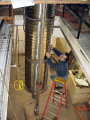
That is a much younger me inspecting heater bands before the auto-clave covers went on.
Clave2.png
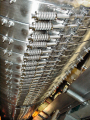
Top to bottom there are 72 heater bands and each half of each band in 3 KW 240 V making a single band 6 KW at 480 V. During heat up a single clave would draw about 432,000 watts of power and it was normal to be running several at a time. The old sub-station was no longer able to meet demand. The dangling yellow wires are Type K thermocouples. Every 6th band we had a skin thermocouple to measure clave skin temperature. During heat up the outer skin of the claves would run between 700 and 1,000 Degrees F. The actual vessel is 316 stainless with a 3" thick wall and a 24" ID.

By some standards our power draw was small and there were also rows of pumps with 40 HP motors.

Ron
 

Thread Starter

Maciek Gromek

Joined May 8, 2017
72
The building I worked in had a sub-station within the building. This was a single building and part of a huge complex. Our area was a sort of skunk works (an official pseudonym for Lockheed Martin's Advanced Development Programs) adopted by many businesses. We had a tremendous demand for power and had two three phase feeders of 5 KV. As demand grew we needed more power and we built a new sub-station just for our building. The old sub used two large transformers reducing 5 KV down to 480 which fed among other things lighting transformers of 277 V and all of our 120 V needs.
and I'm curious, because in Europe it's not needed, 'cause 230/400 v is pretty high to send and can be put directly to the divices, to change 277v to 120v it's needed an extra-transformer, are they hard to place? I mean, are they hidden in the walls or in some boxes? Regards
 

Thread Starter

Maciek Gromek

Joined May 8, 2017
72
Maciek: In America, 99% of small appliances sold are 120 volts. Where dc is required for electronic devices the switching power supplies generally have switch selectable 120/240 input so they can be sold in countries using 240 power. Air Conditioners up to about 10K BTU run on 120 volts. Beyond that again generally 240 volt input is required. According to the National Electrical Code, any 240 volt outlets are specially keyed to not accept 120 volt plugs. The heavier demand appliances such as hot water heaters, clothes dryers, and stoves require 240 volts. In my experience, there is very little confusion about this even with the uninitiated. I have not heard of any homes with three phase power input. The common input for new home construction is 240 volts 200 amps.. There are however many existing homes with 60 amp or 100 amp inputs. I don't understand why you would want to change direction of rotation of a saw. I had a rather elaborate wood shop in my basement and never once even thought about changing the direction of rotation of one of my saws. Maybe you could explain why this is necessary. With three phase, just interchanging two phases will reverse direction of rotation of a motor.
Hey, You know I was talking actually not necessarily about saw, sometimes change of direction makes more convenient work with metal lathe for example, I'm not sure but also by woodmills with band-saw, the change of direction could be helpful.
 
and I'm curious, because in Europe it's not needed, 'cause 230/400 v is pretty high to send and can be put directly to the divices, to change 277v to 120v it's needed an extra-transformer, are they hard to place? I mean, are they hidden in the walls or in some boxes? Regards
Here's https://www.electracool.com/277Volt.html a blurb about 277 V.

Look at 3 phase 4-wire Y here: http://www.baycitymetering.com/services/submetering/wiring-diagrams/

Think of it as a byproduct of 480V 3 phase.

It might even cut down on theft. A homeowner doesn't need a 277 V florescent ballast.

A building has a place where power enters and gets distributed. We had multiple 208 V single phase feeds at 200 Amps to individual panels. The 3 phase 480 were set up as motor starters for the AC system. 30 some air to water heat pumps. So, they were wired direct to the distribution closet. We had a 208 3-phase panel too. Then a few large 277 V lighting panels.

Somebody actually got smart for the machine shop and put local box there with a transformer under the panel. In my high school, they rigged all of the machines in the shops (wood, automotive and metal) to run off a contactor and emergency off button, so you could safely shut down everything.

Now, when we got a 40 kW generator at 480 V, I think, we had to create 208 3 phase, 208/120 single phase, and 277 single phase emergency panels.

==

This https://www.cisco.com/c/dam/en/us/t...ration/guide/SRW2024P_User_Guide.pdf#page=155 is funny.

Linksys states:
Power Internal switching power

So, I guess it doesn't have to be plugged into an electrical outlet to work?
No mention about voltage, Frequency, AC/DC, max power in Watts, nothing at all.
 
Last edited:

Reloadron

Joined Jan 15, 2015
7,891
and I'm curious, because in Europe it's not needed, 'cause 230/400 v is pretty high to send and can be put directly to the divices, to change 277v to 120v it's needed an extra-transformer, are they hard to place? I mean, are they hidden in the walls or in some boxes? Regards
We use 277 because, as mentioned, it is easily done. Our lighting was off 480 volt Y (WYE) transformers where any leg to neutral was 277 Volts. For small industrial applications the power companies can use a few small outdoor pole mount transformers and deliver 3 phase 480 volts. However, for large power demand it requires much higher voltages to the building sub-station. Even once we drop the voltage down to the 480 Volt 3 Phase there is a need for the conduit pipe runs with often sets of conductors (of equal size) running in parallel.

Ron
 
Top