You need to deliver power, that is, voltage x current.
A 120V system has to deliver twice the current as 240V for the same power.
Modern homes in USA are wired for 100A service, that's 12kW. Older homes might be wired for 60A.
Most outlets are wired for 15A or 20A service. That's 2400W with 20A circuit.
Do voltages drop? Yes when equipment that demands large power turns on, you can see the lights dip but only for a fraction of a second. Household appliances, electronics and computers are designed to handle a small drop in voltage.
When you consider that most modern electronics run on 5-12-24VDC some new homes are being wired for 12VDC or 24VDC in order to eliminate all those wallwarts.
US residential years ago was 240 Volt 60 Amp service. Many homes at the time had a four fuse entry panel usually with four fifteen or 20 amp fuses. If a electric heated clothes drier or electric cooking range was added it generally had a separate box off the main entry. This evolved into 100 amp service and today it is not unusual to see 200 amp service. Last year and early this year we rewired my neighbors house which was 60 amp service. We removed all the old knob and tube wiring and installed all new AWG 12. All outdoor service outlets, the kitchen and bathroom are now on GFCI breakers. The old power meter was replaced and a new weather head installed.
When we refer to "service" as 60 Amp, 100 Amp, 150 Amp or 200 Amp residential all it really comes down to is the wire gauge from the utility company feeder to the building. The utility company (in our case First Energy) and the customer each have rights and responsibilities. In the above mentioned case the customer is responsible for the weather head, the conduit supporting the weather head, the power meter box and the wire used from entry panel to the weather head. Service to the weather head and the meter are the responsibility of the utility company. Additionally since in the above case the weather head hardware needed to be all metal conduit since a driveway ran beside the entry point. Plastic PVC was not acceptable. The local city had to inspect the work before the utility company would connect to the new weather head.
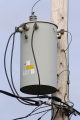
Below is what a typical US residential power transformer looks like. The primary is fed by a single phase high voltage input. Where I live the high voltage is generally around 7,000 volts (7 KV).
The transformer primary is fed from the top, note the large insulator. Below is a cutaway view of a similar transformer. The unit pictured above is a 50 KVA transformer. THe transformer secondary output is seen on the side with the secondary center tap going to ground. Below is a cutaway of a similar transformer.
The wire seen in the foreground is the high voltage primary and in the back the secondary wires can be seen.
Since we start with a single phase line and transformers can't create phases the center tapped output is called a 240 Volt "Split Phase" with two voltages 180 degrees out of phase from each other.
On a long residential street it's not unusual to see three phase high voltage feeding the step down transformers which feed the individual residences. To balance the load each transformer as we travel down the road is connected to a different line of the three phase high voltage.
Below is what a typical US residential power transformer looks like. The primary is fed by a single phase high voltage input. Where I live the high voltage is generally around 7,000 volts (7 KV).
Ron
and on the photo I can see writed "4.8/16" so the transformer gives 480v split phase from probably 16/27 kV medium voltage, and I'm gonna ask, if it's 480v delta three phase local transformer, like You wrote before, so to the household it goes from split phase 240/480v to 120/240v ? and if it's Wye it could be 277v to 120v ?
Best Regards, Matt
oops probably it is....
You know I just talk about solutions not existing in Europe for ex. where I,m living, we have common 3-phase Wye system almost everywhere but almost don't have for ex. delta three-phase, and totally don't have high-leg delta (or wild-leg delta) and split-phase, and in N.America there are transformers from 7,2 kV to 240v, and I think also from 480v to 240v or 120v (I'm talking actually about households) and I'm curious about various transformer instalations
I have never worked with power line components. I am surprised at the area of void. And the size of a residential line transformer is smaller than what I imagined. I've only seen them from the outside. It would take some amount of oil to fill it.
The power transformers that I seldom worked with were in an industrial setting and air cooled.
in N.America there are transformers from 7,2 kV to 240v, and I think also from 480v to 240v or 120v (I'm talking actually about households) and I'm curious about various transformer instalations
In the upper image that I posted it is a single phase residential transformer. This particular transformer is a 50 KVA. Residential transformers can range in primary between about 7 KV to about 13.3 KV. The lower numbers may be, as suggested, a date stamp, I am not sure about that. They output on the secondary 240 Volts split phase.
Below is a picture my neighbor took. My street has two sets of three phase running down it. The lower close together lines are 7 KV and what feeds the transformers for residences. The upper lines are 25 KV 3 Phase which run down to an industrial area. My neighbors granddaughter had some of those Mylar foil covered balloons which got away from her.
A few days after that picture was taken I was in my living room and there came a loud series of Popping sounds, like a string of firecrackers followed by a loud bang. The foil on those balloons was enough to start the arcing. My dogs looked at me with a "what the hell was that look. Broad daylight and the arc flash was so bright it bounced off my living room walls. One of the three phases came down on the street. Lost power in the house. Called 911 on my cell as my concern was a hot smoking line laying in the street and I was worried a car would come along. We had one hell of a busy afternoon. Police and fire showed up and they blocked the street. My emergency generator functioned perfectly and the utility company showed up and restrung the cooked line.
Later I Googled Mylar Balloons and power lines. It seems those balloons have caused some major power outages and caused major transportation problems. I would have figured the balloon would have just vaporized but once the arc began the party was over for the line.
Depends on location. The pictured lamp in my post is supplied by 240 V and is a halogen lamp with its own internal transformer system. The little bubble on the top is a light sensor. They come on around dusk.
Depends on location. The pictured lamp in my post is supplied by 240 V and is a halogen lamp with its own internal transformer system. The little bubble on the top is a light sensor. They come on around dusk.
Ron
I don't know did I good understand, is this 240v split phase, or leg-to-neutral? You say the lamp has internal transformer so the bulb needs a different voltage, like for example 12 volt? Regards
The residential power is 240 Volt split phase. Transformers in street lighting can be used to reduce the voltage or step it up. A good example being low and high pressure sodium street lamps in the 500 watt range. High pressure sodium lamps need a ballast circuit and thus a transformer. Different areas use different types of street lighting. The lamps on my residential street are not the same as those used on the Interstate Highway running through behind my property.
no....? everybody already has "2 times higher voltage" in their homes (240v). If we all switched the wiring in our homes to use that 240V and we threw out our 120V appliances and replaced with 240v appliances, the power generation station would not know the difference. We would not be using any more or any less power. 240V appliances are not any more or any less efficient than 120V appliances. A 240V 2000W hair dryer pulls the same amount of power from the power lines as a 120V 2000W hair dryer.
Nothing to do with the generators, The distribution here in this part of Canada spans from 24Kv to 500Kv, the longest transmission is 900Km.
Now most have been converted to HV DC distribution and reconverted to AC 60Hz at the sub stations.
Max.
Yes that's true that 240v,120v or 12v can deliver the same power, but on the other hand if we talking about for example short circuits, 240v will "react" always stronger on the same material than 120v, because it depends on material, when by 120v goes through it the current for ex. 10 amps, by 240v goes also 10 amps, but in the first situation we have 1200 W, and by 240v it's 2400 W, so maybe the power plants need to have bigger power reserve or something like that. Maybe I'm thinking wrong.
Regards
Your thinking wrong. The power plant would not change,
But going from a 120-0-120 system to a 0-240 system really just affects the property. The transformer secondary would just have to be re-configured. You would not need "double-breakers" for 240 as we have now. A 240 breaker takes up 2 spaces in a typical main breaker box, Each 120 leg of the 240 V has to be fused. Breaker voltage ratings might have to go up. I doubt it, though.

 Facebook
 Google
 GitHub
 Linkedin