Pre-Amp Circuit Design For Piezo-Electric Disk

Thread Starter

elite612

Joined Apr 19, 2026
8
Hello everyone! I am planning to design a pre-amp circuit for a piezo-electric disk. So basically, I am trying to make a contact-based microphone using a piezo electric disk which can work with ESP32. Before I go into the details, I want to mention that I’m still new to circuit design. If I make any mistakes in component selection or any other part of the design, please feel free to correct me. Thanks!

Hardware:

  1. ESP32 Devkit v1.0
  2. ADS1115 16-bit ADC
  3. 27mm Piezo-electric disk (It has a capacitance of 26nF)
  4. MCP6002 OP-AMP (Rail-to-Rail)
  5. MAX98357 DAC (Planning to use it for headphones to listen to live audio)
  6. SD-Card Reader Module (To save audio in it)
Schematic:

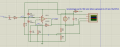
I am planning to power the ESP32 using a 3.3V supply derived from a lithium battery through a buck converter. This is the circuit I have designed for the Preamp. The diodes I have used are 3.3V Zener diodes.

  1. The left graph is of the inverting input terminal of OP-AMP.
  2. The right graph is the output of the OP-AMP.


image

Your valuable feedback would be appreciated. Thanks!
 

crutschow

Joined Mar 14, 2008
38,400
What, exactly, is the preamp supposed to do, and there seems to be extraneous circuitry such as the diodes and capacitor.

The output is rather distorted.
Is that acceptable?
 

Thread Starter

elite612

Joined Apr 19, 2026
8
What, exactly, is the preamp supposed to do, and there seems to be extraneous circuitry such as the diodes and capacitor.

The output is rather distorted.
Is that acceptable?
It's a contact microphone, like the ones usually used on guitars or it could be used on any instrument or surface and capture the sound. The piezo-electric disc is a high impedance device which outputs a very weak signal. Therefore, by amplifying it with an OP-AMP, we can convert it into a useful signal and probably save it on an SD-card or listen to the audio via an audio jack.
 

crutschow

Joined Mar 14, 2008
38,400
It's a contact microphone, like the ones usually used on guitars or it could be used on any instrument or surface and capture the sound. The piezo-electric disc is a high impedance device which outputs a very weak signal. Therefore, by amplifying it with an OP-AMP, we can convert it into a useful signal and probably save it on an SD-card or listen to the audio via an audio jack.
That only answered one of my questions.
Where did you get that circuit?
 

MisterBill2

Joined Jan 23, 2018
27,311
Certainly the circuit shown in post #1 is much more complex than any preamplifier that I have ever seen.
IS this supposed to be strictly an audio frequency range circuit?? Or are there additional requirements???
What is the required gain?? and what frequency range is required?? What is the desired output level??

In addition, understand that the common piezo disc has a resonant frequency that will provide a larger response. So the pickup frequency response might not be flat.
 
Piezo transducers generally need a high impedance load or you will lose the high frequencies - 1M or so. One option is to use a JFET source follower circuit. It will be static sensitive though so use diodes to limit input voltage and a current limiting resistor. You can then use another amplifier as required to set gain, though the source follower will give quite high output
 

Alec_t

Joined Sep 17, 2013
15,112
Your circuit has a nominal gain of -3 and you show an input voltage of 20V rms. If the input really is that large why would you need to amplify it?
Why the resistors in series with the diodes?
 

MisterBill2

Joined Jan 23, 2018
27,311
Certainly the piezo will need a very high impedance input, no question about that. And certainly protecting against static voltages is a requirement. But the polarityof the upper clamp diode in post #1 is incorrect, and as post #7 comments, resistors in series with clamp diodes seems to defeat their purpose.
Since the input is to the opamp inverting input, no need to provide a separate input bias. And what is the purpose of the RC string from the input to "ground"? OR, is that string connected to the non-inverting input?? It is difficult to tell in that image.
Since a piezo is asort of capacitor, the series cap on the input is redundant.
AND, using the simulator display for the circuit does make it rather tedious to read.
 
Last edited:

MisterBill2

Joined Jan 23, 2018
27,311
What is missing from this thread is the explanation of the intended purpose! A statement of what the intended goal is! REALLY, that is important. The intended application usually affects the design.
 
Last edited:

Thread Starter

elite612

Joined Apr 19, 2026
8
What is missing from this thread is the explanation of the intended purpose! A statement of what theintended goal is! REALLY, that is important.
It's a contact microphone, like the ones usually used on guitars or it could be used on any instrument or surface and capture the sound.
 

Thread Starter

elite612

Joined Apr 19, 2026
8
Certainly the piezo will need a very high impedance input, no question about that. And certainly protecting against static voltages is a requirement. But the polarityof the upper clamp diode in post #1 is incorrect, and as post #7 comments, resistors in series with clamp diodes seems to defeat their purpose.
Since the input is to the opamp inverting input, no need to provide a separate input bias. And what is the purpose of the RC string from the input to "ground"? OR, is that string connected to the non-inverting input?? It is difficult to tell in that image.
Since a piezo is asort of capacitor, the series cap on the input is redundant.
AND, using the simulator display for the circuit does make it rather tedious to read.
I needed help regarding that 1 Mega Ohm resistor between inverting and non-inverting terminal, I thought it might act like a bleed resistor, but I guess I am using it wrong and as for the capacitor it was there just for stabilizing the voltage spikes. If you have suggestions to improve this circuit, please do suggest. Thanks!
 

Thread Starter

elite612

Joined Apr 19, 2026
8
Certainly the circuit shown in post #1 is much more complex than any preamplifier that I have ever seen.
IS this supposed to be strictly an audio frequency range circuit?? Or are there additional requirements???
What is the required gain?? and what frequency range is required?? What is the desired output level??

In addition, understand that the common piezo disc has a resonant frequency that will provide a larger response. So the pickup frequency response might not be flat.
This is my first time working on a piezo electric device and also with the pre-amp. So, I know that I am making way too many mistakes but as for strictness of the frequency range I would say no, consider that I want to record the audio of a guitar, just like there are commercial products that do this already.
 

Alec_t

Joined Sep 17, 2013
15,112
With that circuit
1) The amp output is driven against the +ve rail.
2) R2,R7,R3,R4 form an attenuator for the input signal.
 

Thread Starter

elite612

Joined Apr 19, 2026
8
With that circuit
1) The amp output is driven against the +ve rail.
2) R2,R7,R3,R4 form an attenuator for the input signal.
Ok, but can u guide me, what should i be doing next, because I used R3 and R4 to be used as a voltage divider so that I can give a virtual ground / dc bias of 1.65V so that the signal can have room to oscillate below and above this reference point.
 

MisterBill2

Joined Jan 23, 2018
27,311
What comes to mind at this point is that about 30 years ago I did a bit of work with a guitar builder who was planning to put piezo type pickups under the bridge of guitars that he was building. His initials were T.H., and he was in Michigan. I wonder if this project is somehow related to that guitar builder.
Those pickups were simply fed to the input of a common guitar amplifier that normally was used with magnetic pickups.
 
Top