Electric systems in different regions

Thread Starter

Maciek Gromek

Joined May 8, 2017
72
Ok I understand, so the situation, when theoretically would be 240/480v instead 120/240, and 522/960 instead 277/480, and 690/1200 instead 347/600, it also doesn't matter, it's only the appliances. I wanted to say only that Europe kept being under pressure of smaller amparages and went further, they increased the power of appliances and now there is many "power eating" stuff in the house, even over 2000 watts, every electric kettle, every portable room heater, of course the hairdryers, the microwaves (in N. America sometimes only at 750 W), the steam iron is 2800 watts when in N. America is only 1700 watts, typical iron could have 3 times bigger power. This level of power by 100-120 volts could be only by 30 A breaker probably. And have You ever checked is the cable or plug pins very hot after almost 20 Amps loading like after the hairdryer? Could in American house be used the big vacuum cleaners or hairdryers with many power consumming options, like extra heat, or ionning? Regards
 
Last edited:
Ok And have You ever checked is the cable or plug pins very hot after almost 20 Amps loading like after the hairdryer? Could in American house be used the big vacuum cleaners or hairdryers with many power consuming options, like extra heat, or ionning? Regards
Vacuum cleaners have their own bunch of advertising - Peak Horsepower. 746 W/HP makes no sense.
Yep, the cords get warm. They don't even have the right wire gauge, So, nothing adds up!
Whole house vacuums might be a choice for higher power.

See: http://www.thinkvacuums.com/central-vacuums/systems.html
 

Thread Starter

Maciek Gromek

Joined May 8, 2017
72
Do voltages drop? Yes when equipment that demands large power turns on, you can see the lights dip but only for a fraction of a second.
.
In Europe it's also that lights dip, it's higher voltage there but it actually doesn't matter because of thinner wires, long distances from the transformer, lower AC frequency and maybe more
 

Reloadron

Joined Jan 15, 2015
7,891
Here in the US the most commonly seen voltages are 120, 240, 480 and on a few occasions I have seen some large motors running on 4160 volts. Originally this started with voltages like 110, 220, and 440 with much machinery still labeled as such, so for example I may see a motor nameplate reflect 220 while running on a 240 line.
When we built the new substation where I worked we brought in 13,300 volts and wanted 480 Volt Delta. The 13,300 volts is not actually a perfect 13,300 volts so what is done is we try a few different primary taps on the large transformers until we get about 480 volts on the secondaries. In reality my three phase 480 was about 477 when all was said and done. It's all plus or minus a little and +/- 10% is not unusual.

Here in my home on average my outlets are about 123 volts and not a perfect 120 and my 240 entry is more like 246 which is just fine.

During my industry years at the plant I only saw a single instance of big, very big pump motors which ran on 4160 volts. We were all part of a large industrial park which had a RWS (Reclaim Water System) maintained by a "pump house" with huge pumps. Much of the early power was underground in tunnels which on occasion filled with water. One day there was a loud bang, a steam plume followed by smoke from a sub station feeding the pump house. Things got ugly real fast. The pump house went down when the substation blew up. They had to bring in a tractor trailer huge generator to run the pumps. Every two days this monster was fueled with 2,000 US Gallons of diesel fuel. Imagine the cost of burning 1,000 US Gallons (3,785 Liters) per day just to power those pumps. That generator ran for a week. :)

Those pumps were the only time during my career I actually saw motors made to run on such a high voltage. There are plenty of motors like those but I never had much anything to do with them. Our old substation in the building had 5,000 volt feeders and I didn't even like being in that room. :) One time we shut the sub down to clean and I read the huge transformer plate data. Those transformers were manufactured by General Electric in 1953 when I was 3 years old. Go figure.

Ron
 

Reloadron

Joined Jan 15, 2015
7,891
In Europe it's also that lights dip, it's higher voltage there but it actually doesn't matter because of thinner wires, long distances from the transformer, lower AC frequency and maybe more
When I lived in Italy I could literally watch the intensity of my house lamps change. It was funny as the line voltage was all over.

Ron
 

Reloadron

Joined Jan 15, 2015
7,891
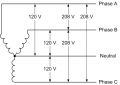
In a three phase 120 volt wye system the phase to neutral voltage is 120 volts, The phase to phase voltage is 208 volts. This is derived by 120 volts * 1.732 = 207.84 or 208 volts. That is where the 208 comes from. The 1.732 being the square root of three.

Three Phase 120 Volt WYE.png


Ron
 

Thread Starter

Maciek Gromek

Joined May 8, 2017
72
In a three phase 120 volt wye system the phase to neutral voltage is 120 volts, The phase to phase voltage is 208 volts. This is derived by 120 volts * 1.732 = 207.84 or 208 volts. That is where the 208 comes from. The 1.732 being the square root of three.
Yeah yeah I know, but "KeepItSimple" wrote it seemed it was 120/208v split, and I just was thinking is that possible to do the tap on single winding with potential 208v in the way that would be 120v and on the rest would be 88v, but very likely it was high leg delta with 120, 208 and 240v .
 
Last edited:

Thread Starter

Maciek Gromek

Joined May 8, 2017
72
Here in the US the most commonly seen voltages are 120, 240, 480 and on a few occasions I have seen some large motors running on 4160 volts. Originally this started with voltages like 110, 220, and 440 with much machinery still labeled as such, so for example I may see a motor nameplate reflect 220 while running on a 240 line.
So when I see 460v or 115v on the appliance it's just the older one or some tolerant level?
 

Reloadron

Joined Jan 15, 2015
7,891
Yeah yeah I know, but "KeepItSimple" wrote it seemed it was 120/208v split, and I just was thinking is that possible to do the tap on single winding with potential 208v in the way that would be 120v and on the rest would be 88v, but very likely it was high leg delta with 120, 208 and 240v .
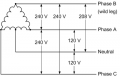
Called Three Phase Split Delta which looks like this:
3 Phase split delta.png

Years ago I worked in a facility which had the main power as seen above. Living in the Cleveland, Ohio USA suburbs we have plenty of old rust belt manufacturing plants still in existence. Not unusual to run across many of the older wiring designs and configurations like the above or the "high leg" designs. As I mentioned earlier I worked on transformers which were wound for a sub station that went in when I was 3 years old in 1953. They last and run forever. :)

Ron
 

Thread Starter

Maciek Gromek

Joined May 8, 2017
72
something again about the changing the direction of rotation of the motor, it's often about install different switch of motor it's called probalby Cross-Switch I think, it could even have options Left-Off-Right, it changes the wires itself, so even doesn't matter if it's single phase AC or DC, but the motor mechanism need to be suitable too, for example by many room fans it doesn't matter if you turn the plug and connect in different polarity, the fan still spins in the same direction. 3 phases motors are good for that, because they can spin on windigs in circle with the natural move of motor, by 3-phase power it's called probably Power of Electromotoric Rotation, and changing the direction is only exchange places of 2 phases (for exaample with the switch with options "Left-Off-Right") and the move of phases and motor is in different direction.
and by the way Are in America 3-phase alternators in cars? Regards
 

MaxHeadRoom

Joined Jul 18, 2013
30,681
Room fans are unidirectional on purpose due to their main function, but the capacitor PSC type motor is capable of reversing if required.
Alternators on automobiles have been used for some many decades now, world wide.
Max.
 

Thread Starter

Maciek Gromek

Joined May 8, 2017
72
Room fans are unidirectional on purpose due to their main function, but the capacitor PSC type motor is capable of reversing if required.
Alternators on automobiles have been used for some many decades now, world wide.
Max.
ThankYou for answer, and are alternators more often 3-phase or single?
 

Reloadron

Joined Jan 15, 2015
7,891
From the WIKI:
https://en.wikipedia.org/wiki/Alternator
An alternator is an electrical generator that converts mechanical energy to electrical energy in the form of alternating current. ... In principle, any AC electrical generator can be called an alternator, but usually the term refers to small rotating machines driven by automotive and other internal combustion engines.
Alternator (automotive) · ‎Linear alternator · ‎Alternators · ‎Alexanderson alternator
No, any AC generator can be called an alternator. Automotive alternators use three phase and then rectify it because you can get more power out of a small three phase package than single phase making it more efficient. The cars I grew up around had generators as the diodes used in alternators had not yet come along. :)

Uh Oh, Max clicked before me. :)


Ron
 
Top