Electric systems in different regions

MaxHeadRoom

Joined Jul 18, 2013
30,680
Motor reversal is the same in N.A. as everywhere else in the world as far as 1ph or 3ph equipment.
There is not many places in the world I can think of that has 3 phase residential supply as a norm.
If it is a industrial situation then it is 440 3ph. 0r 580/600v 3 ph in Canada.
Max.
 

dendad

Joined Feb 20, 2016
4,639
I don't know why you want to change the direction of a saw unless it was built wrong.
It would be handy if running a saw in reverse would put the stuff it cut back ;)
Hand power saws generally have a "Universal Motor", with brushes connecting the armature. To reverse such a motor, you swap the connections to the field OR the armature, not both.
In a lot of AC induction motors, there is a start winding as well as a run winding. Some with a switch and others with a capacitor.
To reverse these, once again, you can swap the connections of the start winding if you can get to both ends.
 
In America are specialized parameters of energy for specific appliances, for example for computers and audio systems is balanced split phase 2 x 60v = 120v, (transformed from 2 x 120v), You use generators, transformers, frequency converters and much more often the direct current, and in Europe it all is not common (everything is simplified to send 3ph 400v on long distances and minimalized, the old wires are very thin so easy to damage and then You have open 200v, but from the other side if You have big sizes of conductor it's actually waste of money), many NEMA plugs configurations which makes unable to plug 120v connector to 240v receptacle f.exmpl., so I just wanted to know some practice here about that 120v system.
For residential, the feeds are usually about 9,600 V single phase Transformers have been placed on poles or in large boxes for underground utilities. That transformer serves about 4 single-family homes. The primary is fused. Sometimes a primary disconnect is found there.

We are starting to see external to the house disconnect switches.

In my area, electric meters are in some sort of Zigbee network that use cellular to "call home".

The secondary is not fro the path from the tansformer to the utility meter to the main breaker panel. The main is has a breaker their for something like 60, 100, 200 A service at 240 V.

So, if we look at a typical duplex outlet in the US, it's fed by split-phase 240 or 120 VAC with Neutral Ground and Hot. white / Green or bare and black, respectively.

Multiple outlets are usually paralleled, but not always.

They are either 15 A (14 AWG) or 20 A (12 AWG) circuits. The cable that runs through the walls is has a rectangular cross-section with a bare ground conductor with insulated black and white wires. The wire is called Romex and is specified as 14/2 or 12/2 with ground.

The shared ground can be problematic. In industrial settings outlets can be what's called "independent ground" and are orange.

We are starting to see what I think is a "code change" where 3 conductors and ground are run to switches that control "lighting", Typically Neutral is not available, but is required for automation such as timers etc.

"living rooms" may not have a built-in ceiling light. Instead, a switch controls an outlet for a table or floor lamp.

We don't have "fused plugs" like the uk does, but 16 AWG is the minimum "fixture wire" that can be used. Fixture wire is found inside lamps, for instance.

We don't have a "whole house" RCD at this point as far as I know, but ground fault and arc fault breakers are now more common place, I don;t know the code requirements. Arc Fault breakers look for a spark signature such as a loose connection. GFCI is our name for an RCD,
 

Reloadron

Joined Jan 15, 2015
7,891
Slightly off topic but during the early 80s I worked aboard the then brand new USS Dwight D. Eisenhower CVN-69 a then brand new US Aircraft Carrier. I was an civilian component of the US DoD. During the first Mediterranean Cruise I went to visit a friend's family in Ireland. So a group of us is sitting around a dinner table and suddenly all the power goes off. Everyone is digging coins out of their pockets as I wonder what the heck is going on? Someone runs outside and stuffs coins in a box and the electricity returns. Sort of like a parking meter in the US and among the funniest things I have ever seen.

Ron
 

MaxHeadRoom

Joined Jul 18, 2013
30,680
Slightly off topic but during the early 80s I worked aboard the then brand new USS Dwight D. Eisenhower CVN-69 a then brand new US Aircraft Carrier. I was an civilian component of the US DoD. During the first Mediterranean Cruise I went to visit a friend's family in Ireland. So a group of us is sitting around a dinner table and suddenly all the power goes off. Everyone is digging coins out of their pockets as I wonder what the heck is going on? Someone runs outside and stuffs coins in a box and the electricity returns. Sort of like a parking meter in the US and among the funniest things I have ever seen.

Ron
Quite common in the UK a few decades ago for many family residences, usually it was under the stairs or similar location.
You always had to keep a shilling or two handy, just in case.
Max.
 

Thread Starter

Maciek Gromek

Joined May 8, 2017
72
I don't know why you want to change the direction of a saw unless it was built wrong.
It would be handy if running a saw in reverse would put the stuff it cut back ;)
Hand power saws generally have a "Universal Motor", with brushes connecting the armature. To reverse such a motor, you swap the connections to the field OR the armature, not both.
In a lot of AC induction motors, there is a start winding as well as a run winding. Some with a switch and others with a capacitor.
To reverse these, once again, you can swap the connections of the start winding if you can get to both ends.
ThankYou for explain, I was talking actually not necessarily about saw, sometimes change of direction makes more convenient work with metal lathe for example, I'm not sure but also by woodmills with band-saw, the change of direction could be helpful. And yeah it would be cool saw if put the stuff cut back ;-)
 

MaxHeadRoom

Joined Jul 18, 2013
30,680
The majority of home machine shop users now tend to use either DC brushed or 3ph motor/VFD combo and these are the least invasive to reverse as both have the ability to be reversed external to the motor.
Max.
 

Thread Starter

Maciek Gromek

Joined May 8, 2017
72
Motor reversal is the same in N.A. as everywhere else in the world as far as 1ph or 3ph equipment.
There is not many places in the world I can think of that has 3 phase residential supply as a norm.
If it is a industrial situation then it is 440 3ph. 0r 580/600v 3 ph in Canada.
Max.
In the eastern Europe where I'm living but also in Germany, three phases for residential supply or even housholds is totally common, not only because people very often prepare the wood for heating, have farm stuff with big power, but also the electric cooks are built for 400 volts, so You have that level of voltage in the kitchen (!) nowadays in that red IEC outlet. That's because the wires are thin. Every single phase 230v can give about 25 A, so 400v (formerly 380v) can give about 43 A, and the meters of course are for three phases (40 A)
 

MaxHeadRoom

Joined Jul 18, 2013
30,680
The closest I got to it in residential situation was in the UK installing storage heaters, if several were installed in one home, the service Co request that they be spaced across 3 ph each to the Neutral.
This was because each homes on a street were each fed from 1ph and a neutral in a block of 3 or 4. from a 3ph star transformer.
The next 3 the next phase etc, so it was requested in order to avoid a miss-balance of one phase.
Max.
 

Thread Starter

Maciek Gromek

Joined May 8, 2017
72
For residential, the feeds are usually about 9,600 V single phase Transformers have been placed on poles or in large boxes for underground utilities. ,
and do You know, is this 9600 volts split-phase, single phase to neutral, or three-phase? Does it happens sometimes transforming from high voltage directly to low voltage, or it is always high to middle and only then to low ? Regards
 

Reloadron

Joined Jan 15, 2015
7,891
In my neighborhood, the greater Cleveland, Ohio suburbs on my residential street we have 3 phase WYE which is about 7,000 volts feeding the transformers for 240 VAC 60 Hz. split phase to the homes. There is also a 25 KV line (3 phase) just passing through.

Prior to retiring we added a new power sub station where I worked. All the new equipment was Siemens and really nice stuff. At any given time I could bring up the entire sub and know exactly what was going on. We had a choice of entry voltage. We could have either 13.3 KV or 25 KV (3 phase WYE) and me opted for 13.3 KV. While the 13.3 KV power cost a few cents more the prices of the 25 KV switch gears were unbelievable. So while we were going to pay slightly more for the 13.3 KV service in the long run we were looking at over a 25 year payback going with 25 KV and slightly lower cost power. We also kept the switchgear and two transformers outside the building and brought in only the 480 V 3 phase Delta. It was if I recall correctly 5 MW sub we added to an old 2.5 MW sub and my first real look at facilities engineering and I had the pleasure of working with some great people on the project.

Here in the US The selection of system voltages is crucial to successful power system design. Reference [1] lists the standard voltages for the United States and their ranges. The nominal voltages from [1] are given in table 4-1. As can be seen, ANSI C84.1-1989 divides system voltages into “voltage classes.” Voltages 600 V and below are referred to as “low voltage,” voltages from 600 V-69 kV are referred to as “medium voltage,” voltages from 69 kV-230 kV are referred to as “high voltage” and voltages 230 kV-1,100 kV are referred to as “extra high voltage,” with 1,100 kV also referred to as “ultra high voltage.” The emphasis of this guide is on low and medium voltage distribution systems. So it all comes down to ANSI C84.1-1989. The voltages in the linked chart are approximate. For example while the chart reflects 13,800 as a common 4 wire voltage in my area it would be 13,300.

Ron
 
and do You know, is this 9600 volts split-phase, single phase to neutral, or three-phase? Does it happens sometimes transforming from high voltage directly to low voltage, or it is always high to middle and only then to low ? Regards
It may not be 9,600, but it's close. Based on Ron's data, it could be 13, 800.

The distribution to "house transformer" is single phase to ground. It's likely, that it's part of a larger 3 phase system, but the other two phases are no where to be found on the pole.

Three phase exists along the main road. The development has 99 houses. They had to divide up the three phase so it's "evenly" loaded whatever that means. So, the development may have 33 houses on each phase, but the other two phases won't exist on the nearby pole.

Substation generates relative to EARTH.

Earth (8 foot ground rod - usually) and Neutral bond exist at one point per single family home on the secondary side. That one point is the center tap of a 120-0-120 transformer.
 

Reloadron

Joined Jan 15, 2015
7,891
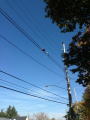
Here is a good one. As I mentioned on my street we have two three phase lines which run up the street before going underground where the freeway went through. Our friends across the street have an adorable granddaughter who had some of those common Mylar balloons. A few got away from her and came to rest here:
Ballons in Power Line.png

That lower set is the about 7 KV line and a few poles down is where the lower 7 KV goes underground. The picture was taken by grandma.

The following day I was in the living room and I heard a series of loud pops and crackling sound followed by a heck of a bang and quiet, very quiet. Yeah, quiet as the TV went off and the dogs were looking at me like what the heck was that? I looked outside and sure enough one line was severed and lying in the road. On the bright side my emergency generator did its thing. I could just see a car running into that line and I haven't a clue which way that power runs and if the in the street was hot or cold. I called 911 and suggested a cop to block the line. Heck within minutes I had a few police and a few fire trucks. Damn we have good service. :) The power company showed up and within a few hours everything was fixed.

A few years back we had what I called suicidal squirrels. About one a week for about six weeks would manage to bridge the primary of the transformer up the road. When that fuse blows they use an explosive charge to make sure the disconnect does indeed disconnect. Those things sound like about a 12 gauge shotgun when they fire. Every time it went off another squirrel was pretty much vaporized and all the houses leading up to us were without power. We are on the next transformer down the line. That was so strange as I could not figure out what was attracting them to that particular transformer? Haven't had it happen again in a few yaers now but that was strange, about six in as many weeks. Go figure?

Anyway, that Mylar Balloon episode got me thinking and Googling. " Mylar balloons power lines". Major blackouts have happened as a result of Mylar balloons contacting power lines, some really good reads. :)

I used the word Mylar for what is really metalized PET film. Mylar I believe is a trademark of Dupont. I have no clue who made the material the balloons were made from. Mylar was just a convenient word at the time.

Ron
 
Last edited:

Thread Starter

Maciek Gromek

Joined May 8, 2017
72
ThankYou so much Ron for that picture and story :) So that highest one line is high voltage and there where are the baloons is low voltage? and street lamps has different lines and voltages? You wrote before about 3-phase Delta and I remind that, by the 480v 3-phase High-Leg Delta can give 240 volts only to neutral, not split-phase isn't it? And to this You use also NEMA 240v plugs, for example 15 Amp (NEMA 6-15), or different connectors?
 
Last edited:

Thread Starter

Maciek Gromek

Joined May 8, 2017
72
It may not be 9,600, but it's close. Based on Ron's data, it could be 13, 800.

The distribution to "house transformer" is single phase to ground. It's likely, that it's part of a larger 3 phase system, but the other two phases are no where to be found on the pole.

Three phase exists along the main road. The development has 99 houses. They had to divide up the three phase so it's "evenly" loaded whatever that means. So, the development may have 33 houses on each phase, but the other two phases won't exist on the nearby pole.

Substation generates relative to EARTH.

Earth (8 foot ground rod - usually) and Neutral bond exist at one point per single family home on the secondary side. That one point is the center tap of a 120-0-120 transformer.
ThankYou very much for these informations
 

Reloadron

Joined Jan 15, 2015
7,891
ThankYou so much Ron for that picture and story :) So that highest one line is high voltage and there where are the baloons is low voltage? and street lamps has different lines and voltages? You wrote before about 3-phase Delta and I remind that, by the 480v 3-phase High-Leg Delta can give 240 volts only to neutral, not split-phase isn't it? And to this You use also NEMA 240v plugs, for example 15 Amp (NEMA 6-15), or different connectors?
Yes, on my residential street we have a 7 KV three phase line and on the pictured poles the top is 25 KV. At my place of work we had 480 Volt Delta. The balloons were interesting and I never really would have thought they could do the damage they did and the more I read about foil balloons and power lines the more stuff I found. :)

Ron
 

Reloadron

Joined Jan 15, 2015
7,891
I doubt that we would run 240 to neutral, BUT at work we had "German Power" installed for a tenant for a German furnace.
I bet that was fun. :)

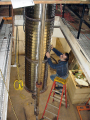
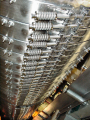
Pictured below is a slightly younger me when I actually worked. I was checking the torque and tension on some heater bands which were custom made. Each half is 240 Volts @ 3 KW so each complete band is 480 Volt 6,000 Watts. Top to bottom there are 72 bands or when the clave is heating and calling for 100% power on the 480 VAC bus it draws about 432,000 Watts. With smaller pipe heaters each clave would draw about 1/2 Million Watts on the 480 bus.
Me Clave.png
Clave2.png

The added autoclaves were part of the reason we installed the new sub station I mentioned earlier. The sides of the pictured clave were about a 30" OD with a 24" ID. The walls are 3" and the entire affairs are 316 Stainless Steel. High pressure vessels. Wow, I still had brown hair in the picture. Thinning but at least it had color. :)

The control systems were really my area but... every now and then I actually could be found on a ladder and this was obviously pre-osha safety. Today they use a lift and anyone doing the work is in a harness. That image was likely about 15 years ago.

All in all as far as power went there were 24 bands per phase staggered. A to B had 24, B to C had 24 and C to A had 24. Each band had a small current driven LED so as heater bands burned open it was easy to see. The entire mess was covered with large insulated clam shell covers and only opened when we had about a dozen or so open bands as the clave would get sort of slow heating up to temp.

Ron
 
Last edited:
Top