Electric systems in different regions

strantor

Joined Oct 3, 2010
6,875
this is interesting that USA stand by lower voltage and it's still ok, meanwhile rest of the world wanted to change to higher, because of wire diameters, but America has the biggest power use and large buildings. I wish to have lower voltage in the house also because of costs because American appliances have visibly lower power use
I'm just asking about it, because that system 230/400v proposed for global standard by International Electrotechnical Commission is actually ..... primitive a little, because it's over 200 volts even for smallest appliances, and in the U.S. it's used only for high wattage stuff and not even for all.
I think you give America too much credit. I think our American system is the more primitive one. 120V at 60Hz is just what we standardized on because that's what was easiest to accomplish with the tech we had at the time we standardized on it. Nowdays I think we have a lot better options that we will never explore because we are standardized already. We pay the early adopter cost. Higher voltage, higher frequency AC would reduce the size of wiring and transformers; higher frequency magnetic materials are available now that weren't before. HVDC power transmission is now a reality since we now have cheap ways of stepping up/down DC.

I think 50Hz is more primitive than 60Hz, But I think 60Hz is still primitive; 400Hz has been used in airplanes for a LONG time.
I think 120V is more primitive than 230V. I do not think we benefit from having a lower line voltage than the rest of the world. I do not consider 120V to be any safer than 240V. We just pay extra for copper.
 

Reloadron

Joined Jan 15, 2015
7,891
I think you give America too much credit. I think our American system is the more primitive one. 120V at 60Hz is just what we standardized on because that's what was easiest to accomplish with the tech we had at the time we standardized on it. Nowdays I think we have a lot better options that we will never explore because we are standardized already. We pay the early adopter cost. Higher voltage, higher frequency AC would reduce the size of wiring and transformers; higher frequency magnetic materials are available now that weren't before. HVDC power transmission is now a reality since we now have cheap ways of stepping up/down DC.
Next week we can get into the transmission of Digital Television and what it finally took to change the US standard. :) The US power and distribution system is not about to change anytime soon. My grandparents house in the Park Slope section of Brooklyn NY was originally on Edison's DC. When the change came about customers were given a large selenium rectifier to run their refrigerators (those that had refrigerators) since the fridge had a DC motor compressor.

Ron
 

MaxHeadRoom

Joined Jul 18, 2013
30,681
Next week we can get into the transmission of Digital Television and what it finally took to change the US standard. :)
Ron
Sometimes it does not pay to be first.
The UK were the first to broadcast TV to the public and they decided on 405 scanning lines, this was found to cause high pitched sound from the flyback transformer and slight flicker.
Probably learning from the error, the US went with their higher resolution, around the 60's UK decided to go to 625 line scan for UHF, this resulted in a TV set that catered to both frequency bands with a set that had a huge multi contact slider switch crossing the whole width of the circuit board in order to change over.o_O
Max.
 

Thread Starter

Maciek Gromek

Joined May 8, 2017
72
I bet that was fun. :)

Pictured below is a slightly younger me when I actually worked. I was checking the torque and tension on some heater bands which were custom made. Each half is 240 Volts @ 3 KW so each complete band is 480 Volt 6,000 Watts. Top to bottom there are 72 bands or when the clave is heating and calling for 100% power on the 480 VAC bus it draws about 432,000 Watts. With smaller pipe heaters each clave would draw about 1/2 Million Watts on the 480 bus.

Ron
Oh thankYou so much, I'm a layman so it is very informative for me. So if here is the split-phase 240/480v theoretically between neutral and one hot would be 240v, so on this it could be pluged for example european appliance unless it needs 50 hertz necessarily, but on the split-phase 240v could be work too, because in Europe neutral is not exactly 0 volts either way. Do You think it could be do the split-phase on every AC winding when I make the tap and put it to the mass or ground, or it is not so simple. Must the tap be exactly on the center to achieve the balance?
Best Regards, Matthias (Maciej)
 
Last edited:

Thread Starter

Maciek Gromek

Joined May 8, 2017
72
Next week we can get into the transmission of Digital Television and what it finally took to change the US standard. :) The US power and distribution system is not about to change anytime soon. My grandparents house in the Park Slope section of Brooklyn NY was originally on Edison's DC. When the change came about customers were given a large selenium rectifier to run their refrigerators (those that had refrigerators) since the fridge had a DC motor compressor.

Ron
so American system is really based on DC, that where came from split-phase probably, it reminds connecting of the DC circuits
 
Last edited:

Reloadron

Joined Jan 15, 2015
7,891
so American system is really based on DC, that where came from split-phase probably, it reminds connecting of the DC circuits
The American System began with DC. Initial Commercialization of Direct-Current (D.C.) Applications is a good read on the subject. and the ensuing problems that would plague a DC distribution system or grid. While Edison was an OK inventor he was also a very shrewd businessman. What is interesting is looking back at the world wide grid(s) today and seeing how they worked in their early beginnings.

Ron
 
oh, so it is 50 hertz frequency 3-phase 400volts? How do You achieve this, from fuel generator maybe? Regards
I wasn't involved, but frequency wasn't the issue. It was a BIG furnace that had to melt aluminum.

This was the manufacturer and possibly the furnace: nabertherm-kilns.com/chamber_kilns.htm

I know they had issues:

From their catalog:
Mains Voltages for Nabertherm Furnaces 1-phase: all furnaces are available for mains voltages from
110 V - 240 V at 50 or 60 Hz. 3-phase: all furnaces are available for mains voltages from 200 V - 240 V or 380 V - 480 V, at 50 or 60 Hz.

The connecting rates in the catalog refer to the standard furnace with 400 V (3/N/PE) respectively 230 V (1/N/PE).

The building natively had 120/208 split ( I think), 208 3 phase, 277 and a higher voltage 4xx 3 phase @ 60 Hz.

They may have already bought the furnace, maybe even used it and let's say it was 400 V 3 phase or 230 single phase.

Our "distribution" internally was mostly broken up into 120/208 V split phase 200 A panels with motors for the HVAC system at the 4xx voltage. Then there were two 277 V lighting panels.

Motors have taps that get changed for 208/240. Heating elements had to be replaced. We moved from a location with a 240 V system (they came from another place much later in time).

We had lots of diffusion pumps with 240 V heaters that had to be changed to 208 V. There are no controls on these heaters. They are just on for the pump to work.
It heats oil at the bottom and cools it with liquid Nitrogen at the top, taking gasses with it.

Management made lots of mistakes during the move. e.g. wiring that was supposed to be L1 L2 N G was just L1 L2 and G. I doubt anyone considered the 208/240 issue at all.
 

Reloadron

Joined Jan 15, 2015
7,891
The building natively had 120/208 split ( I think), 208 3 phase, 277 and a higher voltage 4xx 3 phase @ 60 Hz.
Least we forget that here in the US 277 Volts is a very common industrial voltage used for lighting. An industrial 3 phase 480 volt WYE configuration will have 480 volts phase to phase with any phase to neutral being 277 volts (480 / square root of 3 or 480 / 1.732 = 277). This made it easy in a large industrial setting to just use any phase to neutral to setup lighting panels. Somewhere around here I have a case of 277 volt ballast transformers unless I dumped them. :)

Ron
 

Thread Starter

Maciek Gromek

Joined May 8, 2017
72
I think you give America too much credit.......
I think that American system is really able to modificate, of course if You wish, because of closeness of medium voltage (at least a few kilovolts) and if I'm not wrong, almost everywhere exist 240 or 208 volts, and for example producers of hairdryers could very quickly start the production of 200-240v hairdryers, I say about it cause I think hairdryers are the biggest-power appliances which are used by 15 or 20 amps breakers and that makes them turning off. The problem would be when more and more 240v appliances would be put to consumers, that could make the need of gradual changing the generators in the power plants to manage the thousands of 240 volts appliances,
and there will create the costs and maybe power outages, but I personally would change only hairdryers 'cause only they make the problem probably.
The most important point I think is that Japan have still 100 volts system,
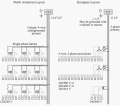
and the interesting thing is they have practically no low voltages over 200 or 250 volts, and in the big buildings the stationary machineries, separated from people, are operating with ..... medium voltage, about the few kilovolts, and I thing it exists in some way in the walls of big buildings, if I'm not wrong, so that would be really "anti-primitive" thing ;-) but for little appliances which people have contact with them, is only about 100 or 200 volts. In Europe it is not even to think, seems to me. In America are used industrial motors on 3-phase 2400/4150 volts and in Europe the stuff over 1 kV is rare, it's only 230/400v, sometimes 400/690v. I think if Japan is still with 100v, North America will not leave 120v completely but maybe it's only my feeling. And here is the excellent article, where the author compares Eur. and U.S. distribution systems, and the results show among others that American system is cheaper, European system is maybe more convenient, but higher 3-phase voltage is abused for too long distances
Here is the link and the the picture from that.
http://electrical-engineering-portal.com/north-american-versus-european-distribution-systems
On the picture is one wrong, Europeans don't know what is split-phase (240/480v)
 

Attachments

Last edited:

strantor

Joined Oct 3, 2010
6,875
producers of hairdryers could very quickly start the production of 200-240v hairdryers, I say about it cause I think hairdryers are the biggest-power appliances which are used by 15 or 20 amps breakers and that makes them turning off. The problem would be when more and more 240v appliances would be put to consumers, that could make the need of gradual changing the generators in the power plants to manage the thousands of 240 volts appliances,
and there will create the costs and maybe power outages, but I personally would change only hairdryers 'cause only they make the problem probably.
The problem is all the plugs in American houses are 120V except for the plug for clothes dryer and electric oven. There is not 240V run throughout the house. If I wanted to use a 240V hair dryer in my house right now, I would need to tear open my walls and run a new power cable through my attic to the bathroom from my breaker panel outside.

And I do not think that switching to 240V appliances would cause any problems for the power generation stations. They would not demand any more power than 120V versions.
 

drc_567

Joined Dec 29, 2008
1,156
I bet that was fun. :)

Pictured below is a slightly younger me when I actually worked. I was checking the torque and tension on some heater bands which were custom made. Each half is 240 Volts @ 3 KW so each complete band is 480 Volt 6,000 Watts. Top to bottom there are 72 bands or when the clave is heating and calling for 100% power on the 480 VAC bus it draws about 432,000 Watts. With smaller pipe heaters each clave would draw about 1/2 Million Watts on the 480 bus.
View attachment 127418
View attachment 127419

Ron
... Ron, what substance were you processing that required so much heat/power?
thanks
 

Reloadron

Joined Jan 15, 2015
7,891
... Ron, what substance were you processing that required so much heat/power?
thanks
Without getting myself in trouble and black helicopters flying above my house. We developed, built and tested control rod drive mechanisms as used in nuclear reactor systems but strictly military for the US Navy Nuclear Program, also called Navy Power. All US Navy submarines and aircraft carriers are nuclear powered. The huge auto-clave vessels were used for testing of the final product. When we think about it the control rods are the only moving part in the core of a reactor. It was a great job but I am happy to be retired now. Anyway, that was the last 25 years of my career. :) Those vessels were big as can be seen with me in perspective and once the heater bands are setup the large covers are put in place.

Ron
 
That's pretty impressive. Our group almost got into trying to clean heat exchangers (application nuclear) with a high pressure pulses. It was designed, built, dismantled and transported somewhere else. It never was "fired up". The guy doing it was also interested in my I-V converter design for application to corrosion monitoring.
 
So, why not 350 DC? That;s almost what happens now. 120 VAC and 240 VAC are either full or half wave rectified and the switching supplies start there. Heaters/AC's might use VFD's.

Then there is the idea of low voltage DC. e.g. 48V

The 100 VAC, I think is only in certain areas of Japan. Had two scanning electron microscopes, two different manufactures, that were 100 VAC. One used a Variac with the knob removed on the wall and the other an enclosed transformer.

The US did have some creap from 120. It's closer to 125 now. Stuff was rated for 117V,
 

Thread Starter

Maciek Gromek

Joined May 8, 2017
72
The problem is all the plugs in American houses are 120V except for the plug for clothes dryer and electric oven. There is not 240V run throughout the house. If I wanted to use a 240V hair dryer in my house right now, I would need to tear open my walls and run a new power cable through my attic to the bathroom from my breaker panel outside.

And I do not think that switching to 240V appliances would cause any problems for the power generation stations. They would not demand any more power than 120V versions.
Yeah, the only help would be extension cord, but probably not for too long. And generators would need to be changed when America strart to produce 2 times higher voltage, like in Europe?
 

strantor

Joined Oct 3, 2010
6,875
generators would need to be changed when America strart to produce 2 times higher voltage, like in Europe?
no....? everybody already has "2 times higher voltage" in their homes (240v). If we all switched the wiring in our homes to use that 240V and we threw out our 120V appliances and replaced with 240v appliances, the power generation station would not know the difference. We would not be using any more or any less power. 240V appliances are not any more or any less efficient than 120V appliances. A 240V 2000W hair dryer pulls the same amount of power from the power lines as a 120V 2000W hair dryer.
 

MaxHeadRoom

Joined Jul 18, 2013
30,681
And generators would need to be changed when America strart to produce 2 times higher voltage, like in Europe?
Nothing to do with the generators, The distribution here in this part of Canada spans from 24Kv to 500Kv, the longest transmission is 900Km.
Now most have been converted to HV DC distribution and reconverted to AC 60Hz at the sub stations.
Max.
 
Modern homes in USA are wired for 100A service, that's 12kW. Older homes might be wired for 60A.
That's 2 circuits of 125 V fused at 100 A or one 240 circuit at 100A (Each leg fused at 100 A). Your math doesn;t work. P=VI= 240 V * 100 A = 24 KW. 200 A service is common too. Consider the all electric vs gas/electric or oil/electric home.

Cooking can be primarily gas or electric.
Heating is primarily oil or gas and heat pump
Clothes dryers can be gas or electric.
Air conditioning is primarily electric.

There is hybrid stuff too e.g. gas/heat pump and solar thrown in. Gas can also mean propane.
 
Top