Electric Current poll and call out

Electron current same as Electric current

  • TRUE

    Votes: 3 33.3%
  • FALSE

    Votes: 6 66.7%

  • Total voters
    9
Status
Not open for further replies.

MrAl

Joined Jun 17, 2014
13,709
- " if we define the electron as negative and read 10 amperes, then if we change our minds and define it as positive we will still read 10 amperes. "

Is this because the ammeter will measure current (electric current) as how many electrons are flowing right through the clamp at that moment regardless of the charge it carries at that moment.
Hi,

Well if you want to get technical, current is almost always measured indirectly. Usually by a force due to an electromagnetic effect. Even more indirectly of course is the voltage drop in a resistor, or the Hall Effect.

The meter would measure the same current if 100 holes passed in once second or 100 electrons passed in 1 second, but the holes would be going in the opposite direction as the electrons. Obviously if we change the polarity then everything reverses. Ammeters do have a polarity.
 

Thread Starter

Mac Rodriguez

Joined Mar 24, 2016
140
Hi,

Well if you want to get technical, current is almost always measured indirectly. Usually by a force due to an electromagnetic effect. Even more indirectly of course is the voltage drop in a resistor, or the Hall Effect.

The meter would measure the same current if 100 holes passed in once second or 100 electrons passed in 1 second, but the holes would be going in the opposite direction as the electrons. Obviously if we change the polarity then everything reverses. Ammeters do have a polarity.
- You keep saying " holes " in your posts.
Isn't that strictly for semi-conductor circuits, i'm just asking.
I mean, I guess it could fit in this situation, it would still be through a wire, I think.
I don't really work with semi-conductor parts.
 

Thread Starter

Mac Rodriguez

Joined Mar 24, 2016
140
In general, electric current could physically be due to the flow of positive charge carriers, negative charge carries, are changing electric fields. But YOU keep wanting to limit the discussion to electrical current in a typical wire. Under THAT restriction, electric current is physically due to the movement of electrons (that carry a negative charge).
-Ah yes, you are right.
My mistake.
Yes I do.
In that paragraph of the page it was talking about circuits so it seemed like it was staying on topic when I read that. I guess Wiki would not be the best of choices to rely on. Better stick to AAC, more reliable.

" electric current is physically due to the movement of electrons (that carry a negative charge)."

it sounds to good to be true to read you write that, I must still be missing something.
Going back to post #14, how would you compare the sentence above to that post.
curious.
 

nsaspook

Joined Aug 27, 2009
16,330
- "
Conventional current is not the opposite of electron current.

conventional current is defined to flow in the same direction as positive charges
"

why is it when I read the first sentence and then the second I seems like i'm trying to opposite statements.
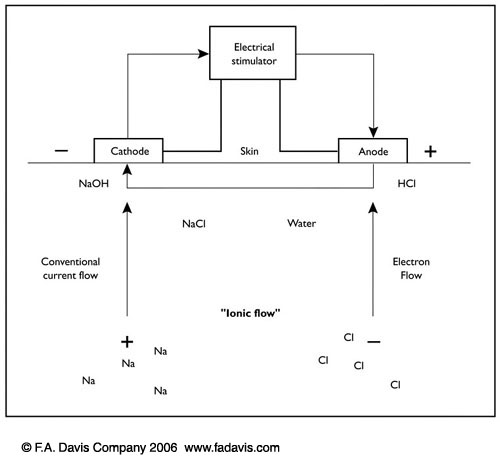
Lets look at the electric current in a human body from an electric potential attached to the body with copper conductors. The electric current in the copper conductor is 1mA and since it's a series circuit the current in the body must also be a 1mA electric current. When we look at the physical charge movements in the body (as ions that move because there are no "free" electrons as in a wire conductor) we see positive charge carriers and negative charge carriers moving in opposite directions in response to the applied electric field to neutralize the electric field in the body. Do these opposite body charge carrier movements cause a negation of charge and somehow reduce the total current flow or do they as Conventional current flow match the current in the copper conductor?


WBahn

Joined Mar 31, 2012
32,883
I don't think it makes much sense to even think about holes in a metallic wire. A hole is a vacancy in the valence electron population resulting from the excitation of an electron to a and those would be vanishingly rare in a metal.
-Ah yes, you are right.
My mistake.
Yes I do.
In that paragraph of the page it was talking about circuits so it seemed like it was staying on topic when I read that. I guess Wiki would not be the best of choices to rely on. Better stick to AAC, more reliable.

" electric current is physically due to the movement of electrons (that carry a negative charge)."

it sounds to good to be true to read you write that, I must still be missing something.
Going back to post #14, how would you compare the sentence above to that post.
curious.
What you are missing is the concept of the minus sign. You aren't going to make any progress until you grasp that concept.
 

MrAl

Joined Jun 17, 2014
13,709
- You keep saying " holes " in your posts.
Isn't that strictly for semi-conductor circuits, i'm just asking.
I mean, I guess it could fit in this situation, it would still be through a wire, I think.
I don't really work with semi-conductor parts.
Hello again,

I guess you think i bring things up for my health :)

The fact that holes in metals are not USED for calculations does not mean that there are no holes. Even if we said that there were no holes in pure metal even with the slightest impurity there could be some. If you dont accept that, then i await your proof that there are no holes in the many pieces of wire i have around here ranging in length from 1 foot to 50 feet, and various gauges from #32 or less to #6 gauge (AWG). And BTW, none of them are stored at absolute zero.

But again, i was not bringing that up for any detailed discussion about holes and if they exist in wire or not, i was bringing it up so that we have a reasonable means to talk about what a positive charge in a wire might be like and what it might do. And even if we have ONE hole in ONE wire in the universe, that's enough.

If you ask me, you've got to learn to recognize the significant from the inconsequential. But i guess you just got confused over what we read sometimes about these subjects, which usually have an entirely different point of view and thus context.
In other words, see the forest not the trees.

Another example i heard once and i thought was really cool, was if you hear hoof beats, go right ahead and assume they are horses NOT zebras. More about this later perhaps :)

I think i'll bow out of this discussion for now until something significant comes up here :)
 
Last edited:

MrAl

Joined Jun 17, 2014
13,709
Hi,

Ha ha, i didnt realize this was becoming Comedy Central, but i like comedy so i'm not complaining :)

On the more serious side, it takes time for anyone anywhere in any subject to learn, so sometimes we have to be patient with them just like they have to be patient in dealing with the learning process for themselves.
 

BobaMosfet

Joined Jul 1, 2009
2,211
In a wire, the electrons flow one direction but the charge flows the other (because the electrons carry a negative charge). Since electric current is defined as the flow of charge (not of charge carriers) then electric current is in the direction opposite the flow of electrons.
No, you are patently wrong. Only conventional current flows in the opposite direction of electrons.-- I hate to break it to you but the entire concept of 'conventional current' was a mistake. Current does not flow from positive to negative. Ever. It _always_ flows from negative to positive. If we want to get into the physics of it, it always flows from more negatively charged pile of electrons to any less-negatively charged pile of electrons. The entire concept of 'positive' is a lie.

All electron movement is based on neutralization of charge. An attempt by physics of the universe to equalize electron charge-- everywhere. This is why E= I/R is the most fundamental equation there is. KVL and KCL were simply another way to say it-- which most people don't even realize.
 

atferrari

Joined Jan 6, 2004
5,012
This thread may be the silliest one I've ever read here. That's a high bar. The one with over 1000 posts about the weather makes more sense than this one.
Long threads leave eventual gems of wisdom lost / buried for the prospective interested reader in the future. You do not browse a long thread for something that you ignore if is there... Not even with Google.

Contrary to the silliest one, the best long ever thread I read was in the Microchip forum. Search for USB implemented with PICs (Brad Minch Olin College). I managed to add to the confusion, why not? ;)
But, it did not start with a :oops: :oops: poll and was an explicit application.
 

MrAl

Joined Jun 17, 2014
13,709
WBahn said:
In a wire, the electrons flow one direction but the charge flows the other (because the electrons carry a negative charge). Since electric current is defined as the flow of charge (not of charge carriers) then electric current is in the direction opposite the flow of electrons.
No, you are patently wrong. Only conventional current flows in the opposite direction of electrons.-- I hate to break it to you but the entire concept of 'conventional current' was a mistake. Current does not flow from positive to negative. Ever. It _always_ flows from negative to positive. If we want to get into the physics of it, it always flows from more negatively charged pile of electrons to any less-negatively charged pile of electrons. The entire concept of 'positive' is a lie.

All electron movement is based on neutralization of charge. An attempt by physics of the universe to equalize electron charge-- everywhere. This is why E= I/R is the most fundamental equation there is. KVL and KCL were simply another way to say it-- which most people don't even realize.
Hi,

I didnt understand that statement either. My best guess was that WBahn was taking the definition of current as moving positive charges as being the ONLY definition of current. I am thinking now that he changed that stance.

But the most general case is where we have two unequal charges in free space. If held in place at a distance D they dont move, but if let go, they move toward each other at the same rate so they should meet directly at a distance of D/2 from their original starting points. That's if we consider the charge only, and if we consider the mass as well then the equations of motion will also come into play and cause the meeting distance to be different. The more important point though is that they will both move, in opposite directions until they meet.
So it is POSSIBLE for either charge to move, but i dont think this kind of movement, which is truly a physical movement of both charges, ever happens in a wire unless maybe the wire is heated, and then probably only thermal expansion and more hap hazard collisions could cause atoms to shift, but i dont think we can classify that as part of the current because it would probably be just random.

I too view this thread and threads like this as being informative because questions that are on many people's minds come up and are discussed, and that leads to better understanding. It's like a "think tank" where opinions are expressed and the less important are eventually weeded out. Very good overall i think.
 

WBahn

Joined Mar 31, 2012
32,883
No, you are patently wrong. Only conventional current flows in the opposite direction of electrons.-- I hate to break it to you but the entire concept of 'conventional current' was a mistake. Current does not flow from positive to negative. Ever. It _always_ flows from negative to positive. If we want to get into the physics of it, it always flows from more negatively charged pile of electrons to any less-negatively charged pile of electrons. The entire concept of 'positive' is a lie.

All electron movement is based on neutralization of charge. An attempt by physics of the universe to equalize electron charge-- everywhere. This is why E= I/R is the most fundamental equation there is. KVL and KCL were simply another way to say it-- which most people don't even realize.
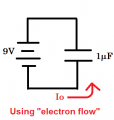
So answer the following questions:
electroncurrentC.png

What is Io?

If the capacitor is initially uncharged, how much charge is on the bottom plate of the capacitor once it is fully charged?
 

Thread Starter

Mac Rodriguez

Joined Mar 24, 2016
140
Yes, and the Truth usually will have a nuance that scurvy Pollywogs fail to grasp in the beginning as they stumble through a series of tests and trials until they are accepted by King Neptune as one of his trusty shellbacks.
-Truth is bound to its expression. Not the pollywogs fault " kings " can't speak CORRECT English(any language).
I wonder how long this is going to go on... :rolleyes:
- you don't have to read if you don't want to.
 

nsaspook

Joined Aug 27, 2009
16,330
-Truth is bound to its expression. Not the pollywogs fault " kings " can't speak CORRECT English(any language).
When facts, logic and reason fail ...


"A MAN WITH A CONVICTION is a hard man to change. Tell him you disagree and he turns away. Show him facts or figures and he questions your sources. Appeal to logic and he fails to see your point."

Leon Festinger
 
Last edited:
Status
Not open for further replies.
Top