Electric Current poll and call out

Electron current same as Electric current

  • TRUE

    Votes: 3 33.3%
  • FALSE

    Votes: 6 66.7%

  • Total voters
    9
Status
Not open for further replies.

BobaMosfet

Joined Jul 1, 2009
2,211
- But you can't superimpose what happens somewhere else into here or there ( i.e. current in a wire )
It doesn't matter what the conductor is. Air, water, copper, dirt-- if you move electrons through it in the same direction you _will_ get a voltage. Period. End of story. That's physics.
 

WBahn

Joined Mar 31, 2012
32,878
Given the response to my question above-- there is only one universal definition of current flow. That is determined by atomic physics and nothing else. One standard, one measure. The answer to the Poll is TRUE, not FALSE. Electrical current is the flow of electrons through any conductor-- and it is the same everywhere in the universe.

End of story.
The "flow of electrons" is measured in electrons per second.

Electrical current is measured in coulombs per second.

These are not the same thing, particularly when most people that want to pretend they are want to measure the flow of electrons using units of amperes with positive amperage corresponding to electrical current flow in the same directions as the electron current flow.

There is a fixed conversion factor between electrons per second and amperes and that conversion factor is negative.

6.24E18 electrons/second = -1 coulomb/second = -1 A
 

WBahn

Joined Mar 31, 2012
32,878
It doesn't matter what the conductor is. Air, water, copper, dirt-- if you move electrons through it in the same direction you _will_ get a voltage. Period. End of story. That's physics.
You may or may not get a voltage. Electrons can and do flow between points that are at the same voltage. Also, if there is a voltage drop across a particular segment in which electrons are flowing that voltage drop might be positive or negative. Just look at the relationship between voltage and current in either a capacitor or an inductor. Or consider the case of current flowing in a superconducting magnet.
 

nsaspook

Joined Aug 27, 2009
16,330
Given the response to my question above-- there is only one universal definition of current flow. That is determined by atomic physics and nothing else. One standard, one measure. The answer to the Poll is TRUE, not FALSE. Electrical current is the flow of electrons through any conductor-- and it is the same everywhere in the universe.

End of story.
The people at LHC disagree with you.

The beam is a conductor. (equivalent to a current carrying wire of hydrogen)
http://www.lhc-closer.es/taking_a_closer_look_at_lhc/0.proton_source
http://www.lhc-closer.es/taking_a_closer_look_at_lhc/0.beam_current
 

BobaMosfet

Joined Jul 1, 2009
2,211
You may or may not get a voltage. Electrons can and do flow between points that are at the same voltage. Also, if there is a voltage drop across a particular segment in which electrons are flowing that voltage drop might be positive or negative. Just look at the relationship between voltage and current in either a capacitor or an inductor. Or consider the case of current flowing in a superconducting magnet.
I will use the term impedance in this case to mean either resistance, impedance, or both. The proper answer is in a better understanding of what voltage is. Volts do not exist as a physical element. They are not real. 'Voltage' is a value which represents the reciprocal relationship between electron densities on either side of an impedance. Period. If you measure a voltage drop (which is what voltmeters do), it will only register a difference between the probes if either one of two possibilities exist: a) the ground reference between the two points is different (such as if you were measuring two electrically disconnected systems), or b) there is a impedance between those points (in the same circuit).

Whether or not a voltage drop is positive or negative is a semantic, materially only in reference to which side is used as the reference point. All voltage drops are a loss of potential used in inducing current.

Where inductors and capacitors are concerned, most people are confused by their behavior. A capacitor is an open circuit. Period. Current does not flow through a capacitor. It will flow onto one plate on one side, while flowing off the other plate on the other side, or vice versa-- but it will never flow through it. Inductors on the other hand are short. Both devices build exactly the same field, though the actual understanding of that is beyond the grasp of most people in the field, because they have no true understanding of the electron interaction involved that makes one field a static non-electromagnetic field, and the other a dynamic electromagnetic field.
 

BobaMosfet

Joined Jul 1, 2009
2,211
The people at LHC disagree with you.

The beam is a conductor. (equivalent to a current carrying wire of hydrogen)
http://www.lhc-closer.es/taking_a_closer_look_at_lhc/0.proton_source
http://www.lhc-closer.es/taking_a_closer_look_at_lhc/0.beam_current


No, they don't disagree. The writer is using the term 'current' loosely. All they are doing is causing an excitation of the electormagnetic field through a different proton-based mechanism, and the 'transformers' are physically moving electrons in the standard way as electron-based current.
 

nsaspook

Joined Aug 27, 2009
16,330
No, they don't disagree. The writer is using the term 'current' loosely. All they are doing is causing an excitation of the electormagnetic field through a different proton-based mechanism, and the 'transformers' are physically moving electrons in the standard way as electron-based current.
There is absolutely nothing loose about their use of current WRT to the proton current 'wire' primary loop of the transformer. It meets the requirements exactly as a electrical current in DCCT transformer theory.
https://cas.web.cern.ch/cas/Switzerland-2014/Lectures/Cerqueira.pdf
 

WBahn

Joined Mar 31, 2012
32,878
I will use the term impedance in this case to mean either resistance, impedance, or both. The proper answer is in a better understanding of what voltage is. Volts do not exist as a physical element. They are not real. 'Voltage' is a value which represents the reciprocal relationship between electron densities on either side of an impedance. Period. If you measure a voltage drop (which is what voltmeters do), it will only register a difference between the probes if either one of two possibilities exist: a) the ground reference between the two points is different (such as if you were measuring two electrically disconnected systems), or b) there is a impedance between those points (in the same circuit).

Whether or not a voltage drop is positive or negative is a semantic, materially only in reference to which side is used as the reference point. All voltage drops are a loss of potential used in inducing current.

Where inductors and capacitors are concerned, most people are confused by their behavior. A capacitor is an open circuit. Period. Current does not flow through a capacitor. It will flow onto one plate on one side, while flowing off the other plate on the other side, or vice versa-- but it will never flow through it. Inductors on the other hand are short. Both devices build exactly the same field, though the actual understanding of that is beyond the grasp of most people in the field, because they have no true understanding of the electron interaction involved that makes one field a static non-electromagnetic field, and the other a dynamic electromagnetic field.
This has so many inaccuracies is hard to even know where to start.

'Voltage' is a value which represents the reciprocal relationship between electron densities on either side of an impedance.
In a circuit there is no difference in the electron densities on either side of resistance that has a voltage across it. There is, however, a difference in the electric potential energy associated with the electrons on either side.

Whether or not a voltage drop is positive or negative is a semantic, materially only in reference to which side is used as the reference point. All voltage drops are a loss of potential used in inducing current.
The voltage drop between two points in unaffected by what point is chosen as the reference. The reference only affects the voltage value we assign to a specific point and that is because voltage is ALWAYS a potential difference between two points and so if we want to talk about the voltage AT a point, we need an agreed upon other point that the voltage is referred to. A voltage drop as no need of any such reference and, in fact, you don't need any reference at all.

Whether a voltage drop is positive or negative is not a semantic -- it is very clearly defined, including it's sign. The voltage drop from Point A to Point B is the work per unit charge performed on a charge that is moved from Point A to Point B. Notice that there is no reference mentioned and no ambiguity as to the sign.

As for all voltage drops being a loss of potential used in inducing current, just look at the voltage drop across a battery or across a charged capacitor that is sitting their looking stupid. No current in either case, yet there is very much a voltage drop present.

If you measure a voltage drop (which is what voltmeters do), it will only register a difference between the probes if either one of two possibilities exist: a) the ground reference between the two points is different (such as if you were measuring two electrically disconnected systems), or b) there is a impedance between those points (in the same circuit).
Take two electrically disconnected systems and measure the voltage drop between them. Guess what? You get zero (unless there is a net charge between them, in which case they are not isolated systems but, rather, part of a larger system). Don't take my work for it, go measure the voltage difference between the positive terminal of a 1.5 V battery and the negative terminal of a 9 V battery that otherwise aren't connected (such as sitting on a table several inches from each other). Now measure the difference between the two positive terminals. Guess what? Zero difference.

So much for (a).

Now make a circuit consisting of two voltage dividers that have the same ratio. Then connect a resistor between the outputs of both dividers and measure the voltage between those two points. Guess what? You get zero.

So much for (b).

Where inductors and capacitors are concerned, most people are confused by their behavior. A capacitor is an open circuit. Period. Current does not flow through a capacitor. It will flow onto one plate on one side, while flowing off the other plate on the other side, or vice versa-- but it will never flow through it.
You need to study the behavior of changing electric fields and their equivalency to electrical currents.

Inductors on the other hand are short.
So, since they are shorts, you are saying that they can never have any voltage across them. So explain how a traditional automotive electrical system produces the voltage for the spark plug.

Both devices build exactly the same field, though the actual understanding of that is beyond the grasp of most people in the field, because they have no true understanding of the electron interaction involved that makes one field a static non-electromagnetic field, and the other a dynamic electromagnetic field.
So are you claiming that Maxwell's equations are a bunch of hogwash? If so, then what ARE the equations that should be used in their place, along with the theory to explain where they come from.

While you are at it, please answer the following:

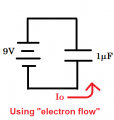
electroncurrentC.png

Since you are claiming that electron flow and electrical current are the same, then you must be claiming that Io is positive (starting with an uncharged capacitor until the time that it is fully charged).

So what is the final charge on the bottom plate?
 

Thread Starter

Mac Rodriguez

Joined Mar 24, 2016
140
It IS "respected as it is" -- it is the flow of electrical CHARGE!!!!!!!!!

- Not if it's not being named correctly, that is, calling it (electron current) the electric current that bumps through wire only.

You still refuse to comprehend the distinction between charge and something that carries charge.

- No no, I got it. Post #148 made it very clear the difference and I accept it.

So you go right ahead an do whatever you want and use magical mystery minus signs that you pull out of thin air whenever you need to multiply two positive numbers and come up with a negative number.

- Positive times a positive = a positive. That's the math I was taught.

.
 
Last edited:

Thread Starter

Mac Rodriguez

Joined Mar 24, 2016
140
We can produce two polarities of potential.

But we can only produce one polarity of current. All coulomb movement and therefore all current has a negative charge. A negative current can produce both polarities of potential.

If you insist on carrying the polarity of the coulomb in the equation, ALL electrical current and All electrical power must be labeled as negative.

If you insist on the proper math, then I insist on the proper and real dynamic.

And believe it or not, the FACT the we can only produce one polarity of current is the very reason that we can use electricity.

Electricity can not exist with two polarities of charge flow.

Not only is positive charge flow NOT real, it's that teaching and promotion causes all the misery and suffering in the world. That's been mathematically proven by the way. Without a minus sign.

Our children deserve to be protected from that perverse minus sign at all cost, even if we hide the truth from them.

It is now easier to get the truth out of a politician, than an academic.
- " even if we hide the truth from them. "
This one sentence here I have to say is devastatingly wrong.
Truth hurts, it may even kill, but it should never be hide. Especially with intent.
 

Thread Starter

Mac Rodriguez

Joined Mar 24, 2016
140
Our children deserve to be protected from that perverse minus sign at all cost, even if we hide the truth from them.

It is now easier to get the truth out of a politician, than an academic.


Those statements were in jest, Mac. Just jest.
-Ah I see.
Sarcasm.
I missed that, my mistake.
Great of you to clear that up.
I was beginning to think wrong of you.
 

Thread Starter

Mac Rodriguez

Joined Mar 24, 2016
140
Exactly right, and the worldwide standard. Electron flow is worth considering and using at times, but it must be clearly distinguished from "current" which it is not.


You're trying to say the whole world is crazy except you. In the world of science and technology, words have meanings. Precise, defined meanings. WBahn has repeatedly given you the definition of "current". It's correct.
- " You're trying to say the whole world is crazy except you "
My opinions about the whole world have no place in this subject.
I'm not going to deny my humanity.
I'm pointing fingers and asking questions, say what you want.
 
Last edited:

Thread Starter

Mac Rodriguez

Joined Mar 24, 2016
140
Hi,

I am happy to see that you narrowed it down a little here with one issue at a time. It's so hard sometimes to talk about something that involves a whole bunch of issues at once.

I guess i did not make my points clear enough, that's the only explanation, because i know from reading your other posts that you are a very knowledgeable person.
When i said that "A positive charge moving from left to right is the same as a negative charge moving from right to left" what i meant is that we cant, nor do we usually want to, be able to tell the difference with any measurement including the polarity of the current.

That means that when we insert an ammeter into the circuit and we have positive charge moving left to right we measure current of say +2 amps, but if instead we had negative charge moving right to left we would still measure +2 amps.

-Same AMOUNT of charge but not type, is what you are saying. am I wrong.

Let me state the four cases using 2 amps magnitude as example:
1. Positive charge moving left to right, +2 amps.
2. Negative charge moving right to left, +2 amps.
3. Positive charge moving right to left, -2 amps.
4. Negative charge moving left to right, -2 amps.

To put it another way, say we can see the movement of any charge in a wire at one specific point along the wire length. There are a lot of possibilities so i'll just mention a few...
1. If we see a positive charge move left to right past the test point, then see another positive charge move left to right, we have a net charge of 2 units.
2. If we see one positive charge move left to right, then see one positive charge move right to left, we have a net charge of zero.
3. If we see a positive charge move left to right, then see a negative charge move left to right, we have a net charge of zero.
4. If we see a positive charge move left to right, then see a negative charge move right to left, we have a net charge of 2 units.

The most obvious though i think is when we put an ammeter into the wire it doesnt matter what convention we use we always measure the same polarity. If we have it connected properly then we see the expected polarity. That polarity however does not change just because we decide to use electron current flow instead of positive charge flow.

The chair/room analogy was just meant to show that sometimes we cant tell what moved, and sometimes it doesnt matter what moved if we get the same effect.
A simpler example is say two buckets and one baseball. If we see the baseball in the bucket to the right, then later we look again and see the baseball in the bucket to the left, did the baseball move into the other bucket, or did the empty bucket swing around the bucket with the ball in it and thus appear on the other side. In the end we see the same result, which is the 'effect' not necessarily the cause. If we could see someone pick up the baseball and put it into the other bucket, then we would also know the 'cause', but in theory we dont always have to know the cause just the effect, because that is often good enough to give us a working knowledge of what we are dealing with. When it becomes not good enough then we have to dig into the physical reality a bit deeper to find out the underlying truths, but a lot of theory stops at a certain knowledge depth because it's good enough for the current era.
- (eyes wide open) Please explain this!

1. Positive charge moving left to right, +2 amps.

--if positive charge could move through the wire from left to right, then how does it get there.

2. Negative charge moving right to left, +2 amps.
3. Positive charge moving right to left, -2 amps.

--But if the - terminal is on the right side, then where is the + coming from. And if its not coming from the terminal and coming just through the wire then does it "push" the - charge out of the way to get to the left terminal.

4. Negative charge moving left to right, -2 amps.

--But if it the terminal on the left is + and it's full of protons and proton charge with no electrons and electron charge then where is the - charge coming from.

" To put it another way, say we can see the movement of any charge in a wire at one specific point along the wire length. There are a lot of possibilities so i'll just mention a few...
1. If we see a positive charge move left to right past the test point, then see another positive charge move left to right, we have a net charge of 2 units.
2. If we see one positive charge move left to right, then see one positive charge move right to left, we have a net charge of zero.

-what!

3. If we see a positive charge move left to right, then see a negative charge move left to right, we have a net charge of zero.

- I don't know what to think of this.

4. If we see a positive charge move left to right, then see a negative charge move right to left, we have a net charge of 2 units."

-This part I understand, I think.
 
Last edited:

Thread Starter

Mac Rodriguez

Joined Mar 24, 2016
140
I don't know how many different ways to explain it.

An electron is like a UPS truck that is delivering widgets to a factory with each truck carrying 500 widgets. You can talk about 20 trucks/day going into the factory or you can talk about 10,000 widgets/day going into the factory. These both convey the same amount of information. But do you see that they are NOT the same thing?

Now let's say that we use widgets/day so often that we want to give it a special name and call 1 widget/day a flintstone, in honor of the founder of the factory. So we have 20 trucks/day or we have 1000 flintstones. These are NOT the same thing.

The truck is a carrier and we can describe the delivery "current" in trucks/day. But what we are really interested in is what the trucks carry, which are widgets. The widget current has units of widgets/day, or flintstones. In the case above, there are widgets/truck and that is the conversion factor between trucks/day and flintstones. Namely:

X = 20 trucks/day * 500 widgets/truck = 1000 widgets/day = 1000 flintstones.

Now let's say that things slow down but that we still have 20 trucks/day but each truck is carrying only one widget.

X = 20 trucks/day * 1 widgets/truck = 20 widgets/day = 20 flintstones.

Even though each carrier only carries one item in which we are interested, it is still the case that "truck current", in trucks/day, is NOT the same things as "widget current", in flintstones. The fact that the numerical part has the same value does not make them the same. 1 desk is not the same as 1 chair despite the fact that both quantities have a numerical value of 1.

The same is true for electrons that carry electrical charge. And ampere is NOT a measure of the flow of electrons, it is a measure of the flow of electrical charge. The amount of electrical charge carried by an electron happens to be -1.602E-19 C/e-.

That negative sign is not ignorable. It is, in fact, critical to making the system consistent.

One thing to keep in mind is that wires using electrons as carries are not the only means of creating an electrical current. We have a stream of protons. Each proton has a positive amount of charge.

So if we have a system that had both a proton beam and an electron beam impinging on our sphere with the same number of charge carries per second in each beam, then the total current impinging on the sphere would be zero even though both particle currents (carrier currents) are positive because the electric current from the electron beam would be negative and the electric current from the proton beam would be positive by the same magnitude.
-This was very helpful, but I still don't see why I am wrong to SEE the following:
If you need UPS trucks to take the widgets to the factory, then until said widgets are unloaded off the truck at the factory dock they should labeled as one. when the factory shipper/receiver calls UPS for information on the widgets the dispatch will tell him " the truck is 30 min. away " never once did the dispatcher mention the widgets or even felt the need to because between the dispatcher and the shipper they both UNDERSTOOD that the truck and the widgets at that point were the " same " thing, not like they were fused together or anything but it's like, if the truck is on the way, so is the cargo.
Same with the OP, if electrons are the only carrier of - charge in the wire, which is the only charge that the load uses as force to do work, then ELECTRON FLOW should be labeled as the only ELECTRICAL ENERGY FLOW in wire.
 
Last edited:

Thread Starter

Mac Rodriguez

Joined Mar 24, 2016
140
But if you want to call the electron flow current positive, then you CANNOT use the unit of amperes because amperes is the rate of the flow of CHARGE!

In addition, you need to change a whole slew of equations in order to make them consistent with the fact that voltage is defined in terms of charge and not electrons.

If you don't (which no one does) then you end up with a mish mash system that forces you to use magical mystery minus signs all over the place. For instance, replace the resistor with a capacitor and then ask how much charge is on the plate connected to the negative terminal. We know that it is negative since it has an excess of electrons. But if the current flowing into it is positive (per the electron flow current guys) then how is it that a positive current (remember, 1 ampere = 1 coulomb of charge per second) results in a negative charge building up? Answer, it can't -- unless you throw a magical mystery minus sign at it because that's the sign that you know the answer has to have.
-" But if you want to call the electron flow current positive, then you CANNOT use the unit of amperes because amperes is the rate of the flow of CHARGE! "
I am not calling electron flow current positive or even trying to. electron charge is - . That's what I understand.
 

Thread Starter

Mac Rodriguez

Joined Mar 24, 2016
140
Quite the contrary -- electrical current in a wire is a subset of electrical current in general, therefore whatever definition of electrical current that applies to a wire MUST be consistent with the general definition of electrical current that applies in any and all other situations. So coming up with any understanding for current in a wire that is inconsistent with any other form of electrical current is a non-starter.
-" therefore whatever definition of electrical current that applies to a wire MUST be consistent with the general definition of electrical current that applies in any and all other situations "

Yes I agree that the "definition of " should match but electrical energy current is crazy. it changes the way it acts in so many different situations. it's different in (positive and negative) lightning compared to wire, fluorescent light bulb compared to spark plug gap, your vacuum example compared to your chemical tank(battery), so like I asked before " where's the ruler " who's to say in which situation electrical energy current is in it's absolute form to be compared to and by.
 
Last edited:

Thread Starter

Mac Rodriguez

Joined Mar 24, 2016
140
The "flow of electrons" is measured in electrons per second.

Electrical current is measured in coulombs per second.

-VERY helpful words.

These are not the same thing, particularly when most people that want to pretend they are want to measure the flow of electrons using units of amperes with positive amperage corresponding to electrical current flow in the same directions as the electron current flow.

- I believe there's a typo in that, but no, i'm not trying to pretend they are, at least I think I am not.

There is a fixed conversion factor between electrons per second and amperes and that conversion factor is negative.

6.24E18 electrons/second = -1 coulomb/second = -1 A
 

MrAl

Joined Jun 17, 2014
13,709
- (eyes wide open) Please explain this!

1. Positive charge moving left to right, +2 amps.

--if positive charge could move through the wire from left to right, then how does it get there.

2. Negative charge moving right to left, +2 amps.
3. Positive charge moving right to left, -2 amps.

--But if the - terminal is on the right side, then where is the + coming from. And if its not coming from the terminal and coming just through the wire then does it "push" the - charge out of the way to get to the left terminal.

4. Negative charge moving left to right, -2 amps.

--But if it the terminal on the left is + and it's full of protons and proton charge with no electrons and electron charge then where is the - charge coming from.

" To put it another way, say we can see the movement of any charge in a wire at one specific point along the wire length. There are a lot of possibilities so i'll just mention a few...
1. If we see a positive charge move left to right past the test point, then see another positive charge move left to right, we have a net charge of 2 units.
2. If we see one positive charge move left to right, then see one positive charge move right to left, we have a net charge of zero.

-what!

3. If we see a positive charge move left to right, then see a negative charge move left to right, we have a net charge of zero.

- I don't know what to think of this.

4. If we see a positive charge move left to right, then see a negative charge move right to left, we have a net charge of 2 units."

-This part I understand, I think.

Hello again,

Very often in physics as well as math and other subjects we talk in the most general way, then when an application comes along we start to get less general in order to actually solve a real world problem.

A simple example is:
y=m*x+b

That's a very general statement about a straight line. But then comes along an application, say Ohm's Law for pure resistance, and then the 'b' becomes zero so we are left with:
y=m*x

and of course now the variables take on meaning and represent what they should in Ohm's Law: E=R*I

So we went from very general, which had nothing to do with Ohm's Law for pure resistance if the 'b' was non zero, to a less general form which made 'b' equal to zero. But now that equation does not apply to a general straight line anymore because a straight line can have an offset and thus where it crosses the y axis it is non zero.

Under the topic of discussing charges, we often talk of negative AND positive charges in order to cover all the bases, just like the equation for the straight line covered all straight lines not just when b=0. So if we say positive charge and negative charge, it's usually because we dont want to leave anything out, not because we must have those charges present all the time.

In the case of the wire, we have both positive and negative charges, but the negative charges outnumber the positive charges. When we say negative charges we mean electrons, or better yet the quasi-electrons, and when we talk about positive charges we talk about stationary atoms that are missing one outer shell electron so their net charge is positive. The positive charges do not move, but they may appear to move if we could actually observe down to that level. That's because if we look at the one-electron-at-a-time model we'll see the hole that the missing electron makes change location. Even though it is not exactly the same exact hole that is moving it appears that it does from a distance.

The simplest analogy i think is to look at a pipe filled end to end with ball bearings, but missing just one at the far left end. That's a 'hole'. Now first the ball next to the hole moves left into the hole, and that fills the hole but the next position to the right now has the hole. Next the 2nd to last ball moves into the hole, and that means the 3rd position has the hole. So already we see the balls moving right to left but the hole 'appears' to be moving left to right. Now bring the two ends of the pipe together to form a complete circular path, and that is like the circuit.
But this isnt the most general rule. The more general rule is in free space where charges can move any way we want them to in order to show their behavior.

In free space, we can say we have a negative charge moving from right to left, and we have a positive charge moving from left to right. It doesnt matter where these charges came from or how they got there because we specify them ourselves so that we can talk about what happens next and what the overall outcome is. This is where we get positive charges moving and negative charges moving. And since the direction is part of the understanding of current, we include the direction.

Given the free space environment, if we have a positive charge moving left to right and a negative charge moving left to right then the total charge that has moved past that point is zero. There are other cases which i mentioned already.
 
Status
Not open for further replies.
Top