Electret Microphone Biasing and Pre-amplifying for low frequencies

Thread Starter

Sil G

Joined Jun 15, 2017
1
Hello guys! I am trying to build a circuit for an electronic stethoscope.
I am using an electret microphone to capture heart and lung sounds(20-1kHz). As far as I know, electret microphone has integrated preamp.

So my question is, would I be needing an external biasing and pre amplifying before filtering the signal?? (i'm using 2nd order butterworth filter)

If yes please suggest an appropriate preamplifier. I am considering of using LM741 or LM358AD for the preamplification, if needed. I'm confused as to how to proceed with it since I need to make the stethoscope as light as possible.


Thank you!
 
Last edited:

kubeek

Joined Sep 20, 2005
5,796
You definitely need to bias the microphone, otherwise you won´t get any signal out. Check the typical connections on google, and check the datasheet in order to get the biasing right. After that you would probably want some low noise preamplifier before you go into the the butterworth filter, although a passive high pass and low pass before that filter probably wouldn´t hurt as well.
 

OBW0549

Joined Mar 2, 2015
3,565
Texas Instruments has a very good reference design for an electret microphone pre-amp, which you could modify to suit your own requirements, and the write-up includes lots of background information on how electret microphones work and how they are used.

An LM741 or LM358 is probably not the best choice for use in a pre-amp; I think you need something with lower noise. The TI design uses an OPA172.
 

DickCappels

Joined Aug 21, 2008
10,661
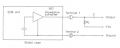
upload_2017-6-15_18-13-15.png
The outputs of electret microphones are the drains of JFETs and you need to connect them as shown in the diagram above. The voltage and load resistor will be recommended in the manufacturer's datasheet.

The electre microcphones you are likely to find in consumer products probably have terrible frequency response below 100 Hz.

For a preamp, you have a wide range of choices. You can do much better than the LM741. A 10¢ opamp that I have been using lately is this little one LMR321G-GTR.

For some preamp have a look at this Google Search.
 

GopherT

Joined Nov 23, 2012
8,009
Hello guys! I am trying to build a circuit for an electronic stethoscope.
I am using an electret microphone to capture heart and lung sounds(20-1kHz). As far as I know, electret microphone has integrated preamp.

So my question is, would I be needing an external biasing and pre amplifying before filtering the signal?? (i'm using 2nd order butterworth filter)

If yes please suggest an appropriate preamplifier. I am considering of using LM741 or LM358AD for the preamplification, if needed. I'm confused as to how to proceed with it since I need to make the stethoscope as light as possible.


Thank you!
Just a 2.2k ohm resistor from your 9v supply to the positive terminal of your microphone and other end of mic to ground. Then connect directly to your second order butter worth (assuming it is made with op amps).

Do not use a 741! There are so many better amps available.
 

MrChips

Joined Oct 2, 2009
34,895
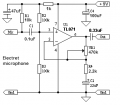
Here is a typical circuit schematic on how to power an electret microphone.


The purpose of the capacitor on the output lead is to AC-couple the signal to the input of the preamplifier. In other words, it removes the DC bias and passes the AC signal to the preamp.

This is a high-pass RC filter. It passes the high frequencies and attenuates the low frequencies.
Unfortunately, your heart beat consists of very low frequencies, lower than 1Hz.

I wouldn't do it like that. I would omit the capacitor.

Feed the signal DC-coupled into a difference amplifier and subtract the DC bias voltage. Use a low noise opamp (such as TL071) powered from a bipolar power supply. Once you have removed the DC bias you can amplify the AC signal and apply the required filtering.
 

GopherT

Joined Nov 23, 2012
8,009
A bipolar power supply can easily be made from two 9-volt batteries in series with the node between the two batteries becoming "ground". Then you have +9 and -9V powering the op amp(s).

Also, a bare microphone doesnt make a good stethescope head. Place it in a dome of some sort so the felt on the microphone is just off of the skin.
 
Top