EHT power supply design and construction

So.. This is in response to complaints and questions coming at me from the AT and a few "camp followers". I've posted this everywhere I can think of. Personally I'd have preferred freehanding it. HP feels the personal touch is sloppy and informal, it's her party, so mote it be.. Unfortunately I have next to no experience with the Ltspice editor (the preferred electronics drafting platform per HP). Well Julie and HP are out of touch for a few and the severity of the issue demands immediate action. So yeah. It's ugly but I think it has what it takes.

Well it seems a surprising number of IDIOTS (that's how it is!) have suffered loss, damage and aggravation for their unwillingness to distinguish autotransformers from potentiometers.

I hope this clears it up:
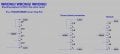
VariavNoNo.jpg

@HP WE NEED TO TALK! I'm at the end of my rope with this sort of crap! And please! Don't dismiss it as "weakness on magnetics"! NOBODY is "weaker on magnetics" than me! But this is a whole new level of ignorance! It's not like anyone had a "momentary lapse of reason"! The jerks (each) actually "designed" and diagrammed the circuit! Still they were surprised it didn't work and remained obstinately insistent that it should! No kidding! Of the six I verbally counseled two remain clueless but "open minded":rolleyes:

Well it's all this! You simply must raise the bar! Your egalitarian fantasy of accommodating all comers is a huge disservice to truly interested parties! Now look! I'm not talking eugenics here! I said "truly interested"! Truly interested electronics enthusiasts intuitively understand the difference between variacs and potentiometers! Forgive me for this but I can't help wondering if part of your objective with all this (RE: some readers) is creating scientific sensibility of a desire for "awesome toys". HP, really! It won't work! It's a lost cause drawn from the same scrap heap as trying to inspire love where only lust exists or attempting to change another's politics or faith! Well.. I wouldn't say abiding passion is "in the genes" but it's as central to the individual as identity itself! Time to narrow the bandwidth, increase the Q!

@HP I'm serious! We need to discuss this! Publicly or privately it's your call but we need to talk!

Thanks!
 

Thread Starter

Aleph(0)

Joined Mar 14, 2015
597
Electrician o/c that explanation totally nails it but some ppl have complete mental block with concept of inductor inrush being worst connecting at crossing and (theoretically) zero connecting at peak:rolleyes: So I say it goes right back to math aversion which IMO is totally crippling W. civilization:( It's like when ppl say they can't handle math cuz _the infinitesimal keeps getting in their way_o_O So it only goes to show sometimes inelegant approaches (like analysis) can be vry useful w/o being pretty:cool:! So anyhow I'm saying kudos for caring enough to make correct explanation and inspiring your readers to listen to it! So now I'm saying you must have _teacher gene_ which I'm totally too impatient to have:oops::)

So since for electrical and radiological safety HP wants LV PSU remotely switchable with like "air tube" (so controllable by single momentary contact switch) there's two ways to go.

@Electrician's suggestion here:
This same function of having a resistor in series which then gets shorted could also be made automatic by using a time delay relay, for greater cost.
Or HP's synchronized circuit (which automatically connects variac to line at peak)

So speaking just for myself I say @The Electrician's idea is best for LV PSU cuz fewer semiconductors = more bulletproof:)!

Well it's all this! You simply must raise the bar!
Theo I TOTALLY agree!

Truly interested electronics enthusiasts intuitively understand the difference between variacs and potentiometers!
Theo OMG! I know they should:rolleyes:! I've seen a lot of ppl connecting wiper to one end of variac winding:eek:!
 
Last edited:
So since for electrical and radiological safety HP wants LV PSU remotely switchable with like "air tube" (so controllable by single momentary contact switch) there's two ways to go.

@Electrician
's suggestion here:
This same function of having a resistor in series which then gets shorted could also be made automatic by using a time delay relay, for greater cost
Or HP's synchronized circuit (which automatically connects variac to line at peak)

So speaking just for myself I say @The Electrician's idea is best for LV PSU cuz fewer semiconductors = more bulletproof:)!
Yup! It provides for the filter-charge current surge too!

Hey HP! Not to diss! Elegant solutions are works of ethereal beauty! In this case though, less than practical, sorry!;)

Thanks!
 
Last edited:

cmartinez

Joined Jan 17, 2007
8,788
Here's an addition to my previous suggestion ... so as to "gild the lily" ... :)

Instead of drilling the sheet stock one by one, and using one of the standoffs as a template, a better idea would be to sandwich several layers (up to ten, for starts) of sheet material for the spacers between two pieces of wood, and tightly hold it together using a couple of c-clamps (or screws, or whatever you can find available for this purpose). The wood would be sacrificial, as you'd be drilling through the whole thing. But the wood, and the pressure applied, would prevent the sheet material from moving, and more importantly, it would produce a much cleaner, sharper, and rounder hole, since the wood's fibers will be pressing tightly against the edges of the hole as it is being drilled. Afterwards, you may remove the drilled material and clamp it between the two washers that I had previously suggested to trim its outside diameter.

I've used this sort of technique many times before, and it always works like a charm.
 
Last edited:
Here's an addition to my previous suggestion ... so as to "gild the lily" ... :)

Instead of drilling the sheet stock one by one, and using one of the standoffs as a template, a better idea would be to sandwich several layers (up to ten, for starts) of sheet material for the spacers between two pieces of wood, and tightly hold it together using a couple of c-clamps (or screws, or whatever you can find available for this purpose). The wood would be sacrificial, as you'd be drilling through the whole thing. But the wood, and the pressure applied, would prevent the sheet material from moving, and more importantly, it would produce a much cleaner, sharper, and rounder hole, since the wood's fibers will be pressing tightly against the edges of the hole as it is being drilled. Afterwards, you may remove the drilled material and clamp it between the two washers that I had previously suggested to trim its outside diameter.

I've used this sort of technique many times before, and it always works like a charm.
Excellent! I see you apprehend the necessity of clean edges (A few micrometers' unevenness measurably effects AL, a few more is a deal breaker). FYI Julie has physically evaluated your first suggestion (flat washer clamping applied to perimeter formation) with excellent results! I've asked her to check this out as soon as she's available (perhaps tomorrow evening). Beyond that, HP has indicated her intent to photographically document the process upon her return.

Thanks!
 
Last edited:

cmartinez

Joined Jan 17, 2007
8,788
Excellent! I see you apprehend the necessity of clean edges (A few micrometers' unevenness measurably effects AL, a few more is a deal breaker). FYI Julie has physically evaluated your first suggestion (flat washer clamping applied to perimeter formation) with excellent results! I've asked her to check this out as soon as she's available (perhaps tomorrow evening). Beyond that, HP has indicated her intent to photographically document the process upon her return.

Thanks!
Thank you ... if you really appreciate my help .. would you mind editing your last message, and within it edit my quote and change my atrocious spelling of the word "guild", to the correct form of "gild"? ... it's an eyesore for me to contemplate ... and very embarrassing ... :oops:

Other than that, I'm happy to learn I'm being heard ... :) ... have a good one! ;)
 
Last edited:
inductor inrush being worst connecting at crossing and (theoretically) zero connecting at peak:rolleyes:
Well Julie I won't kid you! That statement baffled me more and more me the longer I reflected on it (I would have thought "theoretically minimum" [not zero]) But then, mentally walking through it, it hit me! There would be zero inrush current to an "uncharged" inductor only when application occurred at the peak of a sinusoidal exciting waveform. Now that is a "theoretic" condition! Instantaneous transitions (in this sense) don't constitute functions! Well then, "zero inrush" requires our "instantaneous sine wave" to have "history" (with the inductor) but then it's neither instantaneous nor applied to an uncharged inductor.

That's what I love about physical science! It's nothing more or less than flawless corollary to mathematics. As a stunning "for instance".. Well.. I won't bore readers with a "dissertation" on Dodson's (Lewis Carrol's) apprehension of singularities over a century prior to their formal discovery. No need! I believe I've pointed the way for the interested among you..;)

Thanks!
 
Last edited:
And please! Don't dismiss it as "weakness on magnetics"! NOBODY is "weaker on magnetics" than me! But this is a whole new level of ignorance! It's not like anyone had a "momentary lapse of reason"! The jerks (each) actually "designed" and diagrammed the circuit! Still they were surprised it didn't work and remained obstinately insistent that it should! No kidding! Of the six I verbally counseled two remain clueless but "open minded":rolleyes:
Theo, please! While your students, the Alpha Team and all personally acquainted with you 'get' what you're doing - I ask that you please remain cognizant of the 'outreach' nature of this thread! -- Your 'tough love' approach to education (effective though it has proven to be) will almost certainly appear 'newbie-hostile' on to downright forbidding to 'lookers in' and the otherwise 'unindoctrinated'!:eek:

Your egalitarian fantasy of accommodating all comers is a huge disservice to truly interested parties!
But then you seem to be under some misapprehension:confused: -- 'all interested parties' are all who want accommodation:) -- Such are, in fact, our sole target demographic!

Truly interested electronics enthusiasts intuitively understand the difference between variacs and potentiometers!
But then our effort here is not after the fashion of an academic admissions committee (i.e. we don't require our students' conversance with material prior to study of same)!;)

I can't help wondering if part of your objective with all this (RE: some readers) is creating scientific sensibility of a desire for "awesome toys".
Correct! -- As you are certainly well aware - demonstration ('awesome toys', if you will) often provides the 'spark' igniting a lifetime's passion for the abstract!:cool:

It won't work!
And I aver that it 'works' every day! -- Surely you're not suggesting that passion for/serious interest in any entity is 'native':confused:?

trying to inspire love where only lust exists
Actually... that's an excellent analogy! But then it tends to argue against your point -- It is often the case that superficial --even base-- interest blossoms into lofty achievement:cool:

So speaking just for myself I say @The Electrician's idea is best for LV PSU cuz fewer semiconductors = more bulletproof:)!
Yup! It provides for the filter-charge current surge too!
Hey HP! Not to diss! Elegant solutions are works of ethereal beauty! In this case though, less than practical, sorry!;)
No need for the 'kid gloves' - I agree!:) -- Further to that I suggest implementation of the timing function via ubiquitous generic components (i.e. a monostable LMC555 circuit, etc) -- While a passive RC arrangement may, at first 'blush', appear desirable - such is, of course, inadmissible are 'latency issues' to be avoided...

That's what I love about physical science! It's nothing more or less than flawless corollary to mathematics. As a stunning "for instance"..
Dodson's (Lewis Carrol's) apprehension of singularities over a century prior to their formal discovery.
Ah! Yes! The Cheshire Cat!:D --- And let us not neglect John Scott Russell's 'Wave of Translation':)

Beyond that, HP has indicated her intent to photographically document the process upon her return.

Thanks!
'Tis in the works even as I type:)!

Very best regards
HP
 
Last edited:
@cmartinez

The following images illustrate my progress as per your kind suggestions (as I understand them) -- Although the resultant spacers are quite satisfactory for the intended purpose - I seem to be in need of further insight/advice and/or shown 'the error of my ways' is an 'aesthetic' result to be produced...:oops:

--Observations/assumptions--
With reference to the the completed spacers (last image on this post):

1) The spacers are not perfectly circular (nor their bores perfectly centered) because the washers' IDs are slightly greater than the bolt's (mandrel's) OD with inevitable front-to-back misalignment of the washers. Unfortunately I am unable to find a 'snug' washer-bolt combination. Note also that while the head of the thumb-nuts are the desired diameter, securing of stock with same is not a solution (the knurled edge would quickly destroy the currette).

2) Although the stock was well clamped between two pieces of 'kiln dried birch' (bad choice of wood?) prior to drilling, the center holes tended more to the shape of the bit (as opposed to a circle):confused: -- FWIW I've long experienced 'unexpected results' with PTFE...

Any insight and/or further suggestions, refinements or experimental approaches will be greatly appreciated!:)


'Head view' of the 'mandreled' PTFE stock pieces


'Shaft view'


Beginning of 'latheing' operation.


Latheing complete.


Very best regards and many thanks!:)
HP
 
Kind friends

Please be advised that I will not likely be available for significant participation on this project prior to May 21 2018 (At which time I will return to significant activity beginning with a 'wrap-up' of the choke discussion and composition of the EHT Indicator 'TIHIDI'.)

Until then I leave you in the able and oh! so! Competent hands of @Aleph(0) (AKA Julie) and @theodoravain.:D

Very best regards
HP:)
 

cmartinez

Joined Jan 17, 2007
8,788
@cmartinez

The following images illustrate my progress as per your kind suggestions (as I understand them) -- Although the resultant spacers are quite satisfactory for the intended purpose - I seem to be in need of further insight/advice and/or shown 'the error of my ways' is an 'aesthetic' result to be produced...:oops:

--Observations/assumptions--
With reference to the the completed spacers (last image on this post):

1) The spacers are not perfectly circular (nor their bores perfectly centered) because the washers' IDs are slightly greater than the bolt's (mandrel's) OD with inevitable front-to-back misalignment of the washers. Unfortunately I am unable to find a 'snug' washer-bolt combination. Note also that while the head of the thumb-nuts are the desired diameter, securing of stock with same is not a solution (the knurled edge would quickly destroy the currette).

2) Although the stock was well clamped between two pieces of 'kiln dried birch' (bad choice of wood?) prior to drilling, the center holes tended more to the shape of the bit (as opposed to a circle):confused: -- FWIW I've long experienced 'unexpected results' with PTFE...

Any insight and/or further suggestions, refinements or experimental approaches will be greatly appreciated!:)


'Head view' of the 'mandreled' PTFE stock pieces


'Shaft view'


Beginning of 'latheing' operation.


Latheing complete.


Very best regards and many thanks!:)
HP
Let me give this some more thought, and then I'll get back to you. Would you mind telling me what the desired ID and OD of the spacers are?
 

Thread Starter

Aleph(0)

Joined Mar 14, 2015
597
Let me give this some more thought, and then I'll get back to you. Would you mind telling me what the desired ID and OD of the spacers are?
Cmartinez THANKS:)! So I'll give better, more complete response later tonight (when VPN traffic lightens up enough for better connection) but for now looking on HP's notes it looks like ideal spacer OD ≈ 13mm (it can be a little smaller but not larger) and for ID, between 4mm to 5mm inclusive. So anyhow I'll explain rationale for dimensions and also special problems with drilling of ptfe in later post:)!
 

Thread Starter

Aleph(0)

Joined Mar 14, 2015
597
@cmartinez Referring to pic from HP's blog (at bottom of this post) Rel gap spacer intervenes core spindle halves and so separates form shells by thickness of spacer.

I'll explain rationale for dimensions
◊If its OD is too large (larger than OD of spindle), spacer interferes with bobbin (which goes around spindle).
◊If spacer OD is too small it causes unstable gap cuz spacer surface area is insufficient to resist deformation and so keep form pieces parallel.

◊If ID is too large it causes unstable gap mostly cuz of uneven spacer compression but also cuz of resons given in previous paragraph.
◊Small spacer ID means small fastener diameter which is definite problem with low tensile strength of nylon hdwe.

special problems with drilling of ptfe
So major PITA working with PTFE is it resists cutting way more than just perforation and tearing! So as example trying to drill through it just opens like _pedals_ accommodating flutes of bit instead of clean circular cut! Also trying to machine it or using any kind of attrition just turns surface into fuzzy messo_O:mad:! So that's also a major problem for us cuz only tool we've found that works for cleanly lathing it down is Sims UC which a lot of ppl don't have and don't want to bother ordering just for projects:( So we've tried Xacto tools, carpet knife (with like mini bill-hook blade), razor blades at different angles and even manual vegetable peelero_O! But all of those just make like _shag carpet_ of edge:rolleyes:

Also using heat doesn't work vry well either cause ptfe's properties don't change vry much at all below its MP (≈330°C) which is vry close to decomposition temp! Also plz don't be fooled by its purportedly low Tg (≈115°C)! Commercially available PTFE used in forms and sheet stock totally keeps its mechanical properties all the way to its MP:(!

So being clear PTFE is only way to go cuz of perfect thermal, chemical, mechanical and electrical characteristics but it's VRY hard to work witho_O!

So I hope all this helps:cool:! Also HUGE advanced tnx for helping us out:):):)!

 
Last edited:

cmartinez

Joined Jan 17, 2007
8,788
@cmartinez Referring to pic from HP's blog (at bottom of this post) Rel gap spacer intervenes core spindle halves and so separates form shells by thickness of spacer.


◊If its OD is too large (larger than OD of spindle), spacer interferes with bobbin (which goes around spindle).
◊If spacer OD is too small it causes unstable gap cuz spacer surface area is insufficient to resist deformation and so keep form pieces parallel.

◊If ID is too large it causes unstable gap mostly cuz of uneven spacer compression but also cuz of resons given in previous paragraph.
◊Small spacer ID means small fastener diameter which is definite problem with low tensile strength of nylon hdwe.


So major PITA working with PTFE is it resists cutting way more than just perforation and tearing! So as example trying to drill through it just opens like _pedals_ accommodating flutes of bit instead of clean circular cut! Also trying to machine it or using any kind of attrition just turns surface into fuzzy messo_O:mad:! So that's also a major problem for us cuz only tool we've found that works for cleanly lathing it down is Sims UC which a lot of ppl don't have and don't want to bother ordering just for projects:( So we've tried Xacto tools, carpet knife (with like mini bill-hook blade), razor blades at different angles and even manual vegetable peelero_O! But all of those just make like _shag carpet_ of edge:rolleyes:

Also using heat doesn't work vry well either cause ptfe's properties don't change vry much at all below its MP (≈330°C) which is vry close to decomposition temp! Also plz don't be fooled by it's purportedly low Tg (≈115°C)! Commercially available PTFE used in forms and sheet stock totally keeps its mechanical properties all the way to its MP:(!

So being clear PTFE is only way to go cuz of perfect thermal, chemical, mechanical and electrical characteristics but it's VRY hard to work witho_O!

So I hope all this helps:cool:! Also HUGE advanced tnx for helping us out:):):)!

Last question before I venture into a different approach. Would you please remind me of the PTFE material thickness that you're using, and acceptable tolerances in all dimensions?
 

Thread Starter

Aleph(0)

Joined Mar 14, 2015
597
Cmartinez, Tnx!

Last question before I venture into a different approach. Would you please remind me of the PTFE material thickness that you're using, and acceptable tolerances in all dimensions?
Cmartinez here's Rel gap spacer specifications from @Hypatia's Protege's notes:
OD = 12mm to 13mm
ID = 4mm to 5mm
Nominal thickness = 250μm (sold as 0.01")

Cmartinez here's something 2 prevent you from wasting your time with something already tried. Vry low temps can make it easier to work with but temp has to be ≤ -140°C (so like 60°C cooler than CO2 ice) so LN2 bath (-200°C) b4 drilling gives vry good results (cuz low temp doesn't make it too brittle) but it's too inconvenient for most ppl to want to bother with:(
 
Theo, please! While your students, the Alpha Team and all personally acquainted with you 'get' what you're doing - I ask that you please remain cognizant of the 'outreach' nature of this thread! -- Your 'tough love' approach to education (effective though it has proven to be) will almost certainly appear 'newbie-hostile' on to downright forbidding to 'lookers in' and the otherwise 'unindoctrinated'!:eek:
Ok! Got it! No, really! It's no secret that novel strategies effective in the classroom are occasionally disastrous applied to distance Ed. Well, anyway, you know I'm cool with deference to absolute beginners actively soliciting our assistance. But really! You can hardly expect to start the tutorials with "The Fundamentals of Electricity" and expect to retain your target readership or any semblance of intended direction! In my opinion establishment of an unambiguous baseline is nonoptional! So yeah! Electronics beginners should be welcome but not invited.

Thanks!
 
Last edited:
Top