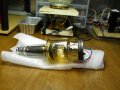
Ok.... Here's the image of the tube (below) -- FWIW the part number "P 125/20/50 CR" indicates a nominal KVP=125kV, and nominal power ratings of 20kW (emission via small filament) and 50kW (emission via large filament) So.... Inasmuch as manufactures never incorporate 'overqualified' inserts (i.e. tubes) -- the Delon rectifier caps should be good to at least 31.25kV (each section)
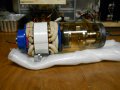
OBTW I slipped the stator over the neck such that I might 'spin up' the anode with the discovery that the bearing is badly brinelled! -- Were you counting on a reliable tube? If so fairness dictates that I find you one!
Please expect the remainder of the images tomorrow/early Mon
While indeed 'Brinell wear' owes it's name to the 'Brinell hardness test' the concepts, as a practical matter, are quite distinct albeit closely related...
To wit: Whereas the classic 'Brinell test' gauges the harness of a substrate via the pressing of a hardened steel sphere into same, a 'brinelled bearing' is characterized by indentation of its race by it's rollers corollary to impact, static overload, or, case in point, dynamic imbalance) -- such wear presents as 'detent action' (à la the VHF channel selector of an antique television receiver)...
--With reference to the image in post #963 (above)--
The structure visible within the 'neck' is, in effect, the 'rotor' of a 'high-slip' induction motor (when assembled a stator assembly is placed over the neck as shown below) -- Said rotor is spindled on the 'anode post' the outside end of which being sealed in glass where it 'exits' the left end the tube -- The anode itself (which being carried by the rotor) is visible immediately to the right of the neck (said structure somewhat resembling a 'hockey puck') - the advantage of said design being greatly improved power-handling capability via distribution of the multi-kilowatt 'focal spot' heating over a 'track' as opposed to a point (as is the case in fixed-anode types)... In anticipation of the oft asked question: All moving parts are entirely within the envelope of the tube! -- There are no 'rotating seals'
'Stickiness' at startup, highly abbreviated 'coasting time' following removal of excitation (less than 3 minutes whereas a 20 to 30 minute free 'spin down' is typical of a good bearing in a similar tube), excessive vibration and, worst of all, a 'morally excruciating' sound (appallingly reminiscent of a cremulator on bone)...
FWIW I have included the following images as an aid to perspective/perspicuity...
Many, many thanks for your interest! -- Sometimes the 'crickets' 'round this thread have us wondering what we're about
Very best regards
HP
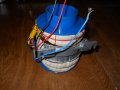
Image of the stator manufactured for the tube shown in post #965 (above) -- as may be seen it's of typical 'capacitor-run' single phase (input) topology...
Image of stator placed over neck of tube as would be the arrangement in the potted assembly...
Oh. We call that wear, galling, or spalling, depending on where the lost metal ends up.
(Dictionary.com) Galling: Machinery. (of either of two engaging metal parts) to lose metal to the other because of heat or molecular attraction resulting from friction.
Thanks for the .tut
Novel way to distribute power dissipated inside a vacuum tube.
I bet a lot of people said that was impossible before somebody built the first one.
Then there's this one. cremulator
Word not found in the (4) Dictionary(s) and (an) Encyclopedia.
Edit: Is that the spinning sound I hear when an x-ray machine gets ready to fire?
...and when the ball-mill encounters competent bone (i.e. remains of osseous tissue having undergone only slight/incomplete thermal degradation) -- it 'raises' a peculiar 'rumbling' sound inspiring all within earshot (and possessed of the barest modicum of 'imagination') with generalized 'psychosomatic ostealgia'
Again, many thanks for your interest and responses!
Very best regrds
HP
PS @Aleph(0) --- As I expect you guessed - the weather has, once again, trampled all over my 'leisure hours' -- I promise to have the images up prior to your visit Wednesday
Galling is different from brinneling. Galling is more like a welding of one metal to the other. Brinneling is what is commonly called spalling, it's when the load of a part breaks through the surface of the part, and the surface the flakes off. Even though most bearings are through hardened, the surface is harder than the under lying material. When too much load is added for too long of a time, the softer metal deforms and allows the surface to break down and flake off.
This is only a problem with bearing and other steels. When you get into tool steels they do through harden, because of their "chemistry" when being formed.
To: HP, Aleph, and #12. The next meeting will be held on Thursday 6/15/17. Topic will be the take over of AAC for the greater good. Unconfirmed as of now, but there may be guest speakers.
Well hey! -- My complaints about the weather doesn't mean I'm with 'The Weather Underground'! -- As for @Aleph(0) ? -- I expect she was born four decades too late for realization of her 'calling' as a radical
Galling is different from brinneling. Galling is more like a welding of one metal to the other. Brinneling is what is commonly called spalling, it's when the load of a part breaks through the surface of the part, and the surface the flakes off. Even though most bearings are through hardened, the surface is harder than the under lying material. When too much load is added for too long of a time, the softer metal deforms and allows the surface to break down and flake off.
This is only a problem with bearing and other steels. When you get into tool steels they do through harden, because of their "chemistry" when being formed.
FWIW All Brinelling I've encountered (which being principally in rotary wing aircraft mast bearings and RA Coolidge tube anode bearings) represents discrete 'indentations' in the race sans significant material loss -- Perhaps such is unique to damage/wear owed to dynamic imbalance?
Being little more than a very smart repairman, I've never focused a microscope on a noisy bearing. I did not mean to derail this Thread into metallurgy, but I am grateful for the education.
I cringe at the truth of that description. There is no emoticon which describes my horror about mechanical mutilation of humans, dead or alive.
(Yes, I know it's a psychiatric problem. I merely have the courage to confess my weakness.)
FWIW All Brinelling I've encountered (which being principally in rotary wing aircraft mast bearings and RA Coolidge tube anode bearings) represents discrete 'indentations' in the race sans significant material loss -- Perhaps such is unique to damage/wear owed to dynamic imbalance?
In my experience that type of damage is from a bearing being not adjusted correctly. Like in a wheel bearing on a car. Too much play allows the bearings to stop rolling and start making the indents. Timken/ taper type bearings took over ball bearings for wheel bearings, because they have more contact area and didn't destroy them selves as fast if not adjusted correctly.
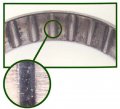
What I was taught as brinelling is different from the indents. Brinneling usually looks like small missing flakes in the race or rolling elements surface.
There must be...
50 ways to leave your bearing.
That makes me happy that I can just buy a bearing, only knowing that something is wrong.
ps, What shape is the bearing in that rectifier tube?
No lubrication? Not an air bearing? I can't imagine how that thing can accomplish a 20 minute spin-down time?
#12 I don't know bearing topology but it's COOLIDGE tube not rectifier! So in spite of being electrically a diode, running it on AC will ruin it cuz thermionic emission from hot anode on reverse part of cycle will melt delicate cathode!
#12 standard tubes (with max anode AV ≤ 4000 RPM) are lubricated with powdered silver and high speed tubes (sometimes > 10,000 RPM) are liquid metal lubricated (which is Hg or room temperature liquid amalgam) but you'd have to ask HP how they prevent Hg vapor from ruining high vacuum cuz IDK
#12 no way! Nothing that can ruin the vacuum cuz if absolute pressure gets higher than 10^-16 bar (which is 7.5*10^-11 umHg) it's totally too high and maybe beyond range of reseasoning by heating the getter impregnated electrodes!
#12 even just Ag powder lubed tubes can take over an Hr to spin down from 3600 RPM when pwr is removed from stator but it's totally better to brake anode motor by applying DC to stater coil right after use to save on bearing life!
OK. It's not a rectifier.
noun, Physics.
1.
a cathode ray tube, used for x-ray production, in which a beam of thermoelectrons is produced by heating a wire cathode.
when the ball-mill encounters competent bone (i.e. remains of osseous tissue having undergone only slight/incomplete thermal degradation) -- it 'raises' a peculiar 'rumbling' sound inspiring all within earshot (and possessed of the barest modicum of 'imagination') with generalized 'psychosomatic ostealgia'
HP OMG! That's just exactly what it sounds like! I always thought there was something more disturbing abt that noise than just knowing it's time to replace a $25k tube! Now I remember what! Tnx! NOT!

 Facebook
 Google
 GitHub
 Linkedin