EHT power supply design and construction

@Hypatia's Protege

HP I know ur busy but if you have time could you plz help me debug broken LNK362 circuit? It's in benchmark acquisition controller for laser ranging retroreflectometer that I'm restoring. So problem is it just stopped working and I checked PSU with foil severed to remove load but it just won't start up:mad:! Anyhow PSU circuit is totally new and worked a few times and now just nothing! And the components test good:confused:
@Aleph(0)

Further to my response (above) I thought you might find the attached datasheet useful!:)

All the best
HP
 

Attachments

@Aleph(0)

Assuming I correctly apprehend the nature of your circuit, please be advised that compliance with site policy requires assumption (and, hence, drafting) of a line isolation transformer at the input...

AAC TOS/UA Restricted topics said:
  • Any kind of over-unity devices and systems
  • Devices designed to electrocute or shock another person
  • LEDs to mains
  • Any kind of jammers (ie - Phone jammers)
  • Rail guns and high-energy projectile devices
  • Transformer-less power supplies
--Emphasis added--

Moreover,
I request that you please use the LtSpice schematic editor or similar drafting tool - as opposed to 'free hand' drawings! -- Such being in no way an aspersion upon your graphic arts ability! - But merely a 'bid' for consistency...K?;)

Very best regards
HP:)
 

Thread Starter

Aleph(0)

Joined Mar 14, 2015
597
Yup! I'm back:D!

HP So I'm back to playing with Royer circuits:cool: So here's stupid problem I'm having right now.
So circuit just draws like 10A and doesn't do anything except heat one of the transistors:mad:! So I checked feedback phasing, condition of transistors, transformer wdgs with lcr meter, capacitor with lcr meter, resistors and also wiring! And it's all ok:confused:!

HP in case you missed it:
The feedback phasing is correct!


So don't you dare start on that;)!
 
So I'm back to playing with Royer circuits:cool: So here's stupid problem I'm having right now
Many, many thanks for returning to topic directly upon your return from holiday!:) -- There may be hope for the tutorial yet!:cool:

So circuit just draws like 10A and doesn't do anything except heat one of the transistors:mad:!
The feedback phasing is correct!
Of course! -- Was the phasing 'reversed' both BJTs would idly draw current!:)

To 'cut to the chase' -- Assuming your test circuit is implemented via an untapped feedback winding - Please inspect the emitter to E-/Gnd connection of the 'cold' BJT --- While such may appear counterintuitive, I remind you that feedback 'return' is via avalanche of the "off transistor's" B-E junction -- ergo, a poor or omitted emitter connection results in a condition marked by no feedback and (DC) current flow through the properly connected transistor...

Should you require further assistance, please upload a schematic of your circuit!:)

Very best regards
HP:)
 
Last edited:

Thread Starter

Aleph(0)

Joined Mar 14, 2015
597
To 'cut to the chase' -- Assuming your test circuit is implemented via an untapped feedback winding - Please inspect the emitter to E-/Gnd connection of the 'cold' BJT
HP tnx cuz that's exactly how feedback is derived. So I'll check again but I think all connections are ok:confused:.

HP remember that in other thread abt push pull drive there were two hypotheses: one (like you're saying) that feedback is grounded at negative end of coil by avalanched b_e junction and the other that negative end of coil just shuts off corresponding transistor by canceling fwd bias. So now I say maybe results of troubleshooting will show which is happening:)

please upload a schematic of your circuit!:)
HP It's basically just like this CCFL PSU circuit you posted on other thread only with flyback instead of little xfmr (so winding inductances and capacitor are different) also choke is in emitter leg so I can use nmos pass transistor in regulation circuit:).
[edit] to say supply voltage for BBed circuit is from 12v to 40v


HP remember that in other thread abt push pull drive there were two hypotheses: one (like you're saying) that feedback is grounded at negative end of coil by avalanched b_e junction and the other that negative end of coil just shuts off corresponding transistor by canceling fwd bias. So now I say maybe results of troubleshooting will show which is happening:)
For ease of reference let's 'name' said 'hypotheses':

1) Switching is achieved via driving of the transistor at the positive end of the FB winding into saturation against 'ground' to which the negative end of said winding is returned via avalanching of the associated transistor's B-E junction...

2)
Switching is achieved via 'cancellation' of the forward bias on the base of the transistor at the negative end of the feedback winding... (Note that scenario #2 assumes the 'pull-ups' are sufficient to drive the transistors into saturation...)

Assuming your difficulty owes (as I expect) to a single open emitter connection:
Oscillation would indeed be impossible was #1 and only #1 descriptive of feedback operation... Whereas oscillation may (with no measure of certainty) occur is scenario #2 solely descriptive of circuit operation... -- All of which is to say - It'll be inconclusive at best...:( --- That said, I may not be adequately thinking this through:oops: - hence (as always) I invite anyone and everyone to offer their expertise, opinions or wild guesses here!:cool::cool::cool:

HP It's basically just like this CCFL PSU circuit you posted on other thread only with flyback instead of little xfmr (so winding inductances and capacitor are different) also choke is in emitter leg so I can use nmos pass transistor in regulation circuit:).
[edit] to say supply voltage for BBed circuit is from 12v to 40v
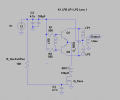
Based upon the reference image and your 'amending comments' I take the following to be representative of your circuit? -- Please advise me of any errors/misapprehension (Please note - for brevity I've omitted the regulation loop and merely 'pulled' the pass transistor into saturation)...


RoyerTest.png

Best regards
HP:)
 
Last edited:

Thread Starter

Aleph(0)

Joined Mar 14, 2015
597
To 'cut to the chase' -- Assuming your test circuit is implemented via an untapped feedback winding - Please inspect the emitter to E-/Gnd connection of the 'cold' BJT
HP tnx cuz that's exactly how feedback is derived. So I'll check again but I think all connections are ok:confused:.
HP Tnx cuz you're totally correct cuz I just soldered one of the emitter leads to solder pad on protobord and didn't notice it wasn't connected to other emitter and RFC:oops: So it works now but I still have to figure out right cap for resonance with flyback primary:rolleyes:

HP now I have another problem I hope you can answer cuz it's just driving me crazy! Now HP you don't need to be having a CVA over all this cuz burned xfmr is just for CCFL inverter it's not flyback so I say stay frosty:rolleyes:!

So anyhow to study a properly resonant royer osc I connected circuit of CCFL backlight inverter which is exactly circuit you drafted for post 851 except I didn't bother with pass transistor for now so just tied RFC to gnd. Ok circuit worked very well and lit ccfl super bright through 27pf ballast cap! And with with 12v supply it could hold at 1.5kv rms (which I calculated from peek cuz it was beautiful sinewave:)) across 100k non inductive resistor which is output 22.5 watts:)! So everything was awesome but then just for curiosity I tried to light F8T5 tube through same ballast cap that I lit backlight tube. So tube started flickering then there was hissing sound and smoke and fire from inverter b4 ocp interrupter opened:(

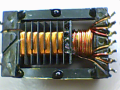
Anyhow I PMed (edit just to say that's post mortem not private msg sry cuz of being alphabet sales babe:oops:) bad xfmr and found the damage shown in pic:oops:!
So first plz look on pics of burned and good transformer for comparison then I'll ask questions:cool:

See how bad xfmr is only burned on one pie of secondary:confused:?
xv001.png

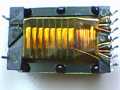
This is good transformer for comparison
xv003.png

Just so you know primary and feedback are wound together on right side and secondary is pie wound in the eight sections.

So my questions are why do you think it burned out? I know I was pushing it with running 22.5w across resistor but I did it for less than 5 seconds and anyway it worked fine after that and xfmr was cool also transistors totally survived even after xfmr burned!

Second question is why did it totally incinerate just single pie and leave others completely undamaged?

HP if you're going to make this like homework question that's ok but plz give meaningful clues ok:):cool:?
 
Last edited:
So anyhow to study a properly resonant royer osc
That's what I like to hear!:)

And with with 12v supply it could hold at 1.5kv rms (which I calculated from peek cuz it was beautiful sinewave:)) across 100k non inductive resistor
So you're telling me that under your drive conditions, a 15mA (RMS) load, loaded the peak EMF to > 2kV --- I can see where this is headed:rolleyes:

So everything was awesome but then just for curiosity I tried to light F8T5 tube through same ballast cap that I lit backlight tube. So tube started flickering then there was hissing sound and smoke and fire from inverter b4 ocp interrupter opened:(
So my questions are why do you think it burned out? I know I was pushing it with running 22.5w across resistor but I did it for less than 5 seconds
Indeed! - 15mA would not immediately overheat the secondary.... -- As to why the secondary burned out? -- Aleph! Kindly dare to think! You've told me that the unit was pushing 2kV under a 15mA load! -- You then connected it to a 12" T5! -- 'Flickering' averages at most 2mA -- So you want 'hints'? I've got 'em:

1) Notebook backlight transformers are rated at a maximum secondary EMF of 1kV
2) You were driving such a transformer to 2kV despite heavy load!
3) You then significantly reduced the load while maintaining said drive parameters!
Need I say more?:rolleyes::rolleyes::rolleyes:

Second question is why did it totally incinerate just single pie and leave others completely undamaged?
Owing to OV insulation failure, said 'pie' developed a 'short circuit turn' -- (i.e, a turn or small number of turns became a shorted, low impedance, secondary in a then 'step down' configuration - and, thus, rapidly attained temps in excess of the insulation's kindling point -- The other 'pies' were 'spared' owing, I can only imagine, to 'fire-wall action' of the separators... If you wish to know why that particular 'pie' failed - it was likely 'random' (i.e. a failure was bound to occur somewhere and the 'pie' in question happened to sport slightly weaker insulation at a critical point) -- then to, the entry of the return lead (from pin #7) to said pie might predispose same to OV failure -- Clearly, it's a moot point at best! - The device was exposed to over twice it's rated EMF during 'load testing' and, likely, many times it's rated EMF while experimenting with the T5 immediately preceding failure...

I would have you know that I'm very pleased with your alacritous investigation of Royer topology!:)

Very best regards
HP:)

PS - Kudos on the images!:)
 

Thread Starter

Aleph(0)

Joined Mar 14, 2015
597
HP I've got to say abt this first cuz just thinking on it is getting to be more than I can stand:(! So I'm saying it here on forum too just so you know I'm not too proud to admit stupid mistake if I made one and also help others with same problems!

So I did more experimenting after I rebuilt burned out CCFL backlight inverter but it was so tolerant of wide capacitor range that it didn't help me understand problem with prototype that uses TV FB Xfmr:(

So I thought I could get better feel for FB circuit by studying my fusor's PSU which is really just a set of high power (like 10kw) MazRoy oscillators. So I completely removed it from fusor to lab bench and loaded positive channel with 25 megohms which is 20mA on 500kvp ac output. Also negative channel was totally disabled by removing jumper and shorting input just to be sure! HP plz don't start abt how I didn't have to remove PSU from from fusor:rolleyes:! I totally know it's safe when chamber isn't evacuated! It's just that I get the creeps running it like that when it's connected cuz if it was evacuated (which it wasn't) I'd have lethal dose from neutron flux in less than 15 seconds at that distance! So it's irrational cuz I know it's not evacuated but you always say neurosis on side of safety is a happy handicap so plz be happy cuz I feel bad enough:(! Anyhow damage of fusor PSU had nothing to do with removing it!

Anyhow I was watching voltage with Kerr effect field analyzer with gap set to flashover at 300kv so big margin of safety from OV damage! Then at abt 200kv there was a noise like a 10ga shotgun and input current meter _pegged_ at 500A until 100A load center cartridge opened! So one of the industrial IGBT blocks totally exploded which had to be cause of noise for sure! But I don't know why and I have a bad feeling that secondary could have shorted out:(!

HP now I going to tell you something! I did NOTHING wrong! So b4 you start ragging on me abt like _conservation of materials_ just remember that when JC nuked his scope and DL you just said congrats on good safety habits! So ok! JC is undergrad and I'm PhD but like you're always saying school is for credentials and life is where real learning happens! So I've done all of this in good faith for tutorial and also cuz I just have to understand why I'm not getting same results:oops:! So I'm not being as melodramatic as to say I sacrificed my fusor for tutorial but I say that's totally how it is anyway! HP now I'm going to tell you something else! I say you're harder on me than JC cuz of our parent child relationship! Like I say that's reverse nepotism and it's not fair:mad:!

HP I don't mean to sound like I'm angry at you! I just don't want a lecture abt how I need to pay more attention and like that! Cuz I can't see how I did anything wrong and even if I did I feel bad enough already so if you think I made a mistake I want to understand it without shamefest ok?

HP Like you know I really need the fusor for my research so I have to fix it or replace it immediately (like within a month) so I can get the IGBTs no problem cuz they're in stock and just $14K for qty of six which gives me at least three chances! But I'm afraid abt the secondary coil! So inductance is ok which means no shorts at LV but I can't know for sure about HV integrity:( So plz tell me where you got coils when you built it cuz I can't find anything like them online!

PS
Ok so anyone saying fusor is OT for being fringe topic I say think again! That bright spot in the sky that lights the day is proof that fusors are practical unless you think 387 septillion watts for like 9 billion years is insignificanto_O! Anyhow I'm not using mine for free energy just for totally controllable neutron source and anyhow post is more abt repairing HV PSU than abt fusor:cool:!
 
Hey @Aleph(0)

I'm experiencing some connectivity issues at the moment - Please know that I've read your post (and email) - and will post a comprehensive response later today or early Sunday!

In the meantime please take it easy! -- The secondary may readily be replaced if necessary and I'm not preparing to read you 'the riot act'!:):):) --- OBTW - Assuming the vendor is reputable, I strongly advise you to 'snap up' the transistors while the price is good (At Ca $2,300 apiece perhaps the price is too good?:confused:)

Best regards
HP:)
 
@Aleph(0)

To get started

You stated that the over-current condition persisted following disruption of the IGBT?:confused: - Were you able to determine the cause of said persistence? -- If not, please 'track down' the 'short' then post your findings here -- FWIW I'd be very surprised did the explosion fail to clear the short (was the IGBT the sole over-current path)...

All the best
HP:)
 
@Aleph(0)

But I'm afraid abt the secondary coil! So inductance is ok which means no shorts at LV but I can't know for sure about HV integrity:(
@Aleph(0) --- Please ignore the stricken text (below) and defer to post #860 in regards to transformer testing!!!

You may test the secondary winding under low power EHT conditions via placement of temporary primary and feedback windings on the exposed end of the core adjacent to the secondary.

As regards said test windings:
The inductance of the [temporary] primary should fall between 10uH and 20uH, whereas optimal [temporary] feedback inductance will ≈ 1/8 the inductance of said primary. The [test] driver configuration should be consistent with that of a non-resonant Royer (e.g. similar to the circuit shown in post #849 but without Cr) -- Of course it goes without saying that the 'bona fide' feedback and primary windings must be disconnected and floating! --- The described test configuration should sustain ≈ 400kVp at up to perhaps 200 uA when supplied with Ca. 60V (expected input current at 60V ≈ 7A 'OC and up 20A arcing) No need to bawk! - For test purposes 'galloping inefficiency' is most distinctly a 'saving grace':cool:


Some more questions:


Why do you suspect the secondary? - Please be advised that even a 'dead shorted' secondary would not likely result in damage to the switching transistors (We would expect the oscillator to merely 'grind' at a frequency determined by the resonance capacitance and (residual) leakage inductance -- And, indeed, such has long been my observation)

Having removed the EHT 'generator' assembly from the IECD chain - How did you power the former? -- Be advised that full load operation (of a single channel) requires a stable (albeit not necessarily regulated) supply capable of 100V at to at least 200A continuous...

I could get better feel for FB circuit by studying my fusor's PSU which is really just a set of high power (like 10kw) MazRoy oscillators.
and loaded positive channel with 25 megohms which is 20mA on 500kvp ac output.
To be clear -- While each oscillator may indeed be correctly viewed as 'contributing' 10KW @ 500KV maximum for a maximum (series loaded) output of 20KW @ 1MV (and, hence a maximum 'global' current of 20mA) - please be advised that such loading is seldom encountered in operation -- Note that once having taken all 100 IECD 'cells' into 'star mode' I[load] seldom exceeds 15mA. -- That said I don't feel the described failure owed to loading...

@Aleph(0) -- I promise to offer a comprehensive response to your post (#854) in the near future -- for now please respond to my questions such that we may 'hit the ground running', as it were!:):cool:

All the best
HP:)
 
Last edited:
@Aleph(0) @Aleph(0) @Aleph(0) @Aleph(0)

It occurs to me that, in consideration of the rather high 'fault currents' experienced -- it may behoove you to test the primary prior to replacement of the IGBTs! -- Please 'refresh my memory' as to the primary and feedback inductances such that I may suggest a (low power) test oscillator configuration -- IMO, any encumbrance owed said windings' relatively high impedances (for test purposes) will be well compensated by the facts that you will be testing the entire transformer sans requirement of disturbing the 'potting' of same!:cool:

All the best
HP:)

PS -- Don't despair should you discover the primary is damaged -- I've yards (literally) of 'surplus' litz cable from that project:cool:
 
Last edited:

Thread Starter

Aleph(0)

Joined Mar 14, 2015
597
I can get the IGBTs no problem cuz they're in stock and just $14K for qty of six which gives me at least three chances!
Assuming the vendor is reputable, I strongly advise you to 'snap up' the transistors while the price is good (At Ca $2,300 apiece perhaps the price is too good?:confused:)
HP I have all six of them now and they're from trusted distributor! So anyhow I tested them and double checked markings just to make 2X damn sure:)! HP I know price seems too good but you know I'm not some idiot that buys components off Ebay or like that:rolleyes:! Hey @Jazz2C? Are your ears ringing:p?

HP to be serious I have to get it right cuz if I burn these 6 then it's 10 weeks lead-time b4 I can get more from ANYWHERE:(! So cuz like you say is best practice to replace both even if only one seems bad it's three strikes and I'm SOL:(!

You stated that the over-current condition persisted following disruption of the IGBT?:confused: - Were you able to determine the cause of said persistence?
HP when module exploded lug end of positive cable landed on safety shield! So it was just shorting out LVPSU that pulled load center fuse but primary wdg took a lot of current for instant b4 module blew cuz of huge rail decouping caps discharging through it! So I say Ipri was more like tens of thousands of amps than just 500A from LVPSU:( So I still don't know what ganked module in first place:(?

Why do you suspect the secondary?
HP Just cuz with my luck I naturally expect worst case scenario:(

Having removed the EHT 'generator' assembly from the IECD chain - How did you power the former?
HP it's just that big a$$ Lambda 100kw BA that you found at Dayton! So it wasn't damaged cuz it can survive continuous dead short on unfused circuit anyhow! So 100A line fuse (which is only good for 24kW on 240v line) didn't sweat it for vry long:eek:!

It occurs to me that, in consideration of the rather high 'fault currents' experienced -- it may behoove you to test the primary prior to replacement of the IGBTs
HP I agree!

any encumbrance owed said windings' relatively high impedances (for test purposes) will be well compensated by the facts that you will be testing the entire transformer sans requirement of disturbing the 'potting' of same!:cool:
HP you can sure say that again! Cuz I have to KNOW transformer won't kill new modules and I hate f'ing around with potting cuz it's nerveraking enough without all that:rolleyes:!

Don't despair should you discover the primary is damaged -- I've yards (literally) of 'surplus' litz cable from that project
HP that's good to know but I don't want to have to rewind primary cuz of all the hassles of repotting:(!

The secondary may readily be replaced if necessary
HP HOW?

Please 'refresh my memory' as to the primary and feedback inductances such that I may suggest a (low power) test oscillator configuration
HP Ok! So cuz you didn't document that on schematic I'll just measure them and also compare with windings of other transformer to make sure:cool:!

I'm not preparing to read you 'the riot act'!
TNX!:)
 

Thread Starter

Aleph(0)

Joined Mar 14, 2015
597
@ Aleph(0) first off very glad you are safe after this. But maybe you should start videoing your experiments, they would get a ton of hits on youtube. :):p:D
Shortbus I say that could work;)! I could call it _The Aleph(0) foibles of Aleph(0)_o_O:oops::D I'd have all the smoke and fire of Photoninduction's channel w/o even trying:oops::D!
 
Top